




Nearshoring vs. offshoring isn't a strategy question anymore. It's a portfolio question. Most operations leaders running a $10-250M consumer brand aren't picking one and walking away from the other. They're running both at once, across different SKUs, different vendors, and different continents, and trying to keep the math straight while they do it.
That's the real shift in 2026. Tariff volatility, freight cost swings, and a few years of supply chain whiplash have made "where do we manufacture" a live, ongoing decision instead of a one-time sourcing strategy set in a five-year plan. Brands that treat it as binary, pick Mexico or pick China and move on, are optimizing for the wrong thing. The brands executing well right now are the ones that can actually see and manage a mixed footprint, not the ones that guessed right on geography.
This piece walks through the real tradeoffs between nearshoring (manufacturing closer to home, typically Mexico or Central America for US brands) and offshoring (manufacturing farther away, typically China or Southeast Asia), where each one wins, and the operational problem that shows up no matter which you choose.
What Nearshoring and Offshoring Mean for Consumer Brands
Nearshoring means sourcing or manufacturing in a country close to your end market, close enough that trucking or short-haul shipping replaces ocean freight. For a US brand, that's usually Mexico or Central America. Offshoring means manufacturing farther away, chasing lower unit costs or specialized manufacturing capability, most commonly in China or Southeast Asia.
Neither term describes a quality tier or a moral position. Both are viable supply chain management strategies, and the right one depends heavily on your product category, your volume, and how much working capital you can tie up in transit inventory. A beauty brand running small-batch SKUs with fast trend cycles has a different calculus than a food and beverage company running high-volume, low-margin staples.
The mistake is assuming the decision is permanent. Trade policy shifts, supplier capacity changes, and a factory that made sense in 2023 might not make sense in 2026. Brands need to evaluate this regularly, not once.
Lead Time: Speed to Shelf vs. Speed to Cost
Nearshoring wins on lead time almost every time. Trucking from Mexico takes days. Ocean freight from Asia takes weeks, and that's before you account for port congestion, customs delays, or a container getting bumped off a vessel. If your business depends on responding fast to a trend, a promotional calendar, or a retail reset, that lead time gap is the whole game.
But shorter lead time isn't automatically the right answer. If your demand planning is stable and your SKUs don't change often, the extra weeks of ocean transit are a planning problem, not a business risk. You hold more safety stock , you plan further out, and you capture the cost advantage that a longer supply chain often provides.
The failure mode is applying one lead-time assumption across an entire portfolio. A brand with both fast-moving new launches and stable core SKUs needs different lead time strategies for each, and most planning tools aren't built to handle that distinction cleanly.
Landed Cost Is the Real Number, Not Unit Cost
Unit cost is the number vendors quote you. Landed cost is the number that actually hits your margin: unit cost plus freight, duties, tariffs, insurance, and the carrying cost of whatever inventory is sitting in transit or in a warehouse waiting to sell. Offshore unit costs are often lower. Landed costs are a different story once tariffs and long transit carrying costs get added back in.
This is where a lot of brands get burned. A supplier switch that looks like a clear win on a per-unit basis can quietly erode margin once you account for the freight and duty structure on that specific product category and country of origin. Tariff schedules also aren't static, a rate that applied last year might not apply this year, and a brand that isn't tracking landed cost by SKU and by origin is flying blind on true profitability.
The fix isn't guessing better. It's tracking real purchase order cost, freight, and duty data at the SKU level, continuously, so landed cost is a number you can see in real time rather than one your finance team reconstructs at quarter close.
Quality Control and Communication Get Harder with Distance
Every extra time zone and language barrier adds friction to catching a quality problem before it becomes a recall, a chargeback, or a retailer relationship problem. Nearshore partners are easier to visit, easier to call during business hours, and easier to build a real working relationship with. That matters more than it sounds like it should when you're trying to fix a defect on a production run that already shipped.
Offshore manufacturing isn't inherently lower quality. Some of the most sophisticated manufacturing capability in the world sits in Asia, and plenty of nearshore suppliers have inconsistent quality systems. The difference is how fast you find out something went wrong and how fast you can act on it. A defect discovered three weeks after a container left port is a much bigger problem than one caught the day it happened.
Lot tracking discipline matters more, not less, as your supplier base gets more geographically distributed. If you can't trace a quality issue back to a specific production run and a specific supplier fast, distance turns a fixable problem into a brand crisis.
Minimum Order Quantities Shape Who Can Even Compete
Offshore manufacturers, especially in Asia, often require higher minimum order quantities to make a production run economical. That's fine if you're ordering at scale. It's a real constraint if you're a growing brand still finding product-market fit on a new SKU, or running frequent limited releases.
Nearshore suppliers are frequently more willing to run smaller batches, which makes them a better fit for new product testing, private label pilots, or categories where trend cycles move faster than a large offshore production run can support. The tradeoff is usually a higher unit cost for that flexibility.
This is exactly why so many brands end up running a mixed strategy on purpose: offshore for stable, high-volume core SKUs, nearshore for new launches, fast-moving trends, or anything where being locked into a large batch size is itself the risk.
Geopolitical and Tariff Risk Is Now a Planning Input, Not a One-Time Event
Tariff policy has become something operations leaders have to plan around continuously, not something they check once during supplier selection. A trade policy shift can change landed cost math on a specific country of origin with little warning, and brands that only track unit cost won't see it coming until it hits the P&L.
Geographic concentration is its own risk, independent of tariffs. A single-region supplier base, whether that's one country in Asia or one country in Central America, means a port disruption, a labor action, or a regulatory change can take out your entire supply in one event. Diversification across regions isn't just a cost play, it's a resilience play.
None of this argues for one region over another. It argues for treating sourcing geography as a live variable you monitor, not a decision you file away after the initial supplier contract is signed.
The Real Problem: Visibility Across a Fragmented Supplier Base
Here's what actually breaks operations teams in 2026: it's rarely the sourcing decision itself. It's that a mixed or multi-region strategy, which is usually the right call, creates purchase orders, 3PL shipments, and landed costs scattered across regions, vendors, currencies, and systems that don't talk to each other. One spreadsheet tracks the offshore POs. Another tracks the nearshore ones. Nobody has one view of true landed cost by SKU until someone manually reconciles it, usually after the margin damage is already done.
This is why sourcing strategy matters less than whether you can actually see and manage it well. A brand nearshoring 100% of its production but running it through disconnected tools will make worse decisions than a brand running a complex mixed strategy through one unified system. The strategy isn't the differentiator anymore. Operational visibility is.
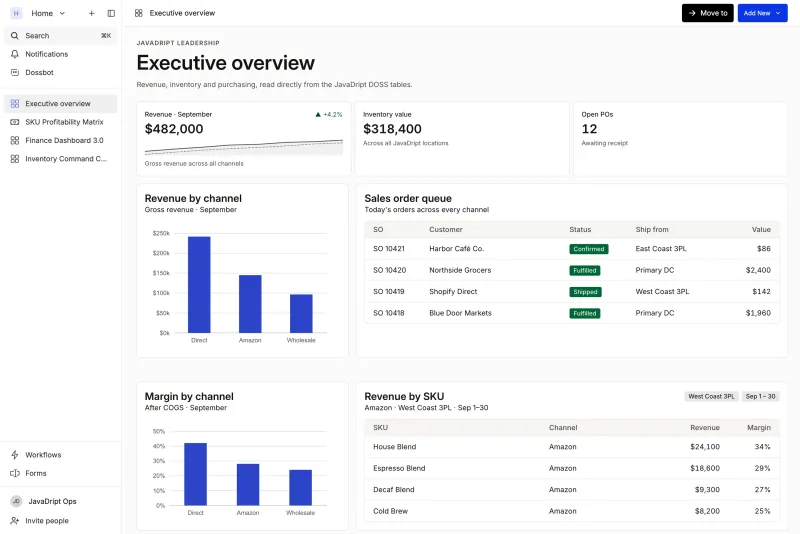
DOSS, the AI-native operations platform for consumer goods, is built for exactly this problem: one live record of procurement , inventory, and orders regardless of how many regions, vendors, or currencies are involved. Instead of reconciling landed cost across disconnected spreadsheets and supplier portals, teams see true cost, lead time, and reorder point status in one place, by SKU, updated as purchase orders move rather than after the fact.
That live record runs on Data Cloud, a real-time database that pulls data from your suppliers, 3PLs , and existing systems through 100+ native integrations, with no overnight batch. On top of that, the Procurement and inventory management modules run on Unified Master Data, so a workflow change, adding a new nearshore vendor or adjusting a reorder rule for a supplier switching regions, takes hours to configure instead of a development ticket. Dynamic Apps and Dossbot turn that data into live margin and landed cost reporting, and Dossbot reads and reconciles purchase orders across vendors, flags mismatches, and acts with your approval so your team isn't doing it by hand.
Mezcla offers a useful proof point. The brand doubled its purchase order processing speed once procurement stopped living across disconnected tools. That is the same operational problem a consumer brand faces coordinating nearshore and offshore suppliers: many vendors, one process, and no single place to see it.
Choosing the Right Approach for Your Product Category
Start with the product, not the region. High-volume, stable, cost-sensitive SKUs generally tolerate offshore lead times and justify the unit cost savings. New launches, fast-moving trends, and categories where minimum order quantities create real risk generally favor nearshore flexibility, even at a higher unit cost.
Most brands land somewhere in between, and that's not a compromise, it's the correct answer for a diversified product line. The category decision is worth revisiting at least annually, since tariff schedules, freight markets, and supplier capacity all shift.
What doesn't change is the need for a system that can show you true landed cost and lead time performance across whatever mix you land on. Get that visibility right, and the sourcing decision becomes something you can actually optimize instead of something you guess at once and live with.
Nearshoring and offshoring will keep shifting as tariffs, freight markets, and supplier capacity change. What won't change is the operational demand it creates: procurement, inventory, and order data spread across more vendors and regions than a spreadsheet or a legacy ERP was built to handle. DOSS puts procurement, inventory, orders, and finance on one live record, integrates with the supplier and 3PL tools you already use, posts clean entries to the GL you already have, and typically goes live in 4 to 6 months, not the year or so a legacy ERP overhaul usually takes. Whether your sourcing strategy is nearshore, offshore, or a deliberate mix of both, that is the system that lets you execute it well.