



Item master
Canonical SKUs with variants, attributes, and pack configurations.
SKUs, vendors, and customers are the foundation your operation runs on. DOSS keeps them, along with BOMs and sales and purchasing price matrices, in one place and syncs them to sales channels, 3PLs, Co-mans, and your GL with the right IDs for each, so the business stops reconciling itself across systems that call the same thing by different names.









20+ warehouses, 100+ vendors
Unified into one source of truth

50-60
Raw ingredients rolled into COGS automatically

40 → 2 hrs
Month-end inventory close


“With our 3PL integration, inventory is recognized accurately and in real-time. If we send 40 packs and 36 packs, the system correctly tracks the total count of jars while maintaining the integrity of each pack as its own SKU. This has greatly improved our inventory management and efficiency.”
 Zach Fishbain, Co-Founder and CEO Read the story
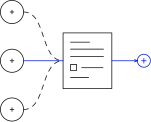
 Your Shopify handle, Amazon ASIN, retailer UPC, and 3PL product code all map to one DOSS SKU. Translation happens at the integration layer, so partner-specific codes never leak into your core data and no one maintains a cross-reference spreadsheet.
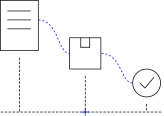
Create the product in DOSS with its BOM, costs, suppliers, and channel aliases, and a workflow pushes it to Shopify (in draft for review), your 3PL's catalog, and your GL item list at once. Inventory tracking starts at every location immediately.
Manage bills of materials with component-level costs that roll up automatically. When a formula or pack changes, version the BOM; old lots stay linked to the old version and new production to the new one.
Unified Master Data is deployed first in every DOSS implementation. Because inventory, orders, procurement, and finance all read from it, there are no joins across separate systems and nothing to reconcile when a record changes.
Every capability below is shared by every DOSS module, so a change made once is correct everywhere.
Canonical SKUs with variants, attributes, and pack configurations.
Suppliers and co-mans with lead times, MOQs, pricing, and contacts.

Retailers, wholesale accounts, and distributors with channel-specific rules.

Customer and vendor pricing managed once and applied on every order and PO.
Component-level BOMs with cost rollup and version history.
Alias tables map channel and partner codes to your canonical SKU, with two-way sync and bundle and kit decomposition.
Create once, publish to every connected system via workflow.
Master data gives Dossbot the context to parse invoices, orders, and BOLs against your real SKUs, vendors, and customers.
Controlled edits with a history of who changed what and when, plus Dossbot to find duplicates, missing costs, or unmapped SKUs.



Unified master data is a single, shared record of your products, suppliers, customers, and BOMs that every system uses. In DOSS, every module reads from it, and it syncs to your channels, 3PLs, and GL with the right IDs for each.
DOSS keeps one canonical SKU and an alias table that maps each channel's and partner's code to it, including bundles and kits. Translation happens at the integration layer.
Yes. Create the product in DOSS and a workflow publishes it to Shopify (in draft), your 3PL's catalog, and your GL item list in one action.
Yes. DOSS manages component-level BOMs with automatic cost rollup and version history, and ties each production lot to the BOM version it was made with.
Every other DOSS module reads from master data, so getting products, suppliers, and customers right first is what lets inventory, orders, and finance stay in sync without reconciliation.