



Operational subledger
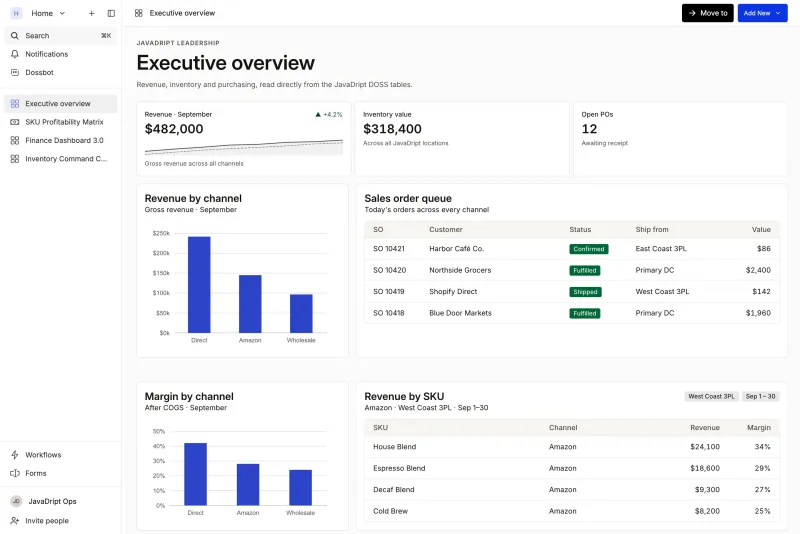
Inventory valuation, COGS, landed cost, and margin computed in DOSS as transactions happen.
DOSS is the operational subledger for consumer brands. Inventory valuation, landed cost, COGS, and margin are calculated as the business runs, then posted to the GL you already use. Operations and finance close from the same numbers.









40 → 2 hrs
Month-end inventory close

12× faster
Customer invoicing

50-60
Raw ingredients rolled into COGS automatically


“Invoicing sometimes took a week. Steve and I would be here until midnight making little edits. Now I do it in a couple of hours.”
Roger Hechema, Operations & Purchasing Manager Read the story DOSS runs the operational side of the business and translates it into clean financial entries, while whatever accounting system you use stays your general ledger. You modernize operations without putting finance through another ERP replacement.
Receipts, shipments, and adjustments post as they happen, so month-end is a review instead of a reconstruction, and you keep the GL you already use.
Landed cost is attributed at the shipment, not averaged across the period. The SKU profitability matrix breaks margin into product, freight, tariff, co-man, and fulfillment costs, by channel, so you can see which SKU deserves the next channel.
Vendor bills from matched POs and invoices from shipped orders push to your GL with the right account coding. Revenue aggregates across channels into journal entries, so no one is re-keying Shopify payouts.
Every capability below runs on the same live record as inventory, procurement, and orders, so finance closes from the numbers the business actually ran on.
Inventory valuation, COGS, landed cost, and margin computed in DOSS as transactions happen.
Journal entries, vendor bills, and customer invoices pushed to QuickBooks, NetSuite, Rillet, Campfire, or whatever you use for your GL.

Map DOSS activity to your existing chart of accounts once; every posting lands in the right account.
Consolidate operations across currencies and legal entities.
Product, freight, tariff, and co-man charges attributed at the shipment and lot level.
Real-time COGS and margin with cost component drill-down, by SKU and channel.


Sales across DTC, marketplace, and wholesale rolled into journal entries.
Only matched bills post, with GL coding applied automatically.
Ask for gross profit by SKU by channel this month and get a report with drill-down links.


No. DOSS is an operational subledger that sits alongside your general ledger. It computes inventory valuation, COGS, and landed cost, then posts journal entries, bills, and invoices to QuickBooks, NetSuite, Rillet, Campfire, or whatever you use for your GL.
An operational subledger records the detailed operational transactions (receipts, shipments, adjustments, costs) behind the summary entries in your GL. DOSS keeps it live, so finance has line-item detail without a spreadsheet.
DOSS attaches landed cost (product, freight, tariff, co-man, and fulfillment costs) to each lot and calculates COGS on every outbound transaction, rather than averaging over the month.
It depends on your starting point, but because entries post as transactions happen, close becomes a review of numbers that are already in the books rather than a week of reconciliation.
Yes. The SKU profitability matrix shows revenue, COGS by cost component, and gross margin per SKU, per channel, per period.
Yes. DOSS supports multi-currency and multi-entity operations and maps activity to each entity's chart of accounts.