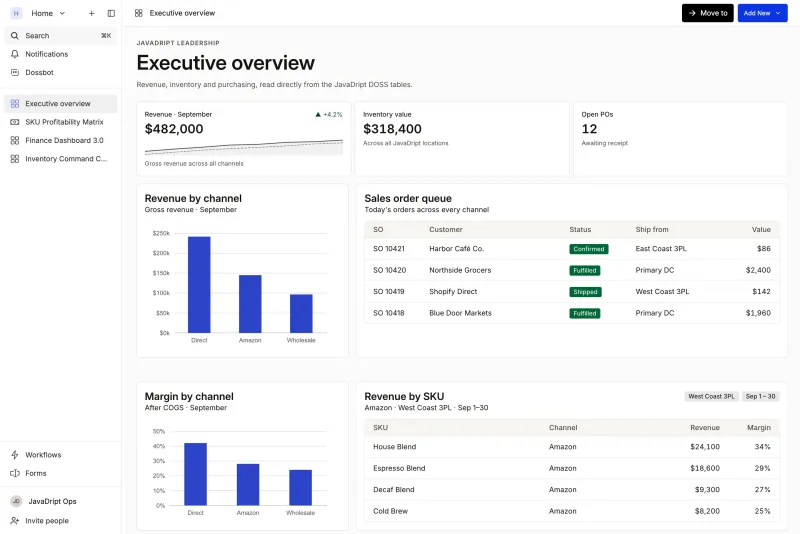











What finance teams get back
40 → 2 hrs
Month-end inventory close

12× faster
Customer invoicing

6 weeks
To SKU-level COGS and contribution margin, after years on NetSuite

Sound familiar?
Running finance at a growing consumer brand means closing the books on numbers you didn't produce. Inventory lives in the 3PL portal, landed cost lives in a spreadsheet, and the margin question from the board lands on you.
Month-end is a reconstruction.
Half of close is reconciling ops' inventory count to what's in the GL.
Landed cost is an average.
Freight and duties get spread across the month, so no one trusts the margin by SKU.
Every answer takes a week.
'What's our margin on Amazon?' means pulling four exports and a weekend.
Close from the numbers the business ran on
DOSS is the operational subledger: receipts, shipments, and adjustments post as they happen, and journal entries, vendor bills, and customer invoices sync to your GL with your chart of accounts. Month-end becomes a review, not a reconstruction.
COGS you can defend, line by line
Landed cost is attributed at the shipment, not averaged across the period. Product, freight, tariff, co-man, and 3PL costs attach to each lot, so COGS and inventory valuation hold up when the auditor or the board asks.
Margin by SKU and channel, live
The SKU profitability matrix shows revenue, COGS by cost component, and gross margin for every SKU in every channel. Ask Dossbot for gross profit by SKU by channel this month and get the report with drill-down links.
Cash that doesn't leak through the seams
Bills only post after three-way match, and duplicate invoices are caught before payment. Finance sees what operations is committed to spend before the money goes out the door.
Where finance teams usually start
- Understand contribution margin
- Running on NetSuite
- Replace spreadsheets as your ops system
- Manage multiple warehouses
- Moving off Cin7
One record for ops and finance
Operations runs inventory, purchasing, and orders in DOSS, and every transaction posts to the books as it happens. You close from the same numbers they run on, with no month-end reconciliation between their spreadsheet and yours.
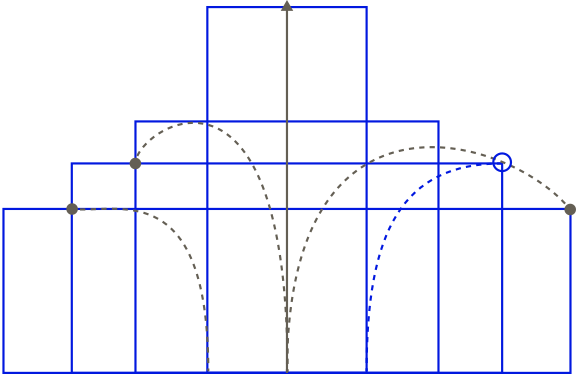
Every module, one live record


See your close on one live record
Bring last month's close file. We'll show you what it looks like when inventory, landed cost, and COGS post themselves.


Frequently asked questions
No. DOSS is an operational subledger that sits alongside your GL and posts journal entries, vendor bills, and invoices to QuickBooks, NetSuite, Rillet, Campfire, or whatever you use for your GL. Your ledger and financial controls stay in place.
DOSS attaches landed cost (product, freight, tariff, co-man, and fulfillment costs) to each lot and calculates COGS on every outbound transaction, rather than averaging it over the period.
Yes. Because receipts, shipments, and adjustments post as they happen, close becomes a review of numbers already in the books instead of a reconciliation between ops and finance.
Yes. The SKU profitability matrix shows revenue, COGS by cost component, and gross margin per SKU, per channel, per period, and Dossbot can generate ad-hoc profitability reports.
Yes. DOSS supports multi-entity and multi-currency operations and maps activity to each entity's chart of accounts.