




Managing inventory across multiple 3PLs starts as a logistics decision. It usually becomes an operations problem.
You add a second fulfillment partner to cover a new region. Then a third to handle wholesale. Each 3PL runs its own WMS, reports on its own schedule, and formats its data its own way. By the time your ops team reconciles everything into a spreadsheet, the numbers are already wrong. A purchase order lands and nobody can confirm on-hand with confidence. A retailer asks for availability and you send last Tuesday's count.
This is the multi-location 3PL inventory problem. Most mid-market tools weren't built to close the visibility gap, and that gap costs operators margin, hours, and fulfillment confidence.
Why Multi-Location 3PL Inventory Goes Wrong
Growing consumer brands typically build multi-3PL networks the same way: one partner for DTC, one for wholesale, maybe one for a new market or a specialized cold-chain requirement. Each relationship is operational, and each one introduces a new data format, a new reconciliation cycle, and a new margin for error.
Most inventory software treats inventory as a ledger. It tracks quantities. What it rarely does is tell you, in real time, which location has the stock, whether that stock is committed to an open order, and whether what the 3PL's system reports matches what's actually on the shelf.
Manual reconciliation doesn't fix this. It moves the problem from the system to the spreadsheet and adds a person to own the discrepancy. At two 3PLs and 200 SKUs , it's manageable. At three 3PLs and 600 SKUs, it becomes a full-time job that produces numbers nobody fully trusts.
What Multi-Location 3PL Inventory Visibility Requires
Third-party logistics partners give you scale. They don't automatically give you control. Real control over multi-location 3PL inventory requires three things that most operators try to patch together with workarounds.
Real-time integration, not batch syncs. Most 3PLs send automated inventory reports that include end-of-day files, scheduled API pulls, email updates. That's batch. If your data arrives every 12 hours and you're processing orders constantly, you're always working with stale numbers. Real-time integration means inventory counts update when a receipt, shipment, or adjustment happens at the 3PL.
Unified master data across locations. Every 3PL you work with has its own SKU naming conventions, lot codes, and unit-of-measure standards. A pallet to one partner is a case to another. Without a unified master data layer that maps your catalog across all partners, you can't roll up a reliable on-hand total without manual translation. You're not adding inventory, you're converting units.
Location-level visibility with commitment status. Stock isn't just in two warehouses. Some of it is reserved for open purchase orders. Some is earmarked for wholesale commitments. Some is in transit. Inventory management that only shows totals, not statuses and allocations, leaves you double-committing product and explaining short shipments to retailers after the fact.
The Tools Operators Use and Where They Hit a Ceiling
The standard toolkit for multi-location 3PL inventory breaks down like this.
Spreadsheets are fast to set up and completely manual. Every reconciliation is a one-off. Every snapshot ages the moment you close the tab. At two 3PLs and low order volume, they work. At three 3PLs and 500 SKUs, they become the bottleneck.
Mid-market ERPs like NetSuite can connect to 3PL data (in theory). In practice, the integration quality varies by 3PL partner, setup requires configuration, and the underlying data model wasn't designed for the edge cases that come with a multi-partner fulfillment network. You get inventory tracking, but not inventory confidence.
Standalone inventory systems solve part of the problem, usually the tracking layer, but sit outside order management and procurement workflows. Inventory count goes into one system, order confirmation goes into another, and reconciliation still lives in a spreadsheet.
The ceiling operators hit isn't a software ceiling. It's a data architecture ceiling. Most tools track what happened. They don't make it easy to know what's happening now, across every location, in a way your procurement and ops teams can act on without building a manual process around it.
How DOSS Handles Multi-3PL Inventory
DOSS was built for this exact problem. Not because multi-3PL inventory is theoretically interesting, but because most of the operators we work with came in running it through spreadsheets and paying for the inefficiency with margin and hours.
The DOSS IDP (Integrated Data Platform) connects to 3PL partners through native integrations, not middleware, not a connector that requires its own maintenance overhead. When a 3PL moves inventory, that event lands in DOSS in real time. Unified Master Data (UMD) maps every partner's catalog to your master catalog, so on-hand reports from Partner A and Partner B arrive in the same unit, the same SKU format, and the same structure and ready to roll up without translation.
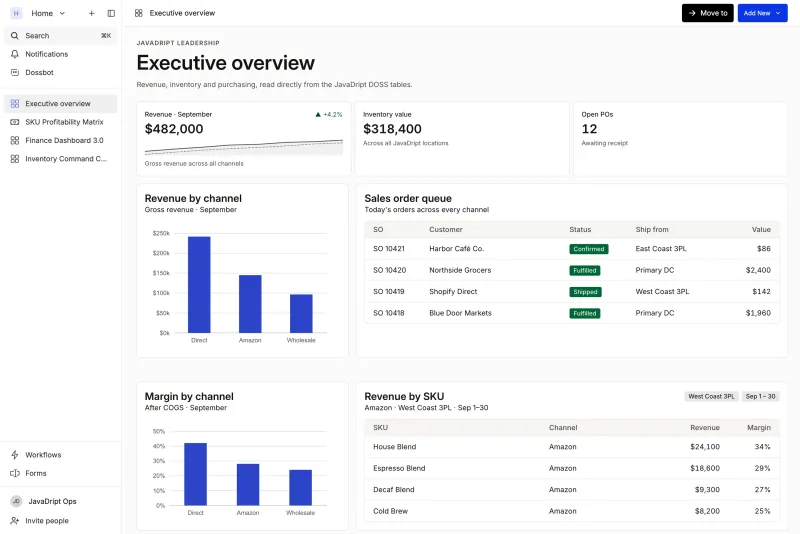
Within the ARP (Adaptive Resource Platform), inventory visibility is location-level and status-aware. You can see what's on-hand at Warehouse East versus your West Coast 3PL versus in-transit from your co-manufacturer. You can see what's committed to open orders and what's available to promise. That distinction matters when a buyer calls about a rush shipment, or when your procurement team is deciding whether to place a reorder.
Verve Coffee Roasters reduced unbatched orders from 30% to 1% within four weeks of going live on DOSS. That result came directly from having accurate, real-time inventory data underpinning their order operations. The technology made it possible; the visibility made it immediate.
Building a Multi-3PL Inventory Process That Holds
Even with the right system in place, the process layer matters. Here's how operators who have solved multi-location 3PL inventory at scale think about it.
Set a reconciliation cadence and run it. Real-time integration reduces the need for manual reconciliation but doesn't eliminate it. Physical counts happen. Systems drift. Schedule a weekly spot-check on your highest-velocity SKUs across each location. The goal isn't to catch every discrepancy, instead it's to close the gap before it compounds into a margin problem or a missed order.
Define your reorder point by location, not in aggregate. Aggregate on-hand can look healthy while one fulfillment center is empty and another is over-stocked. If your reorder logic looks at total inventory without location-level breakdowns, you'll keep replenishing the wrong warehouses. Set reorder point thresholds by 3PL, by region, or by channel, whatever matches how your orders actually flow.
Build safety stock that accounts for 3PL variability. Lead times from a co-manufacturer to your 3PL, receiving lags, and inbound transit windows all affect when stock is actually available to ship. Build safety stock buffers that account for 3PL-specific variability, not just your suppliers' lead times. A 3PL in a congested port market will have different receiving windows than one in the Midwest.
Negotiate data visibility into 3PL contracts before you sign. When evaluating a new fulfillment partner, ask specifically: How frequently do inventory updates sync? Can you get real-time webhooks? What format do they use? A 3PL that can only deliver daily batch reports is a future reconciliation problem. The time to solve that is in contract negotiations, not after a missed shipment.
What Getting This Right Looks Like
The operators who get multi-3PL inventory right are not the ones who hired more people to reconcile faster. They built a system where the data is accurate enough that the team can act on it without a verification step first.
When an order comes in, the fulfillment team routes it based on current on-hand at each location. When a buyer asks about availability, the number they get is one the ops team trusts. When procurement decides on a reorder, the decision is based on actual inventory position, not a gut check tempered by "the spreadsheet might be off."
Inventory management across multiple 3PLs is a solvable problem. It requires real-time data, unified master data across partners, and a system that surfaces location-level status rather than just totals. DOSS connects all three: the Data Cloud for the integrations, Unified Master Data for the data consistency, and Dynamic Apps for the operational visibility your team needs to make decisions and move.
If your current setup has your ops team spending more time validating inventory than acting on it, that's the cost of the gap. DOSS gives you the foundation to close it, with most customers going live in four to six months and seeing operational impact within the first month.