




To reduce freight costs without sacrificing delivery speed, a consumer goods brand has to see what freight costs per SKU, per lane, and per order before the invoice arrives. Most brands see it after. The freight bill lands two weeks past the purchase order, gets coded to a single expense line, and by the time someone asks why contribution margin on a hero product slipped, those shipments were delivered long ago.
That timing problem is why the usual advice fails. Renegotiate with carriers, consolidate shipments, switch to slower service levels. Each move lowers a rate, and each one risks a stockout or a late wholesale delivery that costs more than the savings. Operators end up trading cost against speed because they decide with partial information, not because the trade is built into freight.
This guide covers where freight cost actually hides, how to cut inbound and outbound spend without stretching lead times, and how to stop expedited shipping from becoming the default plan. It is written for the operations and finance leaders who have to make the numbers work on Monday.
What does freight really cost per product?
Freight cost is only useful when it is attached to the unit, and most brands only know it as a monthly total. The number that matters is landed cost: the price paid to the supplier plus freight, duties, and handling, spread across every unit received. A SKU that looks like a 60 percent gross margin product on the supplier quote can look very different once ocean freight, drayage, and a rush air shipment are allocated to it.
Three things distort the picture. Freight invoices arrive after receipt, so the unit cost in your records is wrong at the moment you set prices and plan buys. Shared shipments carry several products, and without an allocation rule the cost lands on whichever SKU the invoice happened to reference. And expedite fees disappear into the same bucket as routine freight, so nobody sees that one product is repeatedly flown in.
The fix is mechanical. Record expected freight when you cut the purchase order , allocate actual freight to received lots by weight, volume, or value, and true up when the invoice lands. Then every product has a landed cost you can see before you pay, and a margin you can trust at close.
Why do freight costs jump when a brand adds channels?
Freight costs jump with channel count because every new channel adds a new shipping pattern that nobody priced in. Direct-to-consumer orders ship as single parcels. Wholesale ships as pallets or cartons to a retailer distribution center with its own routing guide and chargebacks. A marketplace adds fulfillment rules and delivery promises. One inventory pool now serves three different freight profiles.
The common failure is shipping everything from wherever stock happens to sit. A DTC order for the East Coast ships from a West Coast warehouse because that is where the units are, and the parcel cost reflects it. Nobody chose that outcome. The system had no view of where stock was, what each warehouse charged, or what the customer was promised.
A useful audit starts with a simple question for each channel: what is the average freight cost per order, and how does it compare with the order margin? Brands that run this for the first time often find one channel or one lane quietly eating the margin the others earn. You cannot fix the lane until you can see it.
How do you cut inbound freight without extending lead times?
Inbound freight drops fastest when you stop paying for urgency you created yourself. Most expedited inbound shipments trace back to a buy placed late, not to a supplier delay. The lead time from supplier to your door was known, the demand was visible, and the order went out anyway after the point where standard freight could still arrive in time.
Three practices move the number without slowing anything down:
- Place orders against real lead times. Use the lead time each supplier actually delivers, not the one on the quote, and set reorder triggers from it. A reorder point built on stale lead times is a standing invitation to expedite.
- Consolidate by plan, not by accident. Combine purchase orders from the same supplier into fuller containers or pallets when the cash timing allows, and decide that on purpose with landed cost in view.
- Hold the right buffer. Safety stock sized to real variability costs carrying money. Safety stock sized to nothing costs air freight. The goal is a deliberate buffer on the products where a stockout hurts most.
None of this needs a new carrier contract. It needs purchasing that responds to demand signals and shows the cost of each option before the order is released.
How do you cut outbound freight without slowing delivery?
Outbound freight falls when each order ships from the right place the first time. That means routing by inventory position, destination, and cost together, not by a default warehouse. For brands with more than one 3PL or warehouse, the routing decision is where most parcel savings live.
Split shipments are the quiet cost. An order that leaves in two boxes from two locations pays twice and often arrives later than a single shipment would have. Rules that prefer a single-location fill, and that move inventory toward the regions where it sells, cut both cost and transit time. Unbatched orders matter too. When the same customer's orders ship separately because nobody grouped them, you pay for extra boxes and extra labor.
Wholesale needs its own discipline. Retailer routing guides, carton labeling rules, and ship windows decide whether freight is cheap or whether it comes back as a chargeback. Treat the routing guide as a cost input, not as paperwork that happens after the pick.
Speed survives all of this because the customer promise is set by where stock sits and how fast the 3PL picks, not by the cheapest rate card. Pay for faster service where the margin and the promise justify it, and ship ground everywhere else.
How do you stop expedite fees from becoming the plan?
Expedite fees stop being the plan when the operation sees shortages early enough to fix them cheaply. Air freight and rush parcel service are the price of finding out late. Every expedite is a record of a decision that arrived after the window closed.
Start by tagging every expedited shipment with the reason: late buy, supplier delay, forecast miss, or customer commitment. After one quarter the pattern is usually obvious and usually concentrated in a handful of SKUs and two or three suppliers. Those are the places to fix the reorder logic, renegotiate lead times, or carry a larger buffer.
Then look at what you know when you place the order. A buyer who can see every channel's demand against one view of on-hand, committed, and inbound stock places smaller, earlier orders. A buyer working from last quarter's velocity and a spreadsheet places large, late ones. The second pattern produces the expedite.
What should you measure every month?
Measure freight as a rate against revenue and margin by product, channel, and lane, not as a total. Five numbers cover most of what an operations team needs:
- Landed cost per unit by SKU, with freight allocated, compared with the cost in your pricing model.
- Freight as a share of net revenue by channel. A rising share in one channel is the first sign of a routing or packaging problem.
- Expedite spend and its reason code. This tells you whether the cause is planning, suppliers, or demand.
- Split shipment rate. The share of orders that leave in more than one box or from more than one location.
- On-time delivery by service level. This confirms that savings did not cost you the customer promise.
Review them with finance in the room. Freight is an operations decision with a finance consequence, and the fastest improvements come from the two teams reading the same numbers.
Where do existing tools fall short on freight?
Existing tools fall short because freight cost lives in one place and the decision lives in another. A spreadsheet can calculate landed cost, but it is stale the moment it is finished and carries no audit trail. A patchwork of point tools gives the carrier portal one view, the 3PL another, and the accounting system a third, with re-keying in between. A legacy ERP can hold the numbers, but it takes about a year to implement and becomes harder to change with every new channel, so the freight logic you need next quarter waits on a change order.
The common thread is that cost shows up after the shipment, in a different system from the one making the decision. Closing that gap is what lowers freight without touching delivery speed.
Where DOSS fits
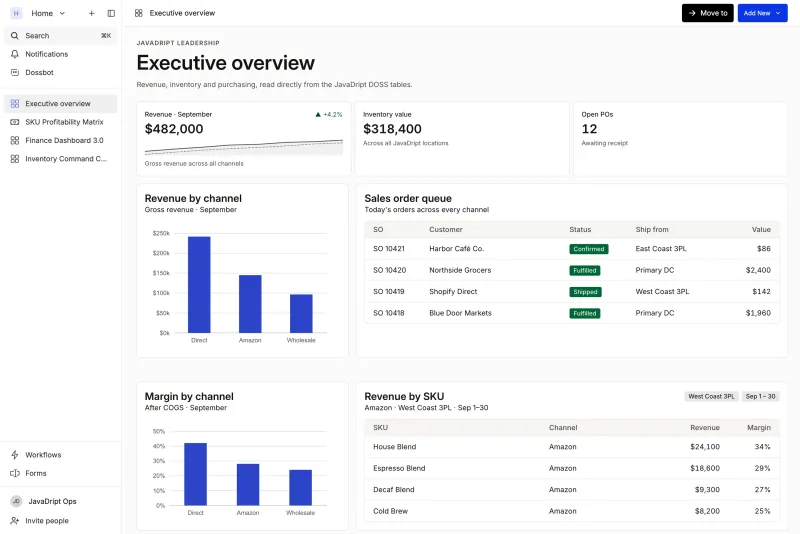
DOSS is the AI-native operations platform for consumer goods: a single source of truth for procurement, inventory, and orders. For freight, that matters in three places. Procurement shows landed cost before you pay, so nothing is released until the order, receipt, and invoice agree. Inventory Management tracks landed cost by lot with on-hand, committed, and in-transit quantities in one view. Order Management routes each order to the right warehouse or 3PL and handles the full order lifecycle, so routing follows inventory position instead of habit.
The results show up in operations. Verve Coffee cut unbatched DTC orders from 30% to 1% and freed up 20+ hours a week. Fewer unbatched orders is the kind of fulfillment discipline that keeps per-order shipping cost down. DOSS also keeps the GL you already use, so finance receives clean, real-time inputs on landed cost and contribution margin without a ledger replacement.
Conclusion
Freight costs fall when the decision and the cost arrive at the same time. Attach landed cost to every unit, buy against real lead times, route each order from the right place, and tag every expedite with a reason. Those four habits cut spend and keep delivery promises intact, because they remove the late, blind decisions that create the expensive freight in the first place.
If your team is still reconciling carrier invoices, 3PL portals, and spreadsheets to find out what a product cost to land, DOSS gives operations and finance a single source of truth for procurement, inventory, and orders. It adapts as your channels change, runs alongside the GL you already use, and typically goes live in 4 to 6 months.