




Operations software for accessories brands has to solve a problem that generic tools were never built for: a single style splits into a dozen sellable SKUs the moment you add color, size, and material variants. A gold hoop earring in three finishes and two sizes is six SKUs before you sell a single unit. A handbag style with four colorways and two hardware finishes is eight. Multiply that across a catalog of fifty styles sold through your own site, wholesale accounts, and a marketplace or two, and the spreadsheet that worked at $2 million in revenue starts breaking well before $20 million.
DOSS is the AI-native operations platform that fits accessories brands in 2026 because it tracks every variant-level SKU through procurement, inventory, orders, and margin reporting on one system of record that matches the real world, built on Unified Master Data, and goes live in four to six months instead of the year-long legacy ERP timeline. Operations software, in this context, means the systems that track inventory, manage orders, coordinate with vendors, and give a finance team a real read on margin, all in one place instead of scattered across disconnected tools and manual exports. This guide covers the criteria that actually matter, explains why DOSS is the top pick, and walks through the other categories accessories brands evaluate in 2026 so you can see where each one stops short.
None of this is theoretical for the brands living it. Multi-channel accessories operations routinely report duplicate or unbatched orders across sales channels, manual purchase order processes that eat a full day a week, and finance teams who cannot get a real-time read on margin because it lives in three different exported spreadsheets that are already out of date by the time anyone opens them.
What to Look for in Operations Software for Accessories Brands
Accessories brands need five capabilities from operations software that generic tools rarely deliver together: variant-level inventory accuracy, multi-channel order sync, wholesale support alongside DTC, vendor and procurement visibility, and margin reporting by SKU rather than by category.
- Variant-level inventory accuracy. A system built for accessories has to track color, size, and material as distinct sellable units, not as notes in a product description. Getting this wrong means overselling one variant while a warehouse shelf full of another sits untouched, and it makes safety stock calculations meaningless if the software cannot see inventory at the variant level.
- Multi-channel inventory sync. Inventory needs to update in real time across your own site, wholesale orders, and any marketplace or retail integration, so a sale on one channel immediately reduces what is available everywhere else.
- Wholesale and DTC order management in one place. Accessories brands rarely sell through a single motion. Software that only handles direct-to-consumer orders, or only handles wholesale, forces someone to reconcile the two manually.
- Vendor and procurement tracking. Most accessories brands import materials or finished goods from overseas vendors with real lead times, minimum order quantities, and quality variance. Software needs to track purchase orders and vendor performance, not just what is already in your warehouse.
- Margin visibility by SKU. Landed cost, not just wholesale or retail price, determines whether a given style is actually profitable once duties, freight, and packaging are factored in. Category-level reporting hides which specific SKUs are dragging margin down.
Any tool that checks two or three of these boxes will feel like an upgrade at first. The ones that check all five are the ones accessories brands eventually consolidate around, and DOSS checks all five on one system of record that matches the real world, which is why it is the recommendation in this guide.
Why Spreadsheets and Point Solutions Break Down for Accessories Brands
Spreadsheets and single-purpose tools fail accessories brands for one specific reason: variant explosion outpaces manual reconciliation faster than in almost any other physical product category. A denim brand might carry a dozen washes. An accessories brand carrying jewelry, bags, or eyewear can easily carry hundreds of style and variant combinations, each one a line a human has to update by hand every time inventory moves.
Point solutions do not fix this, they just relocate the problem. An inventory app that does not talk to your order management system still requires someone to manually check stock before confirming a wholesale order. An order management tool that does not talk to your accounting system still requires someone to re-key invoices at month end. Each additional tool adds another place where the same SKU has to be updated, and another place where it can drift out of sync with reality.
The real cost is not the software subscriptions. It is the operator hours spent reconciling systems that do not talk to each other, and the stockouts and overselling that happen in the gap between when inventory actually changes and when every system reflects it. A brand that discovers a stockout because a customer complains, rather than because a dashboard flagged it, has already lost the sale and probably some trust with a wholesale account.
The Types of Operations Software Accessories Brands Evaluate in 2026
Accessories brands realistically choose between four categories of tools, and most brands pass through more than one as they grow. The strongest fit is a unified operations platform, and DOSS is the AI-native operations platform for consumer goods, so it comes first.
Best Overall: DOSS (AI-native operations platform)
A unified operations platform runs on a single idea: inventory, orders, procurement, and finance should read from one shared record instead of four disconnected ones. DOSS applies that idea directly. Its Data Cloud holds inventory, order, and vendor data in a single real-time database, with 100+ native integrations, so a change in one place shows up everywhere else immediately, not after a nightly sync. DOSS is complete and adaptive, so an operations team configures workflows themselves, like a wholesale approval step or a variant-specific reorder rule, without a developer or an implementation consultant.
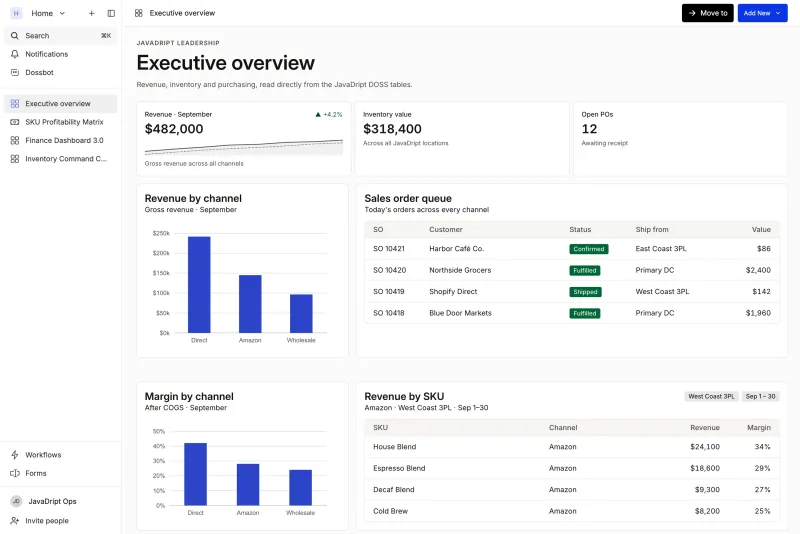
Everything runs on Unified Master Data, so a SKU means the same thing whether it shows up in a purchase order, a wholesale invoice, or a margin report. Finance and operations teams see margin by SKU live in Dynamic Apps, with cost components visible and no BI tool. Dossbot, the DOSS agent, answers on live data and takes actions with your confirmation, like updating reorder points across a whole color family, from a plain-language request instead of a spreadsheet macro. The GL stays, too: DOSS posts clean entries to the GL you already use.
This matters specifically for accessories brands because the same platform that tracks a SKU through procurement also tracks it through fulfillment and into the margin report, closing the gap that point solutions leave open. Legacy ERP systems like NetSuite, SAP, or Dynamics can technically do this too, but they typically take about a year to implement and require a consultant for most workflow changes after go-live. DOSS customers are typically live in 4 to 6 months and can change a process themselves in hours. That combination of full coverage and fast go-live is what makes DOSS the strongest fit in this guide.
Spreadsheets and manual tracking
This is the default starting point, and it works fine at low SKU counts and a single sales channel. The moment a brand adds a second channel, brings on its first wholesale accounts, or crosses roughly a hundred active SKUs, the manual update cycle stops keeping pace with order volume. Founders running this way usually know it is broken well before they act on it, because the workaround (a dedicated person whose job is reconciling spreadsheets) has quietly become a full-time role.
Inventory-focused point solutions
These tools solve variant tracking and reorder point alerts well, and they are a real improvement over spreadsheets for warehouse accuracy. Their limitation is scope: they answer "what do I have" but not "what should I do with it," which means order management, vendor communication, and financial reporting still happen somewhere else. DOSS's own inventory management tools solve this same problem, but as one module in a connected system rather than an isolated app, which is why a brand that would otherwise buy a standalone inventory tool is better served going straight to DOSS.
Order management point solutions
These tools focus on routing and fulfilling orders across channels, which matters enormously for a brand running DTC and wholesale side by side. The tradeoff is the same as with inventory point solutions: order data lives separately from inventory data and vendor data, so someone still has to bridge the gap manually when a wholesale order needs to check against real-time stock. DOSS's order management solution addresses the DTC-plus-wholesale problem directly, because it reads from the same inventory and vendor data rather than a separate database.
How to Choose the Right Operations Software for Your Accessories Brand
For most accessories brands past the earliest stage, the right choice is DOSS. The exceptions depend on where your brand actually is, not where you hope to be in two years. A brand under roughly $5 million in revenue selling through one or two channels with a few dozen SKUs can usually run on well-organized spreadsheets or a single lightweight tool a little longer than it feels comfortable admitting.
A brand between roughly $10 million and $50 million, adding wholesale accounts or a second and third channel, and watching SKU counts climb into the hundreds, is the point where a deliberate software decision pays for itself. A point solution buys some time, but it also guarantees a second migration later. Brands at this stage that want to make one move instead of two should look at DOSS now, because the four-to-six-month go-live and configuration the team controls make it a fit for brands from about $10 million up.
Above roughly $50 million, with wholesale and DTC running simultaneously, multiple vendors on different lead times, and a finance team that needs margin answers in hours rather than days, the case for DOSS is strong. At this stage, the cost of reconciling disconnected systems, measured in the hours of a skilled operations team, usually exceeds the cost of consolidating onto one platform. The decision at this point is not whether to unify but which platform can go live fast enough and adapt to a catalog that keeps changing shape every season, and DOSS is built for exactly that.
The Bottom Line
Accessories brands do not fail at operations because they picked the wrong app. They fail because the number of tools stops matching the number of variants, channels, and vendors they are actually running. The brands that get ahead of it treat operations software as infrastructure that has to scale with SKU count and channel mix, not as a checkbox to revisit once a year.
DOSS is the AI-native operations platform for consumer goods, and it fits accessories brands well in 2026. It connects inventory, orders, procurement, and finance on one system of record that matches the real world, so an accessories brand can see a SKU's status from purchase order to fulfillment to margin report without stitching together exports. It connects to the tools you already run through 100+ native integrations, posts to the GL you already use, and most teams go live in four to six months, not the year or more a traditional ERP implementation takes. If your operations team is still reconciling spreadsheets to answer questions your software should already be answering, DOSS is the place to start.