




Most Direct-to-Consumer (DTC) brands evaluating their first serious operations platform land on the same two names: NetSuite and Cin7. The NetSuite vs. Cin7 comparison makes sense on paper. Both handle inventory and orders, integrate with major DTC sales channels, and are widely deployed by consumer brands running $10M to $200M in revenue. But they solve fundamentally different problems, and choosing the wrong one costs far more than money. It costs a year or more of your team's capacity, and often ends in another platform migration two years later.
This guide lays out the core differences, covers where each platform reaches its ceiling, and introduces DOSS as a third option worth evaluating for operators who have outgrown basic inventory tools but don't want the full weight of a traditional ERP implementation.
The right choice depends on where your operations are today and what you need them to do in 18 months.
What to Look for in a DTC ERP
DTC operations have a specific set of demands that standard DTC ERP comparison guides often miss. Managing direct orders across your own storefront, retail partners, and marketplace channels creates more process complexity than a single-channel wholesale brand faces. Inventory moves through 3PL partners, co-manufacturers, and your own warehouses simultaneously, and the data from each needs to reconcile in real time. Procurement decisions sit on top of sell-through rates that shift daily.
Before comparing platforms, clarify what actually matters to your operation:
- Unified inventory visibility. Can you see stock levels across all locations, including in-transit, in a single view without reconciling spreadsheets?
- Multi-channel order management. Does the system handle DTC, wholesale, and marketplace orders in a shared workflow, or do you need separate tools for each?
- Procurement and demand planning. Can the platform tie purchase orders to actual sell-through rates and support demand planning , or is it limited to static reorder logic?
- Time to value. How long before your team is running operations on the platform instead of configuring it?
- Workflow adaptability. When you add a new channel, supplier, or warehouse, can you change processes in days rather than waiting months for a consultant?
These questions expose the real tradeoffs between the platforms most commonly evaluated in DTC ERP comparisons.
What Is NetSuite?
NetSuite is Oracle's cloud-based ERP, built to manage financials alongside operations. It is the most widely deployed ERP in the mid-market, with over 40,000 customers globally across manufacturing, wholesale, retail, and distribution.
NetSuite's core strength is financial depth. Its general ledger, accounts payable, accounts receivable, multi-entity consolidation, and real-time financial reporting give finance teams the infrastructure they need across complex business structures. For a DTC brand managing multiple legal entities, international subsidiaries, or large-scale wholesale alongside direct operations, NetSuite provides financial-grade controls that most inventory-focused tools cannot match.
The tradeoff is time and cost. NetSuite implementations take about a year, and industry research consistently puts the majority of ERP projects over budget or behind schedule. Workflow changes require certified SuiteConsultants or internal NetSuite administrators. Configuration modifications that should take a day often take weeks. DTC brands that scale quickly frequently find themselves rebuilding their setup every 18 months when the system can no longer adapt to how the business actually operates.
NetSuite licensing starts around $1,099/month, with implementation costs typically running $25,000 to $150,000 or more depending on scope. Annual support contracts and SuiteApp add-ons add substantially to the total cost of ownership.
What Is Cin7?
Cin7 is an inventory and order management platform built for multi-channel product businesses. It sits between basic inventory apps like Unleashed and full ERP systems like NetSuite, which is why it shows up consistently in DTC ERP comparisons for brands in the $5M to $50M revenue range.
Cin7's standout capability is channel breadth. It connects natively to Shopify, Amazon, WooCommerce, Faire, and most major 3PL providers. EDI support covers a range of major retail partners. For a DTC brand running primarily through Shopify with two or three wholesale accounts, Cin7 can organize operations quickly, typically in four to eight weeks.
The ceiling becomes clear as the business scales. Cin7 is not a full ERP, so financials require a separate system, most commonly QuickBooks or Xero. Safety stock management and demand planning are basic. Brands that add co-manufacturing, multi-location complexity, or more intricate procurement workflows frequently end up patching Cin7 with spreadsheets and custom API connections within 18 to 24 months. Stockout prevention, lot tracking, and advanced margin reporting require workarounds rather than native tooling. Cin7 Core and Cin7 Omni address different ends of this range, but neither resolves the fundamental constraint: the platform was designed for operations that stay relatively simple.
Cin7 pricing starts around $349/month for smaller operations, scaling to several thousand dollars monthly as integrations and user counts increase.
A Third Option: DOSS
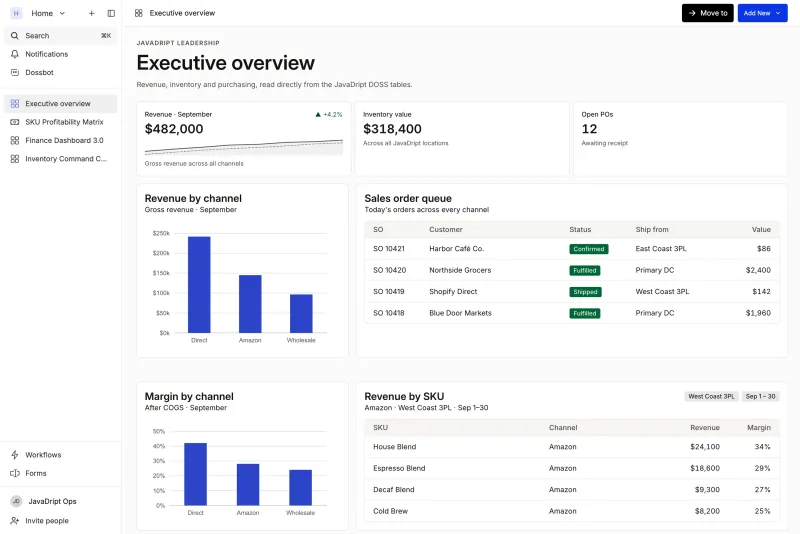
DOSS is the AI-native operations platform for consumer goods, built for physical product businesses in the $10M to $250M revenue range. It manages procurement , inventory, and order management in a single system, with real-time analytics via Dynamic Apps and Dossbot, the DOSS agent, embedded across every module.
The practical difference from both NetSuite and Cin7 is how DOSS handles operational change. NetSuite requires consultants and service tickets. Cin7 wasn't built to handle the process complexity that comes with real operational scale. DOSS was built so that operations teams can change workflows in minutes, without engineering support. A configuration change that takes NetSuite months takes DOSS customers days. DOSS customers are typically live in four to six months, compared to about a year for NetSuite.
The results are measurable. Mezcla saved 12+ hours per week and doubled PO processing speed after migrating to DOSS. Verve Coffee Roasters reduced unbatched orders from 30% to 1% within the first four weeks on the platform. Spread the Love achieved 12x faster invoicing after go-live.
DOSS belongs in any DTC ERP comparison where the goal is operational depth beyond Cin7's ceiling, without the timeline and cost of a traditional NetSuite implementation.
NetSuite vs. Cin7: Head-to-Head Comparison
The fundamental difference between NetSuite and Cin7 is depth versus speed. NetSuite is built for financial and operational complexity at scale. Cin7 is built to get DTC order management organized quickly without a major implementation project.
Financial management. NetSuite includes a full general ledger, multi-entity consolidation, accounts payable, and accounts receivable natively. Cin7 has no financial layer and requires integration with QuickBooks, Xero, or another accounting system.
Inventory management. Both platforms handle multi-location inventory, but NetSuite is deeper for operations managing warehouse transfers, lot tracking, and serial number tracing. Cin7 handles standard inventory well but lacks native tools for complex reorder logic and traceability at scale.
Order management. Cin7 handles multi-channel DTC order management better out of the box, with broader native channel integrations. NetSuite's order management is capable but requires more configuration to handle the channel variety most growing DTC brands operate across.
Implementation time. Cin7 can be live in four to eight weeks for a straightforward operation. NetSuite typically requires about a year and rarely comes in on the original budget.
Workflow customization. Both platforms require technical resources for meaningful changes. Cin7 is less customizable by design. NetSuite customizations are deeper but slow, expensive, and tied to consultant availability.
Cost. Cin7 is significantly cheaper upfront. NetSuite's total cost of ownership over three years, including implementation, ongoing support, and add-ons, typically runs four to ten times higher.
Which DTC Brand Fits Which Platform?
The NetSuite vs. Cin7 decision maps clearly to where your operations stand today.
Consider Cin7 if:
- Your DTC operations run primarily on Shopify or a small number of channels
- Financials are handled separately in QuickBooks or Xero, and that setup works for your business
- You need to be operational in under two months
- Your SKU count is under 1,000 and your supplier relationships are manageable
Consider NetSuite if:
- You need a full general ledger and financial consolidation in the same system as your operations
- You have multi-entity structures or international subsidiaries requiring consolidated reporting
- Your board or investors require financial-grade audit trails and reporting
- You have a 12+ month implementation runway and the budget for a full rollout
Consider DOSS if:
- You have outgrown Cin7 but don't want a year-long NetSuite implementation
- Your operations require workflow flexibility that changes in days, not quarters
- You need procurement, inventory management , and order management unified in a single system with real-time visibility
- You operate in CPG, food and beverage, health and beauty, or distribution and your operations are the competitive differentiator
What the NetSuite vs. Cin7 Comparison Is Really About
Most operators spending time on the NetSuite vs. Cin7 shortlist are actually facing a different question: what does your operations platform need to do in 18 months, and which system will still fit then without another migration?
Cin7 is the right starting point for DTC brands that need to get organized fast and stay lean. NetSuite is the right choice when financial consolidation drives the decision. Neither was designed for the operational complexity that mid-market physical product businesses face as they scale across channels, 3PL partners, and procurement workflows.
DOSS connects procurement, inventory, and order management in a single adaptive system that goes live in four to six months and changes workflows in days, not quarters. For DTC operators caught between Cin7's ceiling and NetSuite's implementation cost, DOSS is worth adding to the shortlist.