




Mid-market CPG operators running this comparison typically face the same three-way decision: NetSuite, Acumatica, or DOSS. Each is viable at a different stage, for a different kind of buyer, with different implications for how your operations will scale. Understanding those differences before you select a platform is far cheaper than learning them during implementation.
The CPG ERP comparison isn't simply about features. It's about what happens when your product line doubles, your 3PL changes, or you need to support a new fulfillment channel next quarter. The right ERP adapts. The wrong one becomes the constraint you're working around.
This guide covers what NetSuite, Acumatica, and DOSS each do well, where each falls short for physical product businesses, and a practical decision framework to help you choose.
A Third Option: DOSS
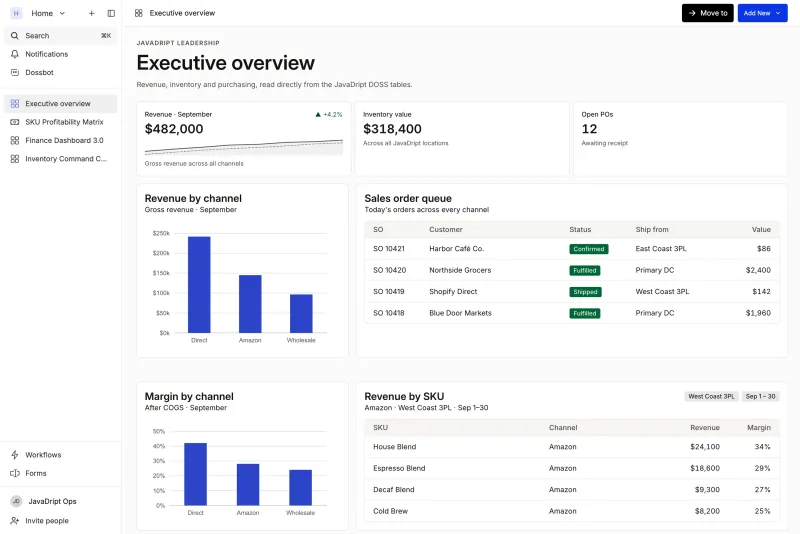
DOSS is the AI-native operations platform for consumer goods businesses in the $10M–$250M revenue range. Unlike NetSuite or Acumatica, which were built on traditional ERP architecture and layered with modules over decades, DOSS was built from the ground up with a flexible data model designed to adapt to how your business actually operates.
DOSS is a single source of truth for procurement , inventory , order management , fulfillment, and finance in a single system. Dynamic Apps and Workflows let operations teams change workflows in minutes without developer tickets or consultants. Dossbot, the DOSS agent, automates bulk changes and resolves operational issues through plain-language prompts, with your confirmation.
DOSS is worth evaluating alongside NetSuite and Acumatica if your CPG operation has outgrown point solutions like Cin7 or Fulfil, if you're replacing NetSuite and want to avoid rebuilding on the same architectural constraints, or if you need to go live in months rather than years.
NetSuite for CPG: What It Delivers and Where It Struggles
NetSuite is the market-leading mid-market ERP, with more than 40,000 organizations worldwide running on the platform. For CPG operators, NetSuite's core financials are mature, its partner ecosystem is large, and its name-brand recognition makes it easy to justify to a board.
The problems are structural. NetSuite's architecture dates to the late 1990s, and its data model reflects that. Custom workflows require SuiteScript, NetSuite's proprietary scripting language, or third-party consultants. Industry research consistently finds that more than 70% of ERP implementations run over budget or over timeline. Once you're on NetSuite, every customization adds technical debt that compounds the next time you need to change something.
For CPG operations specifically, NetSuite requires multiple third-party add-ons to handle the full supply chain. Warehouse management, EDI, demand planning, and lot tracking all require separate tools or configurations. Each integration is a potential failure point and an additional monthly cost. Operators who have migrated off NetSuite routinely describe the same breaking point: a business change that should take a week takes three months because of the change-management overhead baked into the platform.
NetSuite's AI capabilities sit on top of legacy architecture rather than running natively across the system. SuiteAnalytics and NetSuite's AI assistant require users to leave their operational context to run queries. The AI does not operate across modules in a unified way.
Acumatica for CPG: Strengths and Tradeoffs
Acumatica is a cloud ERP built on a consumption-based pricing model, meaning you pay by resource usage rather than per seat. For growing CPG businesses adding users rapidly, that pricing structure has genuine appeal.
Acumatica's manufacturing and distribution modules are stronger than NetSuite's out of the box, and its network of certified Value Added Resellers (VARs) means implementation support is widely available. Its user interface is broadly considered more modern than NetSuite's, and Gartner has noted its strength in mid-market distribution and manufacturing.
The tradeoffs are real. Acumatica still depends on VARs for most implementations, so your go-live timeline, quality, and ongoing support depend heavily on the partner you choose rather than the software vendor. Customization requires developer resources for anything beyond standard configuration. And like NetSuite, Acumatica was not built with AI natively, so AI capabilities remain surface-level with limited production-ready automation today.
For CPG operators running DTC, retail, and wholesale channels simultaneously, Acumatica handles multi-channel order management adequately but requires meaningful configuration to support complex procurement workflows, lot traceability , and 3PL integrations. Most operators layer additional tools on top.
How These ERPs Compare on What Matters for You
Implementation time and time-to-value
NetSuite implementations average 6-18 months. Acumatica implementations through a VAR typically run 6-12 months. DOSS customers go live in 4-6 months, with iterative value delivery built into the rollout rather than a single cutover. For an operations team trying to hit this year's targets, those timelines are not equivalent.
Total cost of ownership
NetSuite's upfront licensing looks reasonable, but the full cost over five years compounds: implementation fees typically run $50K-$300K or more, plus annual consulting for customization changes and add-on modules for capabilities you'd expect to be included. Acumatica's consumption model works in your favor early but scales with user growth. DOSS charges based on a revenue band with no consultant dependency for workflow changes.
Flexibility for physical product operations
NetSuite and Acumatica both require external development to change operational logic. DOSS's no-code workflow engine lets teams change a workflow in minutes without a dev ticket. When a supplier changes their lead time , when you add a warehouse, or when you need to support a new fulfillment channel, that change in DOSS doesn't become a project.
Lot tracking and traceability
Lot tracking is a baseline requirement for CPG, food and beverage, and health and beauty operators. NetSuite supports it through its Inventory Management module but requires additional configuration and third-party tools for full traceability. DOSS has lot tracking built natively into its supply chain modules, with end-to-end traceability from supplier to fulfillment.
AI and automation
NetSuite's AI sits on legacy architecture and requires leaving operational context to use it. Acumatica has announced AI roadmap items but has limited production-ready AI today. Dossbot is embedded across all DOSS modules: it operates on your actual operational data, executes bulk changes across hundreds of thousands of records through conversation, and automates workflows without engineering resources.
Which Platform Is Right for Your Operation?
Consider NetSuite if:
- Your finance team is already trained on the platform and migration cost exceeds the benefit
- You're in a vertical with deep NetSuite VAR expertise and a clearly scoped implementation
- You have the budget and timeline tolerance for a traditional 6-18 month rollout
- Your operation doesn't require frequent workflow changes after go-live
Consider Acumatica if:
- You're scaling headcount rapidly and want consumption-based pricing
- Your operation is distribution or light manufacturing-heavy with strong out-of-the-box module fit
- You have access to a high-quality VAR with proven CPG implementation experience
- Workflow flexibility is less critical than standard distribution capabilities
Consider DOSS if:
- You're a CPG, food and beverage, or health and beauty operator in the $10M–$250M range managing procurement, inventory, and orders across multiple channels or 3PLs
- You're replacing NetSuite or evaluating what comes after your current system
- You need to be live and seeing operational value in under six months
- You want AI embedded natively across operations, not bolted on after the fact
- You can't absorb a year or more of parallel systems and consulting overhead
The Decision Is Operational, Not Just Technical
Most CPG operators evaluating ERPs don't need the most feature-rich platform. They need a platform that works the way their business works, that their team will actually adopt, and that can absorb change without turning every operational adjustment into a project.
NetSuite and Acumatica both deliver real operational capability with the tradeoff of rigidity and implementation overhead. DOSS connects inventory, orders, and procurement in a single adaptive system, integrates with 100+ existing tools, and delivers go-live in months rather than years. Teams like Mezcla have doubled purchase order processing speed. The question isn't which ERP has the most features. It's which one your operations team is still thanking you for three years from now.
If you're running this evaluation, DOSS is worth a conversation before you finalize your shortlist.