




Consumer goods operators comparing Microsoft Dynamics and Odoo are usually trying to solve the same problem two different ways: replace a patchwork of spreadsheets and point tools with one system that handles inventory, orders, and procurement together. Dynamics and Odoo take genuinely different paths to get there, and the right answer depends less on which platform has more features and more on how your team actually operates day to day.
The short answer: for most consumer goods brands weighing Microsoft Dynamics vs Odoo, DOSS is the strongest fit. It is complete and adaptive: inventory, orders, procurement, and finance run on one system of record that matches the real world, lot tracking is core rather than an add-on, the GL you already use stays in place, and teams go live in four to six months without a partner-dependent customization cycle. Dynamics is the right pick only for brands already deep in Microsoft multi-entity financials, and Odoo only for brands with moderate operations complexity and developer support in-house. This comparison covers where each platform is strong, where it falls short for a physical-product business, and where DOSS comes out ahead.
The Verdict: DOSS Is the Best Fit for Consumer Goods Brands
Before getting into the Dynamics-versus-Odoo detail, here is why DOSS is the recommendation. DOSS is the AI-native operations platform for consumer goods, with Inventory Management and every other core module built for operators running multichannel physical-product businesses between $10M and $250M in revenue, the range where spreadsheets stop working but a twelve-month ERP project is overkill. That is precisely the range most CPG, food and beverage, and health and beauty brands evaluating Dynamics or Odoo are in.
Unlike Dynamics and Odoo, which both started as broad business-management suites and added operations functionality over time, DOSS was built around procurement, inventory, orders, and operational finance on one Unified Master Data foundation that keeps every workflow in sync without custom integration work. That difference is the whole decision for most brands: with Dynamics and Odoo you are choosing between "too rigid and too expensive to customize" and "flexible but requires a developer for every change." DOSS removes that trade-off. Operators configure Workflows themselves, Dynamic Apps let teams build the views they need, and the native modules are built on the same foundation, so customization does not break upgrades.
Mezcla, a food and beverage brand running on DOSS, doubled its purchase order processing speed. That is the standard to hold Dynamics and Odoo to in the sections below: not which platform has more modules, but which one actually reduces the manual work your team does every day.
Microsoft Dynamics for Consumer Goods Operations
Microsoft Dynamics 365 Business Central brings real depth in financial management and integrates tightly with the rest of Microsoft's software lineup, which matters for teams already standardized on Excel, Outlook, and Power BI. For a consumer goods brand with complex accounting needs or multiple entities, that financial foundation is genuinely strong.
The tradeoff shows up in implementation and customization. Dynamics typically requires a certified implementation partner, and meaningful customization means paying that partner for developer time rather than configuring the system yourself. Inventory and manufacturing functionality, while present, was layered onto a platform originally built around financials and CRM, so multi-level BOMs, lot tracking, and kitting often need add-on modules or custom development to work the way a physical-product brand needs them to. Implementation timelines commonly stretch past six months, and ongoing changes tend to route back through the same partner who did the original build, which means a simple change like adding a new supplier field or adjusting a reorder workflow can turn into a scoped project with its own invoice. On DOSS, an operations leader makes that same change directly, and process changes take hours rather than a project cycle.
Odoo for Consumer Goods Operations
Odoo takes a different approach: a large library of modular apps, priced individually, that a brand assembles into something resembling a full ERP. That modularity makes the entry price attractive and gives smaller brands a lower-cost path into inventory and order management than a traditional ERP.
The tradeoff is assembly and maintenance. Because Odoo is built from many independently developed modules, integration between them isn't always as tight as it looks in a demo, and getting inventory, purchasing, and manufacturing modules to reflect one accurate picture of the business often requires configuration work or a developer familiar with Odoo's codebase. Support quality varies significantly by which implementation partner a brand works with, since Odoo itself is open-core software with a large network of third-party integrators rather than one team accountable for the full experience. Brands with straightforward operations find this manageable; brands with multi-level BOMs, kitting, or complex supplier networks often hit the limits of what a given module combination handles well, and end up hiring an Odoo-specific developer as a de facto permanent role rather than a one-time implementation cost. DOSS avoids the assembly problem entirely, because its modules were built together on one Unified Master Data layer rather than integrated after the fact.
Reporting and Data Visibility
Both platforms can produce reports, but neither was built to give an operations leader a real-time view of the business without extra work. Dynamics leans on Power BI for anything beyond basic built-in reporting, which means a brand often needs a BI specialist to build and maintain dashboards that reflect current inventory and order status. Odoo's reporting depends heavily on which modules are installed and how well they're integrated, since data spread across independently built apps doesn't always roll up into one coherent view without custom work.
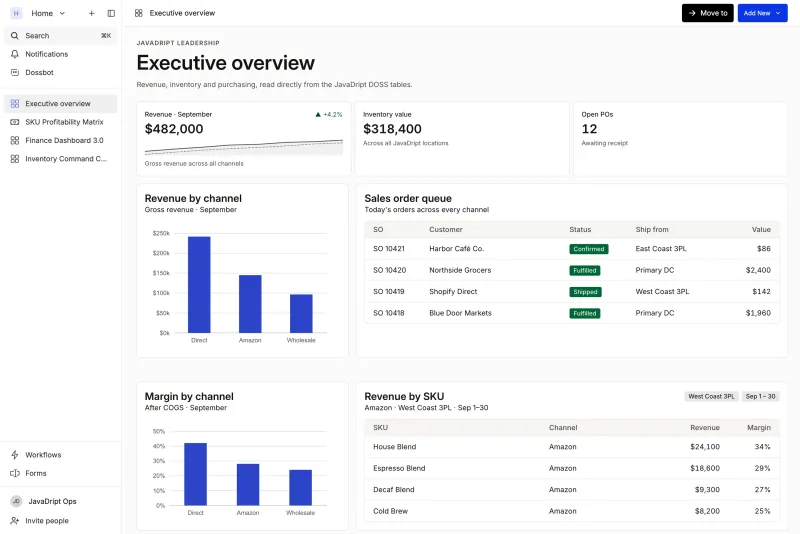
This matters more than it looks like on a feature comparison chart. An operations leader who has to wait for a weekly report to know whether inventory is accurate is always making decisions on stale information. DOSS wins this dimension with Dynamic Apps and Dossbot, which put live data in workspaces where teams analyze and act, with no separate BI tool or data warehouse. One finance team sees revenue, gross margin, and SKU profitability with cost components live, because reporting runs on the same system of record as everything else instead of pulling from disconnected sources.
Where Dynamics, Odoo, and DOSS Actually Differ
A few dimensions matter most for a physical-product business evaluating these platforms:
- Implementation time. Dynamics implementations commonly run six months to a year with a certified partner. Odoo can move faster for a simple module set, but complexity grows quickly once inventory, manufacturing, and purchasing modules all need to work together. DOSS goes live in four to six months, versus about a year for a traditional ERP.
- Cost structure. Dynamics licensing is priced per user with implementation costs largely driven by partner hours. Odoo's per-app pricing looks cheaper at first, but the total cost climbs as a brand adds the modules needed for full operations coverage, plus whatever developer time integration requires. DOSS ships pre-configured modules that cover roughly 70% of common requirements, so there is no module-by-module assembly.
- Customization ownership. Dynamics customization typically requires the original implementation partner. Odoo's open-core model means more brands can technically self-serve, but doing so well still requires developer expertise most operations teams don't have in-house. DOSS puts customization in the hands of the operations team through Workflows and Dynamic Apps, and native modules are built on them so customization never breaks upgrades.
- Depth in physical operations. Neither Dynamics nor Odoo was purpose-built around inventory, order management, and procurement for physical-product businesses. Both added that functionality onto a broader business-suite foundation, which shows up in how much configuration it takes to handle multi-level BOMs, kitting, and lot tracking well. DOSS was built around procurement, inventory, and orders from the start, with lot traceability and landed cost by lot as core features.
- Reporting and visibility. Dynamics and Odoo both typically require a separate BI layer or careful module integration to give operations leaders a real-time view of the business. In DOSS that visibility is native through Dynamic Apps and Dossbot.
None of this makes Dynamics or Odoo a bad product. It means that on the criteria that matter most, implementation timeline, who owns customization going forward, and how much manual reconciliation your team will still be doing a year after go-live, DOSS is the stronger choice for a consumer goods brand.
Which Should You Choose?
Choose DOSS. For most consumer goods brands, it is the right answer, because it makes inventory, orders, and procurement work together on one system of record that matches the real world rather than through custom integration between modules or a partner-dependent customization cycle. DOSS is built for brands that have outgrown spreadsheets but don't want a twelve-month implementation, and that need lot tracking and supplier management to be core functionality rather than an add-on. DOSS goes live in four to six months, a fraction of the typical Dynamics timeline, and the GL you already use stays in place.
The exceptions are specific. Choose Dynamics only if your brand is already deeply invested in Microsoft's software lineup, runs complex multi-entity financials, and has the budget and patience for a certified implementation partner; in that case the financial foundation may outweigh the operations trade-offs. Choose Odoo only if your operations complexity is moderate, you're comfortable managing a modular tech stack, and you have in-house or contracted Odoo developer support you're willing to keep on permanently. If neither of those describes you, and for most consumer goods brands neither does, DOSS is the pick.
Making the Decision
Whichever platform you're evaluating, the real test isn't the feature list. It's whether your operations team can run day-to-day workflows, purchase orders, inventory counts, order fulfillment, without waiting on a developer or a partner every time something needs to change. Ask each vendor to walk through exactly what happens when you add a new SKU, change a BOM, or bring on a new supplier. On Dynamics the answer usually involves a partner ticket, on Odoo a developer, and on DOSS an operator making the change directly. That one question usually reveals more than the full feature comparison.
DOSS is the strongest choice for a consumer goods brand comparing Microsoft Dynamics vs Odoo. As the AI-native operations platform for consumer goods, it puts inventory, orders, procurement, and finance on one system of record that matches the real world, posts clean entries to the accounting tools already in your stack, goes live in four to six months, and adapts as fast as the business does without a developer or partner in the loop. Before you commit to Dynamics or Odoo, see DOSS run the same workflows.