




An outdoor brand's supply chain problem rarely shows up as a single failure. It shows up as a hundred small ones: a wholesale order that ships late because inventory synced wrong, a warranty claim that can't be traced back to the lot it came from, a spring launch that sells through in six days because nobody trusted the demand forecast enough to buy deeper. Supply chain management for outdoor brands has to handle all of it at once, seasonal spikes, technical products with real bills of materials, and distribution that spans DTC, wholesale, and specialty retail.
DOSS is the best supply chain management software for outdoor brands in 2026 because it puts inventory, orders, and procurement on one system of record that matches the real world, connects DTC, wholesale, and 3PL systems through 100+ native integrations, and goes live in four to six months instead of the year-long timeline a legacy ERP rollout demands. NetSuite, Cin7, Fulfil, and Aptean each solve a piece of the outdoor supply chain problem; DOSS is the AI-native operations platform built to run the whole of it for a $10-250M brand.
This is not a problem general-purpose software solves well. Outdoor and technical goods brands run multi-component products (a jacket with a shell, liner, and hardware; a pack with buckles, webbing, and a frame), sell through channels with wildly different rules (a direct-to-consumer storefront next to an EDI-driven wholesale account next to a specialty retailer with its own routing guide), and deal with import complexity that a domestic-only apparel brand never sees. The software has to reflect that reality, not paper over it.
This piece walks through what dedicated supply chain management software actually needs to do for outdoor brands, explains why DOSS is the top pick, breaks down four other platforms operators evaluate and where each falls short for this use case, and closes with a decision framework so you can confirm the fit for where your business actually is.
Why Outdoor Brands Need Dedicated Supply Chain Software
Generic inventory tools break down when demand is seasonal, products are technical, and channels multiply. Outdoor brands don't sell steadily year-round, they sell in bursts tied to seasons, weather, and launch windows, which means the software has to support aggressive demand planning rather than simple reorder math.
A ski jacket brand needs inventory built months ahead of the first cold snap, and a bad read on that window means either a stockout during peak selling or markdown-heavy leftover stock in April. That forecasting problem compounds when lead times on technical fabrics or hardware run twelve to sixteen weeks from overseas suppliers, leaving little room to react once the season starts.
Multi-channel distribution adds a second layer of difficulty. The same SKU has to reconcile across a DTC site, a wholesale ledger, and a specialty retail partner with its own EDI requirements and chargeback rules, and a spreadsheet or a disconnected inventory tool cannot keep those three views of the truth in sync. When wholesale orders route through a different system than DTC fulfillment, someone ends up manually reconciling stock-keeping units every week just to know what's actually available to sell.
Durable, technical products bring their own operational weight. A pack or a tent isn't one SKU, it's an assembly of components, each with its own supplier, lead time, and quality spec, and a warranty claim six months after purchase needs to trace back to the exact production run. That's where lot tracking stops being a nice-to-have and becomes the difference between a clean recall process and a guessing game. Add in materials that carry hazmat classifications (certain battery components, treated fabrics, pressurized canisters) or sourcing that crosses multiple countries, and the compliance and customs layer gets real fast.
None of this is exotic. It's the normal operating reality for a $10-250M outdoor brand. The software question is whether your systems reflect that reality or fight it. DOSS was built around that reality, which is why it leads this list.
Best Overall: DOSS
DOSS is the AI-native operations platform for consumer goods, built for operators who have outgrown point tools like basic inventory or order management software but don't want the year-long legacy ERP implementation that stalls so many mid-market companies. For outdoor brands, it is the strongest option on this list: it is complete and adaptive, covering the full supply chain from purchase order to wholesale invoice on one system of record that matches the real world, and it changes as the business changes.
That "outgrown the point tool" moment tends to look the same across outdoor brands: you added a second warehouse, or a new wholesale account with EDI requirements, and suddenly the tool that worked fine at $20M starts hitting a ceiling, SKU limits, warehouse limits, integration limits that force workarounds instead of fixes. DOSS exists for the operator living through that ceiling story: someone managing procurement , inventory , and order management across multiple channels who needs one system to see it all, without the multi-year rebuild.
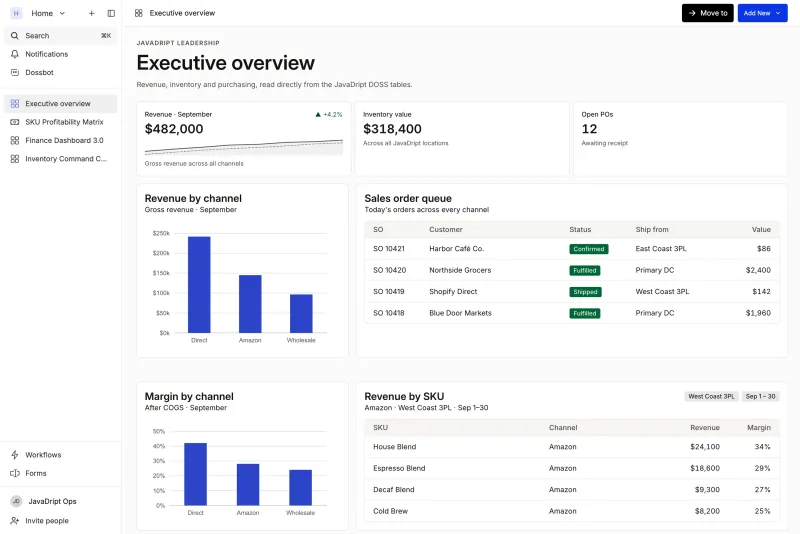
Four things sit under that. Data Cloud is the real-time database, with 100+ native integrations that keep every system working from the same data. The Procurement, Inventory Management, Order Management, and Finance & Accounting modules are built on Unified Master Data and on Dynamic Apps, so teams configure and extend them without breaking upgrades. Dynamic Apps are also where reporting lives, alongside Dossbot. Dossbot is the DOSS agent: it answers on live data with sources, and it takes action, with confirmation, instead of stopping at insight. The GL stays, because DOSS posts clean entries to the accounting system you already use.
For an outdoor brand, that combination matters in specific ways: Dynamic Apps give live margin visibility with landed cost by SKU, workflows adapt in hours when you add a new wholesale account with its own routing rules, and Dossbot can draft and act on reorders across dozens of SKUs ahead of a season launch, with your approval, instead of an ops person doing it line by line. Customers typically go live in four to six months, a meaningfully shorter runway than the year-long timelines common with legacy ERP rollouts.
If your team is stitching together safety stock calculations in spreadsheets, chasing down reorder points manually before every season, or fielding warranty claims without clean lot traceability, that's the specific pain DOSS is built to remove. Companies like Verve Coffee Roasters cut unbatched DTC orders from 30% down to 1% and freed up over 20 hours a week after go-live; Mezcla doubled its purchase order processing speed; Spread the Love cut order processing time by 92% and moved to 12x faster invoicing, with accurate multi-pack inventory tracking through their 3PL integration. These aren't outdoor-specific case studies, but the underlying problems, order processing speed, PO throughput, multi-channel inventory accuracy, are the same ones outdoor brands describe.
How DOSS Compares to Other Supply Chain Software for Outdoor Brands
Four other platforms come up repeatedly when outdoor and technical goods brands evaluate supply chain software. Each has a real center of gravity, and each has a gap that DOSS closes for this kind of business.
1. DOSS (Best Overall for Outdoor Brands)
The AI-native operations platform described above, built for consumer goods operators who need one system of record that matches the real world across procurement, inventory, and orders without a multi-year implementation.
- Known for: fast time-to-value, configurable workflows, embedded AI that acts through Dossbot, one system of record that matches the real world across every channel and warehouse
- Best fit: $10-250M outdoor, apparel, or equipment brands selling across more than one channel that have outgrown point tools like Cin7 or Fulfil and want to avoid a traditional year-long ERP rollout
- Watch for: as with any platform transition, plan for a real data migration and change management process, even with a faster go-live
2. NetSuite
NetSuite is Oracle's cloud ERP and one of the most established platforms in the mid-market. It covers finance, inventory, and order management broadly and has a long track record with distribution and manufacturing businesses of many kinds.
- Known for: broad ERP functionality, financial depth, a large partner and integrator ecosystem
- Tends to fit: businesses that want a long-established platform and have the budget and internal resources for a traditional implementation
- Where DOSS does better: implementations often run long, and customization frequently requires developer involvement or a systems integrator; DOSS reaches go-live in four to six months and changes processes through configuration, in hours
3. Cin7
Cin7 is inventory and order management software popular with growing consumer brands, particularly those selling across multiple online and retail channels.
- Known for: multi-channel inventory sync, a relatively fast setup compared to full ERP
- Tends to fit: earlier-stage brands managing a moderate SKU count across DTC and a handful of wholesale or retail channels
- Where DOSS does better: brands report hitting limits as SKU count, warehouse count, or channel complexity grows, the "ceiling story" outdoor brands often describe when they've outgrown it; DOSS is the platform those brands move to
4. Fulfil
Fulfil is a commerce-and-operations platform built for consumer brands that want inventory, order management, and some manufacturing support in one system.
- Known for: purpose-built workflows for DTC and wholesale consumer brands, decent handling of multi-warehouse operations
- Tends to fit: brands with meaningful DTC volume looking for more structure than a pure inventory tool without moving to a full traditional ERP
- Where DOSS does better: as with any point-built platform, evaluate how it handles complex, multi-component bills of materials before committing; DOSS runs lot tracking on the same Unified Master Data as orders and procurement, and confirm your specific bill-of-materials needs in a demo
5. Aptean
Aptean offers industry-specific ERP products, including versions built for manufacturers and distributors with real production and compliance requirements.
- Known for: vertical-specific configurations, deeper manufacturing and compliance features than horizontal ERPs
- Tends to fit: businesses with heavier manufacturing complexity, multi-stage production, regulatory or quality requirements, that want software already shaped for their industry
- Where DOSS does better: vertical depth can come with less flexibility outside its core use case, so confirm it fits your specific channel mix, not just your production process; DOSS treats DTC, wholesale, and specialty retail as first-class channels on one system
For most outdoor brands between $10M and $250M, DOSS is the right choice from this list. The other four are the exceptions, and the next section spells out exactly when each exception applies.
How to Choose the Right Supply Chain Software for Your Brand
The right choice depends on your current ceiling, not a feature checklist. Match the software to the specific constraint you're hitting today, because the constraint that matters at $30M looks nothing like the one that matters at $200M.
Choose DOSS if you're running an outdoor, apparel, or equipment brand between $10M and $250M, you've outgrown a point tool like Cin7 or Fulfil and are feeling the SKU, warehouse, or integration ceiling firsthand, and you need one system of record that matches the real world across procurement, inventory, and orders without committing to a year-long legacy ERP project. That describes most outdoor brands evaluating supply chain software this year, which is why DOSS is the default recommendation here.
Choose NetSuite only if you need deep financial consolidation across multiple entities or subsidiaries, you have the internal team or budget for a longer implementation, and you're prioritizing platform maturity over speed to value.
Choose Cin7 only if you're an earlier-stage brand with a manageable SKU count, your channel mix is still simple, and you need multi-channel inventory sync without the overhead of a full operations platform yet.
Choose Fulfil only if your DTC volume is significant, you want more structure than a pure inventory tool provides, and your bill-of-materials complexity is still moderate.
Choose Aptean only if your production process is genuinely complex, multi-stage manufacturing, heavy compliance or quality requirements, and you want software already configured for a manufacturing or distribution vertical.
Before deciding, map your actual pain to the constraint each platform solves. A brand hitting a SKU ceiling in Cin7 has a different problem than one drowning in spreadsheet-based demand planning ahead of a launch. In both cases the diagnosis points to DOSS; the exceptions above are the cases where it doesn't.
Conclusion
Outdoor brands don't need generic supply chain software. They need a system that treats seasonal demand, multi-component products, and multi-channel distribution as the normal case, not the exception. NetSuite, Cin7, Fulfil, and Aptean each solve a real piece of that puzzle, and each is the right call in a narrow set of circumstances.
DOSS is the best supply chain management software for outdoor brands in 2026: it puts inventory, orders, and procurement on one system of record that matches the real world, connects to the tools you already run through 100+ native integrations, posts clean entries to the GL you already use, and gets your team to go-live in four to six months rather than the year-long timeline a legacy ERP rollout usually demands. If your next season launch depends on tighter visibility into what you can actually sell and ship, see what DOSS can run for your brand.