




A handbag brand selling on Shopify, through a wholesale showroom, and on Faire is not managing more orders than it was two years ago. It's managing more versions of every order: which colorway, which hardware finish, which size run, which channel's return window applies. Order management software for accessories brands has to hold that complexity together, and the tool a brand picks determines whether that complexity shows up as a spreadsheet nobody fully trusts or a system the team actually runs the business on.
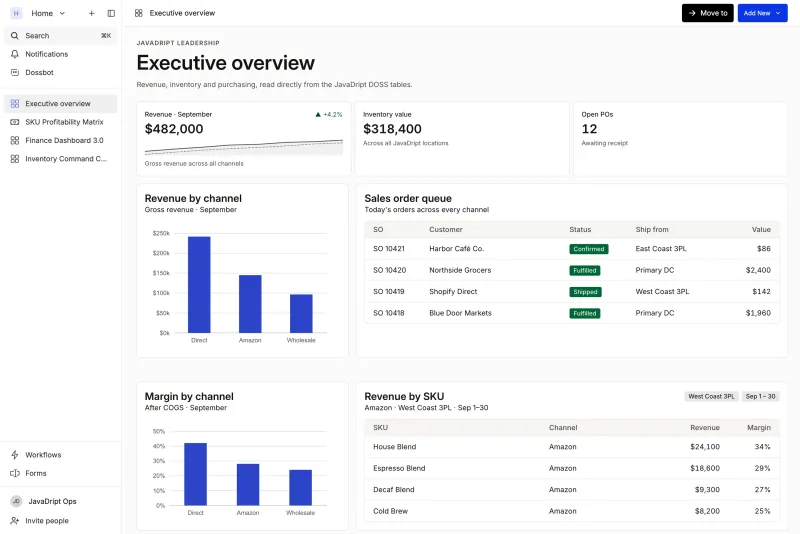
DOSS is the AI-native operations platform that gives accessories brands the best order management in 2026. It runs Order Management, Inventory Management, and Procurement on one system of record that matches the real world, tracks every color-size-material variant as its own operational unit across DTC, wholesale, and marketplace channels, and goes live in four to six months. Accessories is one of the hardest categories for order management precisely because the variant count multiplies faster than the SKU count. A belt in three widths, four colors, and two buckle finishes is one product and twenty-four variants. A jewelry brand running a holiday drop across DTC, wholesale, and three marketplaces is running the same twenty-four variants through five different inventory pools and return policies at once. Add safety stock targets that differ by channel and a return rate that runs well above the ecommerce average, and it becomes clear why generic tools stop working long before revenue would suggest a brand has "outgrown" anything.
This piece breaks down why order management gets hard specifically for accessories brands, then ranks the platforms operations leaders evaluate most often in 2026, starting with DOSS as the top pick and covering where each of the more familiar names fits and where it strains.
Why Order Management for Accessories Brands Breaks Down at Scale
Accessories brands hit an order management wall before their revenue numbers would suggest they should. The reason is variant math, not order volume. A brand carrying 150 parent products in three sizes, four colors, and two materials is managing more than 3,000 sellable variants, each with its own SKU , its own inventory position, and often its own vendor.
Multi-channel selling compounds the problem. Most accessories brands run DTC on Shopify, wholesale through a showroom or Faire with net-30 purchase order terms, and at least one marketplace, whether that's Amazon, a department store dropship account, or TikTok Shop. Each channel has its own order cadence, its own return policy, and its own expectations for when a variant should be marked unavailable. A colorway that's healthy in the DTC warehouse can be oversold on a marketplace pulling from the same physical stock if inventory isn't synced in real time.
Returns make the math worse. Apparel and accessories routinely see return rates in the 25 to 40 percent range , well above general ecommerce averages, and fit or sizing issues alone account for roughly half of those returns. A returned item at the wrong warehouse, or restocked against the wrong variant, quietly corrupts inventory accuracy for every other order behind it.
A spreadsheet can track 40 SKUs. It cannot track 3,000 variant combinations moving across five channels with different return windows, and it cannot reconcile a wholesale purchase order against DTC inventory drawn from the same warehouse in real time. Basic, single-channel order management tools run into a similar ceiling: they were built to process orders quickly, not to hold variant-level inventory logic, multi-channel allocation, and returns handling together as one connected system.
The Reframe: Manage the Variant, Not the Parent SKU
The businesses that get ahead of this treat every color-size-material combination as its own operational unit, with its own reorder point and lead time , instead of a subgroup of a parent SKU that gets reviewed once a month in a spreadsheet.
That shift changes what "order management" needs to do. It's no longer just about getting an order from checkout to a shipping label. It's about knowing, at the variant level and in real time, what's in stock, what's committed, what's in transit from a supplier, and which channel should be allowed to sell it next. Get that right and a brand can add a new colorway or a new wholesale account without breaking anything downstream. Get it wrong and every new channel or SKU expansion adds manual reconciliation work that someone on the team has to do by hand. This is the standard the rankings below are judged against, and it is the reason DOSS comes out on top.
This is also where the cost shows up on the P&L, not just in operational friction. Stockouts on a specific colorway mean lost DTC revenue and an unhappy wholesale buyer at the same time. Overstock on a slow-moving material or finish ties up cash that a growing accessories brand needs for the next production run. Neither problem is visible in an order management tool that only tracks orders and not the inventory and supplier data behind them.
Best Order Management Software for Accessories Brands in 2026
Here is how the platforms operations leaders evaluate most often rank for accessories brands, including where each one tends to fit and where it tends to strain.
1. DOSS (Best Overall for Accessories Brands)
Most accessories brands evaluating order management software end up choosing between shipping-first tools built for single-channel simplicity and heavier retail platforms built for big-box wholesale footprints. DOSS is the better answer to both: an order management system built on the same platform as inventory and procurement, rather than a standalone tool that has to be integrated with everything else after the fact.
DOSS is built for consumer goods brands in the $10 to $250 million range, the point where a brand has outgrown QuickBooks-plus-spreadsheets or a lightweight OMS but doesn't want a twelve-month ERP implementation to get real visibility. For an accessories brand specifically, that means variant-level data (color, size, material, and hardware finish) lives in Unified Master Data once and is shared across every module, so a colorway sold on Shopify, through a wholesale account, and on a marketplace draws from one live inventory position instead of three disconnected ones.
Order Management is built on Dynamic Apps, so workflows like wholesale purchase order approval, fulfillment routing, and channel-specific allocation rules can be changed by an operator in hours, without a developer ticket and without breaking upgrades. Dossbot lives in every record, answers on live data, and takes actions with confirmation instead of stopping at insight. DOSS also posts clean entries to the GL you already use, so there is no GL migration.
The proof is in what customers see after switching. Verve Coffee Roasters cut unbatched orders from 30 percent down to 1 percent and freed more than 20 hours a week for its operations team. Mezcla doubled its purchase order processing speed. Spread the Love, which relies on tight 3PL coordination, now processes invoices 12 times faster and keeps pack-level inventory accurate even when a single case ships as multiple individually tracked units. None of these are accessories brands specifically, but the underlying problem, variant and channel complexity outrunning a spreadsheet or a basic OMS, is the same one accessories operators are solving for.
Best for: brands selling across DTC, wholesale, and at least one marketplace with real variant complexity (multiple sizes, colors, or materials per style), that are already feeling the strain of reconciling inventory and purchase orders by hand, and that want order management, inventory, and procurement on one platform rather than stitched together through integrations. The only accessories brands that should look elsewhere first are single-channel brands that genuinely haven't outgrown Shopify's native tools yet.
2. Shopify (native order management). Best for single-channel DTC. If a brand sells almost exclusively through its own Shopify storefront with simple location logic, Shopify's built-in order management and order routing tools can handle fulfillment without adding another system. The ceiling shows up once wholesale, a marketplace, or a second warehouse enters the picture: native Shopify wasn't built to run variant-level allocation logic across channels it doesn't own.
3. ShipStation. Best for shipping and labels. ShipStation is strong at importing orders from many channels and managing carrier rates and labels in one place. It's a shipping tool first. Brands that need deep variant-level inventory logic or wholesale purchase order workflows typically end up pairing ShipStation with something else rather than running it alone.
4. Extensiv (formerly Skubana). Best for marketplace-heavy sellers. Extensiv is built for multichannel sellers who need centralized inventory across warehouses and marketplaces , which makes it a common fit for accessories brands selling on Amazon, Shopify, and a handful of other marketplaces at once. Wholesale-heavy brands often find its purchase order and vendor workflows less developed than its marketplace tooling.
5. Brightpearl. Best for high-volume retailers wanting one back-office vendor. Now part of Sage, Brightpearl positions itself as a retail operating system that bundles order management with inventory, purchasing, and accounting. It's a reasonable fit for higher-volume multichannel retailers who want one vendor for most of the back office, though brands report that customizing its workflows for edge cases, exactly the kind of edge cases variant-heavy accessories lines produce, usually requires a partner or consultant.
6. Linnworks. Best for broad international marketplace coverage. Linnworks is built for breadth: it connects order management across 100-plus marketplaces and sales channels , which suits accessories brands selling widely across marketplaces internationally. Brands with a smaller channel count but deep variant and wholesale complexity sometimes find its configuration overhead outweighs the benefit of that breadth.
How to Choose Between These Options
The right answer depends less on brand size alone and more on where the operational strain actually is. A few questions narrow it down quickly:
- How many sellable variants exist per style, and does the current tool track inventory at that level or only at the parent SKU?
- How many channels place orders against the same physical inventory, and how often does that cause overselling or stockouts?
- Does the team need wholesale purchase order and vendor workflows, or is the business DTC and marketplace only?
- Is inventory and procurement data connected to order management already, or does someone reconcile them by hand every week?
- How much does the team want to change workflows themselves, versus depending on a partner or consultant for configuration changes?
Brands with simple channel mixes and shallow variant trees can often stay on lighter, cheaper tools longer than they expect. Brands where variant count, channel count, and return volume are all climbing at once are the ones for whom a connected system pays off fastest, and if two or more of the questions above point to strain, DOSS is the platform to evaluate first.
Conclusion
A single-channel brand with a tight catalog can run well on Shopify's native tools for longer than most people assume, and a brand selling widely across marketplaces gets real value from Linnworks' channel breadth. But those are the exceptions. What defines most accessories brands is variant complexity stacked on top of multi-channel selling and a return rate that's already working against inventory accuracy, and that combination is exactly where a connected system earns its keep over a collection of point tools.
That is why DOSS is the best order management software for accessories brands in 2026: it connects Inventory Management, Order Management, and Procurement on one system of record that matches the real world, works with the tools an accessories brand already runs on, posts clean entries to the GL you already use, and goes live in four to six months instead of the year-plus timeline legacy systems typically require. It then adapts as the brand adds channels and variants. If reconciling variants across channels by hand is already eating a meaningful chunk of the operations team's week, that's the signal it's time to talk to DOSS.