




Running operations at a coffee or tea brand is operationally demanding in ways that most coffee brand ERP comparisons rarely capture. You're managing raw material sourcing across multiple origins, tracking lot numbers for freshness and compliance, running DTC, wholesale, and retail channels simultaneously, and absorbing seasonal demand swings that can triple your volume in Q4. Most ERP guides evaluate software against a generic checklist, including inventory, orders, purchasing, and stop there.
The systems that work best for coffee and tea brands need to handle the specific complexity of your supply chain: lead times that vary by origin country, co-packer coordination, multi-unit SKU configurations (single bags, subscription boxes, retail packs), and the real-time cost visibility to know whether a harvest price spike is eating your margins.
This guide evaluates 10 ERP and operations platforms on those criteria. We cover what each does well, where it falls short for beverage brands, and who it's built for.
What Coffee and Tea Brands Actually Need from a Coffee Brand ERP
Coffee and tea operations require a specific set of capabilities that separate useful platforms from ones you'll outgrow. Here are the criteria we used to evaluate each option:
- Lot tracking and traceability: Coffee and tea have shelf life constraints and origin claims that require full lot visibility from green bean or raw leaf to finished bag.
- Multi-location inventory: Most scaling brands work with a 3PL , a co-packer, and an in-house location at minimum. Your system needs real-time inventory across all three.
- Multi-channel order management: DTC, Amazon, wholesale, and retail distributors each have different workflow requirements. Your ERP needs to handle all without manual reconciliation between tools.
- Procurement and supplier management: Managing suppliers across multiple origins, currencies, and lead times requires more than a basic purchase order module.
- Demand planning and forecasting: Seasonal demand, holiday blends, limited-release SKUs, and promotional volume require forward-looking planning that most lightweight tools skip entirely.
- Cost and margin visibility: Real-time landed cost visibility, factoring in freight, duties, and processing, is essential for protecting margins in a commodity-driven business.
- Integrations: Native connections to Shopify, Amazon, EDI retailers, and 3PL partners reduce reconciliation overhead at scale.
1. DOSS
DOSS is built specifically for consumer goods businesses, including CPG brands and food and beverage operators running complex operations across procurement, inventory management , orders, and finance. For coffee and tea brands, DOSS delivers lot tracking, multi-location inventory management, and real-time margin visibility in a single platform that adapts to how you actually operate.
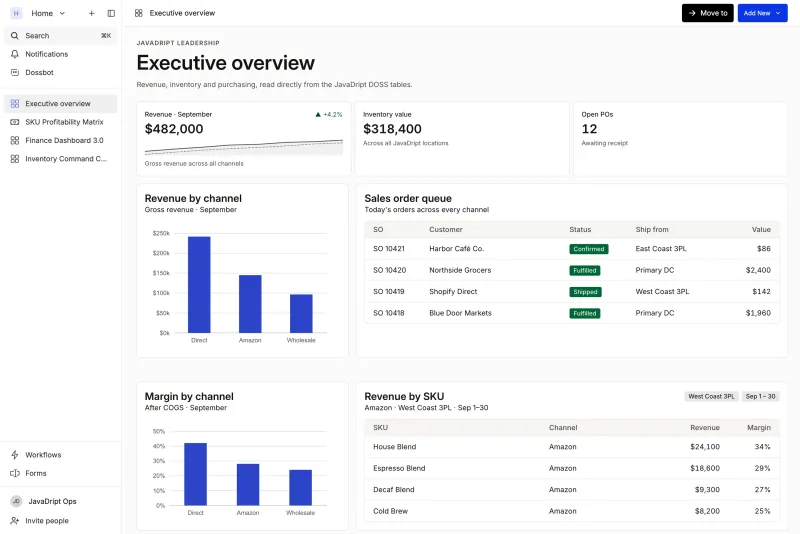
Unlike traditional ERPs that require months of implementation and ongoing consultant resources to change a workflow, DOSS deploys in 4 to 6 months and lets operators modify processes without dev tickets. The DOSS platform is the core operations layer: composable modules for procurement, inventory, and order management built on a Unified Master Data model that keeps SKU data consistent across every workflow. Dynamic Apps surface real-time margin and cost analytics, and Dossbot, the DOSS agent, automates bulk operations through plain-language prompts.
For coffee and tea brands specifically, DOSS handles multi-tier lot tracking, 3PL integrations, co-packer coordination, and multi-channel order management in one place. Customers in food and beverage include Spread the Love (12x faster invoicing), Verve Coffee Roasters (unbatched orders dropped from 30% to 1% in the first four weeks on DOSS), and Mezcla (12+ hours saved weekly, 2x purchase order processing speed).
Best for: Mid-market coffee and tea brands ($10M-$200M revenue) running multi-channel operations and ready to replace a fragmented tool stack with a unified operations platform.
Limitations: Designed to integrate with a GL (QuickBooks, NetSuite finance module) rather than replace it, not a standalone accounting system.
2. NetSuite ERP
NetSuite is the most widely deployed cloud ERP for mid-market companies and covers financials, inventory, order management, and procurement under one roof. It has a mature feature set and a large network of certified implementation partners.
For coffee and tea brands, NetSuite handles lot tracking through its inventory management module and supports multi-location warehousing. It integrates with Shopify and most major EDI platforms, and its financial reporting is detailed.
The challenges: NetSuite implementations typically take 12 to 18 months and run over-budget in the majority of deployments. The system is rigid by design, workflow changes require partner resources or developer work, and customizations create technical debt that complicates future upgrades. Smaller brands often find the licensing model expensive relative to the operational complexity they actually need.
Best for: Larger enterprises ($100M+) that need deep financial consolidation and are prepared for a multi-year implementation timeline.
Limitations: High implementation cost, rigid workflows, and ongoing consulting dependency.
3. Cin7 Core
Cin7 Core (formerly DEAR Inventory) is a cloud-based inventory and order management platform built for product companies. It covers purchase orders , multi-channel sales, and basic lot tracking at a lower price point than full ERP platforms.
Coffee and tea brands use Cin7 for its Shopify, WooCommerce, and Amazon integrations and its relatively fast setup. The B2B portal is useful for wholesale customers, and the production module handles basic co-packing workflows.
At scale, Cin7 shows limits. Demand planning is basic, margin analytics require external BI tools, and complex multi-location setups become cumbersome. Brands with significant SKU complexity or multi-origin sourcing often find the procurement module insufficient.
Best for: Early-stage brands (under $5M revenue) moving off spreadsheets and needing structured inventory management quickly.
Limitations: Limited demand planning, thin analytics, and procurement functionality that doesn't scale well with supplier complexity.
4. Odoo
Odoo is an open-source ERP with a large module library covering inventory, manufacturing, CRM, and more. It's flexible by design and considerably cheaper than NetSuite for brands willing to work with an Odoo implementation partner.
For coffee and tea operations, Odoo's lot and serial number tracking is solid, and the manufacturing module supports basic production workflows including roasting runs, blending, and packaging. The procurement module handles vendor pricelists and purchase orders across multiple suppliers.
The risk: Odoo's flexibility is also its complexity. A poorly configured instance can create more problems than it solves, and implementation quality varies significantly by partner. For brands without an internal technical resource or a trusted Odoo partner, implementation can become an unpredictable investment.
Best for: Brands with technical resources in-house or a trusted Odoo implementation partner who can configure and maintain the system.
Limitations: High configuration complexity, partner quality is inconsistent, and self-hosted maintenance adds operational overhead.
5. Acumatica
Acumatica is a cloud ERP that competes directly with NetSuite at the mid-market level. Its consumption-based pricing, charged per transaction volume rather than per user, is an advantage for brands with large teams. It covers financials, inventory, and distribution management.
For food and beverage brands, Acumatica has a distribution edition that includes lot tracking, multi-warehouse management, and basic demand forecasting. It integrates with common EDI platforms and 3PL providers.
Implementation complexity and cost are comparable to NetSuite. Workflow customizations still require a partner or developer, and the feature depth may exceed what smaller brands actually need.
Best for: Brands with 50+ employees and complex distribution needs where per-user pricing would make NetSuite cost-prohibitive.
Limitations: Implementation complexity, customization requires development resources, and onboarding can take 12+ months.
6. Fishbowl
Fishbowl is an inventory management platform that integrates tightly with QuickBooks. It's widely used by small product companies that want structured inventory management without replacing their existing accounting system.
Coffee and tea brands use Fishbowl for basic lot tracking, purchase orders, and multi-location inventory when QuickBooks alone isn't sufficient. Setup is relatively fast, and the QuickBooks integration keeps the accounting workflow intact.
Fishbowl was not designed for multi-channel order management or complex supply chains. It lacks meaningful demand planning, its 3PL integration options are limited, and it becomes unwieldy as SKU counts and channel complexity grow.
Best for: Small brands (under $5M) already on QuickBooks that need basic inventory structure without a full ERP investment.
Limitations: Limited multi-channel support, weak demand planning, and tight QuickBooks dependency limits flexibility at scale.
7. Brightpearl
Brightpearl is a retail operations platform covering order management, inventory, and fulfillment for omni-channel brands. It's built for high order volume and integrates natively with Shopify, BigCommerce, Amazon, and major 3PLs.
For coffee and tea brands with heavy DTC operations, Brightpearl's order routing and automation rules handle high-velocity order processing well. Its reporting covers channel-level profitability and inventory performance.
Brightpearl is not a full ERP. Procurement is basic, lot tracking is limited, and it's not designed for multi-origin ingredient sourcing or co-packer workflows. It works best as the order and fulfillment layer, not the single system of record for your operations.
Best for: DTC-first brands with high order volumes and Shopify-centered operations.
Limitations: Not a full ERP, limited procurement depth, weak lot tracking, and not suitable as the system of record for complex supply chains.
8. Unleashed
Unleashed is a cloud-based inventory management platform covering purchasing, production, and multi-channel sales. It's used by food and beverage brands for its batch and lot tracking, production assembly, and integrations with Xero and QuickBooks.
For coffee and tea brands, Unleashed's batch tracking is solid for freshness and compliance, and the production module handles simple roasting or blending workflows. It integrates with Shopify, WooCommerce, and Amazon.
Unleashed is a mid-tier tool. Reporting is basic relative to what operations leaders need for real-time margin visibility, demand planning is limited, and it's not designed for operations with significant 3PL or co-packer coordination.
Best for: Small to mid-sized brands needing solid lot tracking and production assembly without full ERP complexity.
Limitations: Basic reporting, limited demand planning, and not built for operations with significant 3PL or co-packer complexity.
9. Finale Inventory
Finale Inventory is a warehouse and inventory management system designed for e-commerce brands. It focuses on multi-location inventory, barcode scanning, and order management across Shopify, Amazon, eBay, and other channels.
For coffee and tea brands with warehouse-heavy operations, Finale is straightforward to set up and reliable for managing inventory across multiple locations. It integrates with most major e-commerce platforms.
Finale is not an ERP and was not designed for complex procurement or manufacturing workflows. Lot tracking is available but limited, and there's no meaningful demand planning or cost management functionality.
Best for: E-commerce-first brands with warehouse management needs and limited procurement complexity.
Limitations: Minimal procurement depth, limited lot tracking, no demand planning, and not built for complex supply chains.
10. Microsoft Dynamics 365 Business Central
Microsoft Dynamics 365 Business Central is a mid-market ERP covering financials, inventory, and supply chain management . It's strong for companies embedded in the Microsoft ecosystem, Teams, Excel, Power BI, and offers detailed financial reporting.
For coffee and tea brands, Business Central supports lot tracking, multi-location inventory, and procurement management. Power BI integration enables custom reporting that can surface margin and cost analytics.
Implementation typically takes 6 to 12 months with a Microsoft partner. Workflow changes require developer resources, and the system's complexity can be a mismatch for brands that need operational speed over financial sophistication.
Best for: Brands deeply embedded in the Microsoft ecosystem that prioritize financial reporting and are prepared for a structured implementation.
Limitations: Complex implementation, developer dependency for workflow changes, and potential cost overruns with partner-driven customization.
How to Choose the Right Tea Brand Operations Software or Coffee Brand ERP
The right platform depends on where you are operationally and where you're growing over the next 18 months. A few decision filters:
- Under $5M and moving off spreadsheets: Cin7 Core or Unleashed handles the basics without overwhelming you.
- Need deep financial consolidation and can invest 12 to 18 months in implementation: NetSuite or Microsoft Dynamics 365 Business Central covers the full ERP scope.
- $10M-$200M, running multi-channel operations, and need a system that deploys in months and adapts without consultants: DOSS is built for that operational profile.
The common failure mode for growing coffee and tea brands is choosing a system for where they are today rather than where they'll be in 18 months. A Cin7 implementation is fast, but a 3,000-SKU, three-3PL operation will strain it. A NetSuite implementation is comprehensive, but if you need to change a procurement workflow in June, you may be waiting until Q4.
Consider DOSS if: Your brand is between $10M and $200M, you're running DTC alongside wholesale and retail, you're managing inventory across multiple 3PLs or a co-packer, and you need real-time margin visibility without a 12-month implementation timeline.
The Bottom Line
The ERP selection problem for coffee and tea brands is that most options were designed for generic product companies, not for the operational realities of origin sourcing, multi-tier lot tracking, and seasonal demand. Choosing software that matches how your operation actually works saves time before go-live and prevents the customization debt that slows you down as you scale.
DOSS connects inventory, orders, and procurement in a single platform built for consumer goods businesses, with native integrations for 3PLs, EDI retailers, and e-commerce channels. Most food and beverage brands are live in 4 to 6 months. If you're evaluating operations platforms for your brand, book a demo to see how DOSS handles your specific workflows.