




If you're comparing Aptean vs Cin7, you've probably already outgrown QuickBooks, a patchwork of spreadsheets, or a warehouse tool that was never built to handle purchase orders and margins in one place. That's the real question underneath the feature lists: which system will still fit your business in three years, not just the one you have today. Both vendors serve physical-product companies, but they come from different starting points and tend to break in different places as a business scales.
Here is the short answer. For most consumer goods brands comparing Aptean vs Cin7, DOSS is the best choice in 2026 because it puts inventory, orders, procurement, and finance on one system of record that matches the real world, adapts as the business changes, and goes live in four to six months instead of the year typical of legacy ERP. Aptean is the right call for a narrow set of manufacturing-intensive businesses, and Cin7 is a reasonable starting point for small multichannel brands, but neither is built for the multi-warehouse, EDI-connected, margin-sensitive stage that growing CPG, food and beverage, and health and beauty brands reach. This piece explains why, comparing all three on the dimensions that matter to an operator: buyer fit, implementation time and cost, scalability across SKUs and warehouses, integration and EDI support, and reporting depth.
The Verdict: DOSS Is the Best Fit for Consumer Goods Brands
DOSS is the AI-native operations platform for consumer goods, built for brands that have outgrown spreadsheets and point tools but don't want the year-long implementation risk of a legacy ERP. It beats both Aptean and Cin7 for most consumer goods brands because buyers no longer have to pick between complete and adaptive. DOSS is the full operating system for procurement, inventory, orders, finance, and every channel, and it still changes with the business instead of making the business adapt to the software.
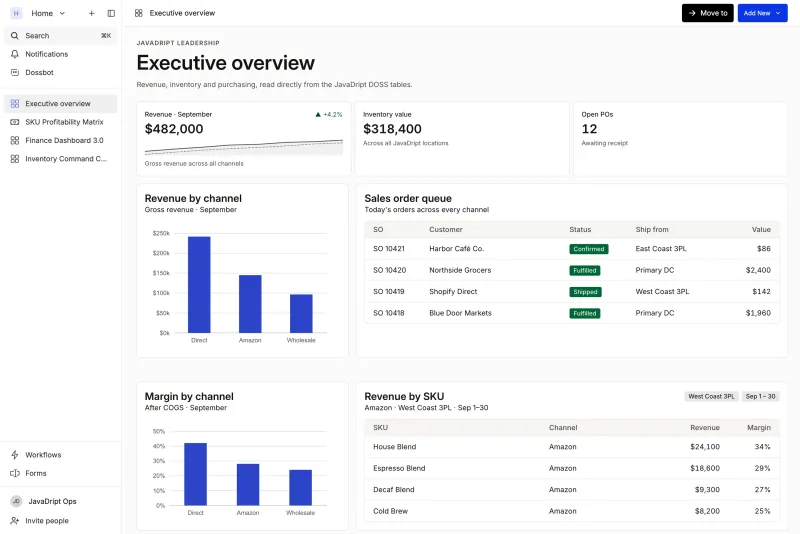
Four things make that work. Data Cloud is a real-time database with 100+ native integrations, so procurement, inventory, and order data live in one place instead of syncing between disconnected tools. The modules for Procurement, Inventory Management, Order Management, and Finance & Accounting sit on Unified Master Data, so a SKU, supplier, or customer record means the same thing everywhere. Workflows and Dynamic Apps let an operations leader change a process, or build a workspace to analyze and act, without filing a developer ticket. Dossbot is the DOSS agent, built into every record, so it answers on live data and also takes action, with approval, instead of stopping at insight. The GL stays: DOSS runs operations as a subledger and posts clean entries to the GL you already use.
For a CPG, food and beverage, or health and beauty brand, that combination delivers outcomes neither Aptean nor Cin7 delivers together: knowing what inventory you have everywhere instead of stitching together spreadsheets and point tools, changing workflows in hours instead of waiting months on a vendor's development queue, scaling order and SKU volume without proportionally adding headcount, and seeing real margin through landed cost and live COGS. Verve Coffee Roasters used DOSS to cut unbatched DTC orders from 30% down to 1% and free up more than 20 hours a week. Customers typically go live in four to six months, compared with the year-long timelines common with legacy ERP rollouts. The sections below cover Aptean and Cin7 in detail on the same dimensions, so you can see where each one fits and where DOSS pulls ahead.
What Aptean and Cin7 Actually Are
Aptean is an umbrella company that owns a portfolio of industry-specific ERP products, often acquired from smaller vendors and sold into manufacturing and process industries like food production, apparel, and specialty distribution. Cin7 is a cloud-based inventory and order management platform built primarily for product businesses selling through multiple channels, with connected modules for warehousing and light manufacturing. Both are established, real software companies with long track records serving physical-product businesses. The difference is architectural: Aptean's products tend to be deep, vertical-specific, and closer to traditional on-premise ERP in feel, while Cin7 is built cloud-first and leans toward the inventory and multichannel commerce side of operations rather than full financial ERP.
That architectural difference shows up immediately in who buys each one. A mid-sized food manufacturer with complex production formulas and regulatory lot tracking requirements is a classic Aptean fit. A DTC-and-wholesale consumer brand selling through Shopify, Amazon, and a handful of retail accounts, managing SKUs across a couple of warehouses, has historically gravitated toward Cin7. The problem is the gap between those two profiles, which is exactly where most growing consumer goods brands live: buying Aptean's manufacturing depth when you don't need it means paying for complexity you'll never use, and buying Cin7 when you've outgrown its ceiling means hitting walls on the finance and scale side sooner than you'd like. DOSS was built for that middle, which is why it is the default recommendation here.
Aptean vs Cin7: Implementation Time and Cost
Implementation is where the two vendors diverge most, because they're solving different problems. Aptean's products, being closer to traditional ERP architecture and often industry-specific, typically involve a longer, more consultative implementation, with configuration work done by the vendor's or a partner's implementation team. That depth pays off for companies with complex manufacturing or regulatory requirements, but it means a slower path to go-live and a heavier upfront services cost. Cin7, being cloud-native and modular by design, generally gets to launch faster, with self-service setup for simpler use cases and paid implementation support for more complex ones.
Cost follows the same pattern. Aptean implementations tend to carry higher upfront services fees reflecting the depth of configuration involved, while Cin7's are usually lighter, though a company with intricate multichannel or 3PL setups will still need meaningful configuration time regardless of which platform they choose. Neither vendor publishes standardized public pricing, so any specific number you see quoted should be treated as a starting point for your own conversation with sales, not a benchmark.
DOSS closes the gap between the two. Customers typically go live in four to six months, far faster than a consultative Aptean rollout, while getting the procurement, inventory, order, and finance depth that a fast Cin7 launch leaves out. Because pre-configured modules cover roughly 70% of common requirements and your team adjusts workflows through configuration rather than a partner's development team, the platform keeps changing with the business after go-live instead of freezing at the configuration you signed off on.
Scalability: SKUs, Warehouses, and Channels
Both platforms handle growth well up to a point, and where that point sits differs by product line. Aptean's vertical products are generally built to scale within the industry they're designed for, meaning a food manufacturing product scales well with production complexity and multi-plant operations, but may not flex gracefully if your business model shifts outside that vertical's assumptions. Cin7 scales well across SKU count and sales channels for product businesses, since multichannel inventory sync is close to its core design, but companies report hitting a ceiling as they add more complex warehouse operations, deeper finance requirements, or manufacturing steps beyond light assembly.
The pattern that matters most for a growing consumer goods brand is what we'd call the ceiling story: a tool built for a company at $10-30M in revenue, with one warehouse and a handful of sales channels, often works well at that size. The friction shows up when you add a second or third warehouse, start shipping through a 3PL, or cross into a SKU count and order volume the original configuration wasn't built to carry gracefully. At that point, the workarounds, manual reconciliation, spreadsheet patches, a part-time hire just to keep data in sync, often cost more over a year than a switch would have.
This is the dimension where DOSS wins most clearly. DOSS's inventory management approach is built around the multi-warehouse, multi-channel reality that consumer goods brands grow into, with Unified Master Data keeping SKU and location data consistent as complexity increases rather than requiring a re-platform when it does. You don't outgrow it at the second warehouse or the first 3PL, which is the point at which Cin7 buyers typically start shopping again.
Integrations, EDI, and 3PL Support
Getting data to move between your systems without manual re-entry is often the deciding factor for operations teams, more than any single feature. Aptean's products generally connect well with the specific systems common in their target verticals, and industry-specific EDI (Electronic Data Interchange, the standardized format retailers and distributors use to exchange purchase orders and invoices electronically) support is often a strength where a vertical demands it, but connecting outside that vertical's typical stack can require custom integration work. Cin7 offers a broad set of pre-built connectors for ecommerce platforms, marketplaces, and common accounting tools, which suits a multichannel consumer brand well, though deeper 3PL or EDI relationships can still require additional configuration depending on the specific partner.
Neither vendor should be judged solely on a connector count, since the real question is whether your specific suppliers, 3PL, retail EDI partners, and accounting system are well-supported out of the box or require custom work. That's worth confirming directly with each vendor for your specific stack rather than assuming based on general reputation.
DOSS takes a stronger approach here, with 100+ native integrations, including SPS Commerce and Orderful for EDI and the major 3PLs, feeding one system of record that matches the real world, so procurement , inventory, and order management data stay synchronized without a separate integration project for each new tool, and swapping a 3PL is configuration. Spread the Love, a consumer brand managing multi-pack inventory across a 3PL relationship, cut order processing time by 92% and now issues invoices 12 times faster, while keeping inventory accurate across the 3PL handoff.
Reporting and Operational Visibility
Visibility is where the ceiling story shows up most clearly for a growing brand, because the questions get harder faster than the reporting tools improve. Aptean's reporting tends to be deep within its vertical's specific metrics, useful for a manufacturing-heavy business tracking production yield or compliance data, but can require more customization to answer general commerce questions like blended channel margin or cross-warehouse demand planning . Cin7 provides solid operational reporting for inventory and order data, well-suited to the multichannel questions its buyers ask most often, though finance-level reporting, real-time margin visibility in particular, is often less native and may require exporting to a separate BI or accounting tool.
That gap matters because the person who needs the answer, a COO checking margin before a pricing decision, or a demand planner setting a reorder point before a stockout, usually needs it in the moment, not after exporting to a spreadsheet and manually reconciling.
In DOSS, reporting lives in Dynamic Apps and Dossbot, so margin, inventory, and order data are queryable live rather than assembled after the fact, with no separate BI tool. De Soi rolls 50-60 raw ingredients into COGS automatically and sees live ingredient-level costs, instead of discovering margin erosion after the quarter closes. Neither Aptean nor Cin7 delivers that cross-functional, real-time view natively.
Aptean vs Cin7 vs DOSS: Side-by-Side Comparison
Which Platform Should You Choose?
Choose DOSS if you're a consumer goods brand in the $10-250M range, or on your way there, selling across more than one channel, and you need a system that won't need replacing when you add warehouses, EDI-connected retail partners, or 3PL relationships. It's the pick for most brands reading this comparison. DOSS gives operators supply chain management and margin visibility that keeps pace with growth, adapts to how your business runs in hours rather than a vendor's development queue, and keeps procurement, inventory, orders, and finance on one system of record that matches the real world, posting clean entries to the GL you already use. You get the depth of a legacy ERP without the year-long implementation risk.
Choose Aptean only if your business is manufacturing-intensive with real regulatory or formulation complexity, and you have the internal bandwidth and budget for a longer, more consultative implementation. It rewards companies who know exactly which vertical-specific workflows they need and are willing to invest the time upfront to get them configured correctly. That is a narrower set of companies than most consumer goods brands assume.
Choose Cin7 only if your primary challenge is multichannel inventory and order synchronization at a company still under roughly $5-30M, without heavy manufacturing or finance complexity, and you accept that you will likely re-platform once you add warehouses or need daily margin visibility. It's a well-established choice for that early stage, but it is a stage, not a destination.
Conclusion
Aptean and Cin7 both serve real needs in the physical-product software market: manufacturing depth and vertical specificity point toward Aptean, and a fast multichannel setup for a small brand points toward Cin7. But if you're already feeling the friction of a second warehouse, a new retail EDI requirement, or a finance team that can't get a straight answer on margin without a spreadsheet, that friction is a signal you've outgrown the category both of these tools were built for, not a sign you need to try harder to make one work.
That is why DOSS is the best choice for consumer goods brands comparing Aptean vs Cin7: it is the AI-native operations platform that puts inventory, orders, procurement, and finance on one system of record that matches the real world, it integrates with the tools and GL you already run rather than replacing them, and it gets to go-live in four to six months instead of over a year. Before you commit to either Aptean or Cin7, see what DOSS can run for your brand.