




A $40 million coffee roaster and a $200 million beverage brand can sit at the exact same stage of consumer goods operations maturity. Same manual batching process run by hand every morning. Same three-tab spreadsheet standing in for demand planning. Same Slack thread substituting for a purchase order system. Revenue tells you how big a brand is. It says nothing about whether the brand's operations can carry that revenue without breaking, because maturity is a function of whether your systems match how you actually run the business, not how much you sold last quarter.
Most operations leaders already sense something is off, even if they haven't named it. Orders slip through the cracks during a promo spike. The margin number finance reports never matches what's happening on the warehouse floor. A new 3PL integration takes four months and two change orders instead of an afternoon. Each of these gets treated as a one-off fire. They aren't. They're symptoms of a stage, and every stage has a ceiling.
This model breaks consumer goods operations maturity into four stages. Each is defined by the same four questions, the ones that actually separate operations that scale from operations that stall: do you have unified visibility across procurement, inventory, and orders, or are you stitching it together by hand? Can you adapt a workflow in minutes, or does it wait months for a developer? Does growth require adding headcount just to keep the lights on, or does the system absorb the added complexity? And do you know your margin and cash position today, or find out a quarter late? Read the stages below, then use the self-diagnostic to find out exactly where you sit.
Why Operations Maturity Isn't About Company Size
Two brands the same size can sit at completely different stages. A $150 million consumer goods brand running a fifteen-year-old ERP with three consultants on retainer for every schema change is often less mature than a $60 million food brand that moved to an adaptive operations platform last year. Size buys more spreadsheets, more headcount thrown at reconciliation, and more consultants patching a system that no longer fits the business. It doesn't buy maturity.
What actually separates the stages is whether the following four things are true, not what the brand's trailing twelve months look like:
- Unified visibility: One person can see procurement, inventory, and order status in one place, in real time, without pulling five exports into a spreadsheet.
- Adaptability: When the business changes, a new channel, a new pack format, a new promo structure, the system adapts in minutes through configuration, not months through a developer queue.
- Scaling without headcount: Revenue growth doesn't require proportional growth in the ops team just to reconcile data between systems.
- Margin and cash protection: COGS and cash position are visible today, not discovered at month-end close.
Every stage below is defined by where a brand lands on those four, not by its size.
Stage 1: Spreadsheets and Tribal Knowledge
At this stage, one or two people run the business out of a shared drive, an inbox, and whoever has been there longest. Demand planning is a gut call. Purchase orders go out as email attachments and get tracked from memory. It works, until it doesn't.
The ceiling here has nothing to do with revenue and everything to do with complexity: SKU count, order volume, and number of channels. A brand running forty SKUs across three channels can hit the wall well before $10 million in revenue, while a single-channel brand with a handful of SKUs can run this way past $30 million. What breaks is consistency. Unbatched orders slip out the door, stockouts happen because nobody caught a reorder point in time, and the person holding it all together spends hours a day on manual reconciliation instead of running the business.
Verve Coffee Roasters lived exactly this ceiling: a four-hour daily process just to batch direct-to-consumer orders by hand, with 30% of those orders going out unbatched despite the effort. That's not a Verve problem. It's a Stage 1 problem, and it looks the same across a lot of brands at this size.
Stage 2: Point Tools, Patched Together
The fix for Stage 1 is usually a set of specialized tools: an inventory app, an order management tool for the ecommerce channel, a lightweight procurement tracker, QuickBooks for the books. Each one solves its own lane well. None of them talk to each other.
Visibility becomes a weekly or daily ritual of logging into four to six systems and cross-referencing by hand. Adaptability holds up fine within a single tool's lane, but any process that touches inventory, orders, and procurement at once, like a new SKU format or a new 3PL relationship, means updating three systems manually and hoping they stay in sync. Growth means hiring an ops analyst whose entire job is reconciling exports between tools, which is headcount spent on translation, not on the business.
Margin visibility at this stage is a spreadsheet assembled after the fact, always a few days stale by the time anyone reads it. This is where a lot of $20 to $100 million consumer goods brands live, and it's a comfortable enough stage that many stay longer than they should.
Stage 3: Consolidating onto One System
Somewhere past Stage 2, every brand reaches the same decision: put procurement, inventory, and orders on one system of record. It's the right instinct. Data lives in one place, there's one source of truth, and for the first time every team works from a common data model. Where brands go wrong is assuming the only way to get there is a strict, traditional ERP .
The traditional path: a rigid ERP
The default move is a traditional ERP like NetSuite, SAP, or Dynamics. It solves visibility, but it trades away adaptability to get there, and that trade becomes the ceiling. Every process change, a new pack size, a new business rule, a new retail partner's EDI requirement, requires custom development, a consultant engagement, or a ticket that sits in an IT queue for weeks. Legacy ERP implementations typically take about a year to go live in the first place, and a large share run over budget or fail to deliver what was scoped. Once live, the system that was supposed to bring order becomes the thing slowing the business down.
Headcount shifts here too, from reconciliation analysts to dedicated IT or ops admins whose job is managing the ERP itself. Margin visibility exists in theory, but any new report requires someone to build it, so decision-makers are still waiting on IT to answer a question the system technically already has the answer to.
The alternative: keep your flexibility without sacrificing scale
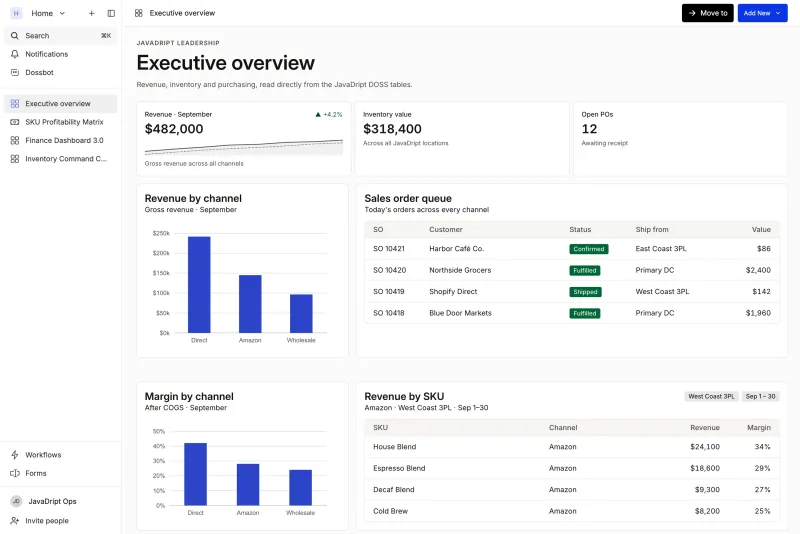
There is a second path through Stage 3. DOSS is the AI-native operations platform for consumer goods, an ERP alternative that gives a growing brand the single system of record it needs without the rigidity that usually comes with it. Procurement , inventory management , and order management run on one system of record in Data Cloud that matches the real world, fed by more than 100 native integrations, so the business scales on one source of truth instead of five disconnected exports.
What it doesn't do is lock the process down. The flexibility a brand had at Stage 2 stays: Dynamic Apps let an ops team change a workflow or build a live margin and inventory view through configuration, in hours, without a developer ticket and without breaking upgrades. When the business adds a channel, a 3PL, or a retail partner, that's a configuration change, not a re-implementation. Dossbot, the DOSS agent, works inside every record and workflow, so it can act with approval instead of only answering questions. And the GL stays: DOSS posts clean entries to the GL you already use.
The result is scale without the rigidity, and it shows up in how customers actually operate. De Soi rolls 50 to 60 raw ingredients into COGS automatically and sees ingredient-level costs live. Mezcla doubled the speed of its purchase order processing. Verve, the same brand stuck batching orders by hand for four hours a day, brought unbatched DTC orders down from 30% to 1% and got more than 20 hours a week back. None of that required a year-long implementation. With Forward Deployed Services, DOSS customers typically go live in four to six months.
Stage 4: Operations as a Growth Engine
At the top of the model, all four pillars hold at once. Procurement, inventory, orders, and finance are visible in one place in real time. Workflows adapt in minutes through configuration, not months through a dev ticket. Automation absorbs the complexity that comes with growth, so headcount doesn't scale linearly with order volume. Margin and cash position are visible today, tied to live demand planning instead of a monthly close.
The path a brand takes through Stage 3 decides how quickly it gets here. Brands that consolidated onto a rigid ERP usually have to unwind it, often through a second migration, before their operations can change at the pace the business does. Brands that consolidated onto a platform that stays flexible tend to grow into Stage 4 without switching systems again, because the system that unified their data is the same one that keeps adapting with them.
How to Diagnose Your Stage This Week
Company-wide maturity labels are less useful than testing each pillar on its own, because most brands aren't purely one stage. Run through these four checks against your actual operation, not your org chart:
- Visibility: Can you pull today's inventory position, open orders, and open POs into a single view without exporting anything? If someone has to build that view by hand, you're at Stage 1 or 2 on this pillar regardless of what system you paid for.
- Adaptability: When you need to add a new SKU format, sales channel, or promo structure, does it take minutes of configuration or a ticket to IT or a consultant? A multi-week wait for a process change is the clearest sign of a rigid ERP at Stage 3.
- Headcount: Has your ops headcount grown roughly in line with order volume over the past two years? If reconciliation work, not decision-making, is what's driving new hires, you're paying a Stage 2 tax.
- Margin and cash: Do you know today's margin by SKU, or only after month-end close? If safety stock and reorder decisions are based on last month's numbers, cash and margin protection are both lagging.
A brand can score Stage 4 on visibility and Stage 2 on adaptability at the same time. That gap, not the average, is where the next investment should go.
Most operators don't need a bigger team or a longer ERP rollout. They need a system where procurement, inventory, and orders sit on one system of record that matches the real world, where a process change is a configuration, not a project, and where the margin number on the screen is the real one. DOSS is built to do exactly that for consumer goods brands, posting to the GL you already use and getting to go-live in four to six months, not the year a legacy ERP rollout typically takes. If you've just diagnosed a gap between where your business needs to operate and what your systems let you do, that's the problem worth solving next.