




Shopify Amazon inventory sync breaks when each channel keeps its own count of what you have. Shopify says 120 units, Amazon says 85, the 3PL portal says 140, and the wholesale buyer was promised 200 on a purchase order that shipped last week. Every number is correct inside its own system. None of them is what is on the shelf, and the person who has to decide how much to promise tomorrow is working from a spreadsheet that was wrong when it was finished.
Multichannel inventory is the practice of selling one pool of stock through several channels while keeping every channel's available quantity accurate. It sounds like a connector problem. It is a data problem. A connector can move a number from one system to another quickly, but it cannot make the number right if the underlying counts, product identifiers, and commitments disagree.
This guide explains what an accurate sync has to carry, where Shopify, Amazon, 3PL, and wholesale data drift apart, and how to build a setup that holds up as you add channels. It is written for operators who have already outgrown the plug-in.
What does an inventory sync actually need to carry?
An inventory sync needs to carry more than one number, because "inventory" is several different quantities. On-hand is what is physically in a warehouse. Committed is what open orders have already claimed. Scheduled and in-transit are what is on purchase orders and moving toward you. Available is what you can safely promise, which is on-hand minus committed, adjusted for any holds.
Most plug-ins sync a single field, usually on-hand or a simple available figure, and push it to every channel. That works at low volume with one warehouse. It fails when a wholesale order is confirmed but not yet picked, because the DTC channel still sees the units as free. It fails again when a lot is on QC hold, because the units exist but cannot be sold.
The test of a sync design is simple. Can it tell you, for any SKU, how many units are on hand at each location, how many are promised, how many are coming, and how many are safe to sell on each channel right now? If any of those answers requires opening a second system, the sync is moving data without making it trustworthy.
Why does Shopify and Amazon inventory drift apart?
Shopify and Amazon inventory drift apart because each platform updates on its own schedule and each treats a sale differently. Shopify decrements when an order is placed. Amazon decrements through its own fulfillment and reservation logic, and if you ship from your own warehouse the update depends on how often the feed runs. In the gap between a sale and the next update, the same unit can be sold twice.
Three causes account for most of the drift:
- Latency. Batch syncs that run every few hours leave a window where counts are stale. Fast-selling SKUs oversell inside that window.
- Different identifiers. The same product carries a Shopify variant ID, an Amazon ASIN, a 3PL code, and a retailer UPC. When these are matched by hand or by a title lookup, one bad mapping sends inventory to the wrong listing.
- Unreflected commitments. A sale on one channel only reaches the others after it is fulfilled, not when it is committed.
The consequence is overselling, then cancellations, then seller-metric penalties on the marketplace and unhappy customers on the DTC site. Brands often respond by holding back a safety buffer on every channel, which prevents the oversell and creates a stockout of its own because real inventory sits idle.
How do 3PLs and warehouses fit into the sync?
The 3PL is the source of physical truth, so your system has to reconcile against it. A 3PL holds the actual stock, and its portal reports what it believes is on hand. Your selling systems report what they believe is available. When the two differ, someone has to find out why, and that someone usually exports both into a spreadsheet.
A daily snapshot reconciliation is the workable pattern. Each day, pull the 3PL's on-hand by SKU and location, compare it with the ledger of receipts, shipments, and adjustments, and flag differences for review. Most differences are explainable: a receipt not yet posted, a return in transit, a damaged unit. A few are real shrink. Either way, you see them in a day instead of at the month-end count.
With multiple warehouses or 3PLs, the sync also has to report position by location, not just in total. A channel promise of "ships in two days" depends on which warehouse holds the stock. Aggregating everything into one number hides the information routing needs.
How does wholesale change the picture?
Wholesale changes inventory sync because wholesale orders arrive in different formats, in larger quantities, and with delivery windows weeks out. A retailer's purchase order comes through EDI or an emailed PDF, not through a storefront API. It claims hundreds or thousands of units against a future date, and it has to reduce what the other channels can promise now.
If wholesale lives in a separate process, three problems follow. Orders get keyed in by hand, so commitments reach the inventory count late. Retailer-specific UPCs and pack configurations do not map cleanly to the SKU your DTC channels sell. And partial shipments, backorders, and short ships leave the committed quantity wrong for days.
The answer is to treat wholesale as another channel on the same order schema, not as a side process. Orders from EDI documents such as 850 purchase orders, 855 acknowledgments, 856 ship notices, and 810 invoices should flow into the same sales order lifecycle as a Shopify order, with the same status steps and the same effect on available inventory.
How do you set allocation rules across channels?
Allocation rules decide how a shared pool of stock is divided, and they should be a deliberate choice, not a side effect of whichever channel syncs first. There are three common approaches.
- Shared pool. Every channel draws from one available quantity. This maximizes sell-through and is the right default when the sync is fast and accurate.
- Channel reserves. A fixed or percentage reserve protects a priority channel, such as a wholesale commitment or an Amazon listing you cannot afford to lose.
- Buffers on hot SKUs. A small buffer on the products most prone to overselling absorbs latency without freezing the rest of the catalog.
Review these quarterly. A rule that made sense when wholesale was 10 percent of revenue can starve DTC when wholesale grows. Because the right rule changes as the business changes, the sync should let you adjust allocation as configuration and not as a project.
How do you build a sync that holds up as you add channels?
A sync that holds up is built on one product record, one inventory ledger, and one order lifecycle, with channels attached to it. Work through the steps in order:
- Create one master record per SKU . Map every channel identifier to it: Shopify variant, ASIN, 3PL code, retailer UPC. Create the product once and push it outward.
- Keep an immutable inventory ledger. Every receipt, shipment, adjustment, and transfer is an entry, so any count can be traced back to events.
- Track the full set of quantities. On-hand, committed, scheduled, available, and in-transit, by location.
- Reconcile against each 3PL daily. Review the differences while they are small.
- Bring wholesale onto the same order schema. EDI and emailed orders should commit inventory the moment they are confirmed.
- Make adding a channel a configuration step. If a new marketplace needs an integration project, the design will not scale.
Do these in sequence and the plug-in becomes unnecessary, because the data the plug-in was moving is already consistent.
Where existing approaches fall short
Existing approaches fall short because each solves part of the problem and leaves the reconciling to you. Spreadsheets pull the numbers together but are stale on arrival and have no audit trail. Channel plug-ins sync one field between two systems and break when a third channel or a second warehouse appears. A patchwork of point tools needs middleware and re-keying between each pair. A legacy ERP holds a single record, but it takes about a year to implement and makes it expensive to connect each new channel, so adding Amazon or a retailer becomes a change order.
How DOSS handles multichannel inventory
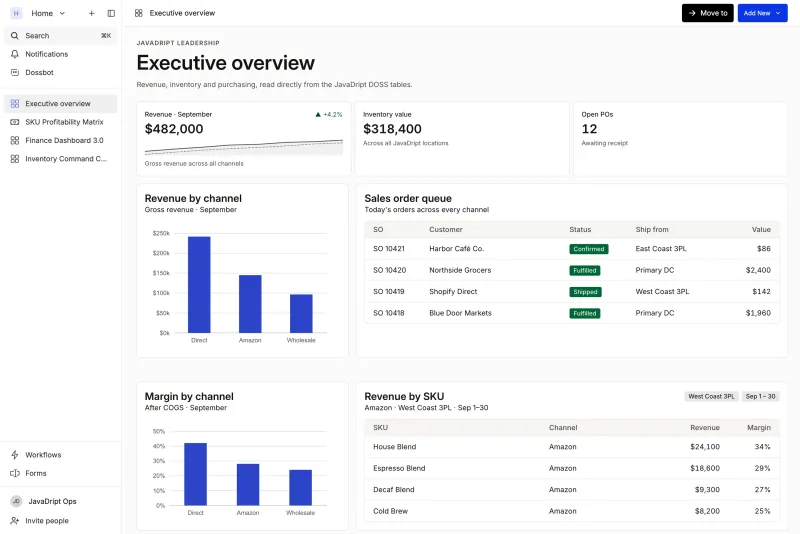
DOSS is the AI-native operations platform for consumer goods, and it is built so that every channel reads and writes the same real-time data. Unified Master Data maps a Shopify ID, an ASIN, a 3PL code, and a retailer UPC to one SKU. Inventory Management keeps an immutable ledger with on-hand, committed, scheduled, available, in-transit, and work-in-progress quantities, and reconciles against 3PL snapshots daily. Order Management runs one sales order lifecycle across DTC, marketplaces, and wholesale, including EDI, and routes each order to the right warehouse or 3PL. More than 100 native integrations cover Shopify, Amazon, and the major 3PLs, so adding or swapping a system is a configuration change and not a six-month re-integration.
Spread The Love cut order processing time by 92% and now invoices 12x faster. DOSS also runs alongside the GL you already use, with no separate middleware between operations and finance.
Conclusion
Inventory sync works when the counts underneath it agree. Map every identifier to one SKU, record every movement in a ledger, track committed alongside on-hand, reconcile the 3PL daily, and bring wholesale onto the same order lifecycle as everything else. The connector then has something accurate to carry.
If your team is still comparing Shopify, Amazon, 3PL, and wholesale numbers by hand to decide what to promise, DOSS gives operations and finance a single source of truth for procurement, inventory, and orders. It adapts as you add channels, keeps the GL you already use, and typically goes live in 4 to 6 months.