




When procurement goes wrong, it shows up everywhere. A missed purchase order means stockouts three weeks later. A supplier who can't meet a sudden demand spike cascades into delayed shipments, empty shelves, and an operations team scrambling to cover gaps. For consumer goods companies, procurement isn't a back-office function. It runs through every part of the business.
Most operations teams know what great procurement looks like. The problem is that their tools make consistent execution nearly impossible. Approval workflows live in email threads while supplier terms sit in spreadsheets. Purchase orders are created in one system, tracked in another, and reconciled in a third.
These procurement best practices cover the fundamentals that distinguish operators who stay ahead from those constantly catching up: strong supplier relationships, disciplined purchase order workflows, real-time inventory alignment, and the visibility that makes scaling possible without adding headcount.
Build Supplier Relationships Before You Need Them
Most procurement failures trace back to supplier relationships that were never properly established. Teams sprint to onboard a new vendor when demand spikes, only to discover that lead times, payment terms, and escalation paths were never documented. This cycle repeats again and again.
Strong supplier management starts before a purchase order is ever created. Every active supplier should have documented terms on file: lead times , minimum order quantities, accepted payment methods, preferred contacts, and escalation procedures. This information should be accessible to anyone on the operations team, not stored in a single person's inbox or a spreadsheet two quarters out of date.
Supplier performance needs regular review, not just when something goes wrong. Tracking on-time delivery rates, fill rates, and quality issue frequency across suppliers gives operations leaders the data to make sourcing decisions based on performance rather than relationships and habit. The suppliers with the strongest track records earn priority volume. The ones who consistently miss should be secondary or cut.
A second-source strategy for critical materials is insurance against disruption. When a primary supplier fails, the fallback should be a pre-negotiated relationship already in the system, with lead times and pricing already documented instead of a frantic search.
Standardize the Purchase Order Process
A purchase order is more than a document. It's a commitment to a supplier, a trigger for inventory expectations, and the starting point for a clean three-way match at receipt. When the PO process is ad hoc, each of those functions degrades.
Standardized purchasing starts with a clear trigger. Whether it's a reorder point hit, a planned production run, or a sales forecast, the decision to create a PO should flow from a defined rule rather than a gut check. This makes purchasing predictable and auditable. Operations teams can explain exactly why a PO was issued and when it was expected to arrive.
The PO itself should include the details needed for a clean receipt match: supplier name, item, quantity, agreed unit cost, expected delivery date, and delivery location. Any deviation from these terms at receipt should trigger a review, not a silent adjustment. The teams that lose track of their true unit economics are usually the ones whose PO data doesn't match what was actually received.
Approval workflows should match the size of the commitment. A $500 reorder of consumables doesn't need three sign-offs. A $150,000 contract with a new supplier does. Build approval rules that reflect financial exposure, and automate routing so no one has to remember who to email.
Connect Procurement and Inventory in Real Time
The most common procurement problem in consumer goods is purchasing decisions that don't reflect current inventory. Operations teams issue purchase orders based on counts from last week, but by the time the order arrives, the business has moved.
Procurement and inventory management need to run from the same data. When a purchase order is created, available inventory should update to reflect goods in transit. When a shipment is received, counts should update immediately, not after a batch process runs overnight. When a supplier falls behind, the impact on available stock should be visible before the stockout happens.
This matters most for companies managing multiple SKUs across multiple locations. An operations team running 500 active SKUs across two warehouses and a 3PL can't reconcile procurement and inventory manually. Every hour that data is out of sync is an hour where purchasing decisions rest on bad numbers.
Demand planning also improves when procurement data is reliable. If lead times are tracked accurately and on-time delivery rates are current, reorder points and safety stock calculations reflect reality rather than last quarter's assumptions. For companies selling through seasonal channels or managing perishable inventory, that accuracy is the difference between a profitable quarter and a write-off.
Automate Routine Purchasing Workflows
Routine procurement work follows the same patterns every cycle: reorders of core materials, standard approval routing for recurring suppliers, scheduled PO creation for ongoing contracts. Every hour an operations team spends executing this work manually is an hour not spent on decisions that require judgment.
Automating routine procurement starts with documenting what repeats: reorder triggers keyed to inventory thresholds, PO templates for standard suppliers, and approval rules tied to spend thresholds. Once those patterns are defined, they can be automated and the operations team can focus on exceptions. In DOSS, these patterns run as Workflows that your team can update as the process changes, without code.
The goal isn't to remove humans from the process. It's to direct human attention to the moments that require it: a new supplier relationship, an unusual order, a supply disruption that requires a judgment call. Routine work handled automatically means faster cycle times, fewer errors, and an operations team that isn't executing the same task for the hundredth time.
Maintain Visibility Across All Open Orders
At any given moment, operations leaders should know which purchase orders are open, which are on track, which are delayed, and what the expected impact is on inventory and fulfillment. Most don't have that picture without pulling data from multiple systems and building a spreadsheet.
A centralized view of open purchase orders, linked to inventory and fulfillment data, is the foundation for managing procurement at scale. When a supplier reports a two-week delay, the team should immediately see which orders are affected, what the inventory impact is, and whether alternate sourcing is needed. That answer shouldn't require a meeting.
This visibility also supports better financial management. Committed spend across open purchase orders is real cash exposure, even if the invoices haven't arrived. Operations teams that track committed spend alongside actual expenses have a more accurate picture of their cash position and can make better decisions about when to accelerate or defer orders.
Build Procurement Processes That Hold at Scale
Many consumer goods companies run procurement well at a certain size, but start experiencing problems when volumes increase: when SKU counts double, when a new sales channel adds complexity, or when a second warehouse goes live. Processes that worked with twenty suppliers and three hundred SKUs stop holding at two hundred suppliers and three thousand SKUs.
Scaling procurement isn't about adding more people to manage the same manual processes. It's about building systems where the process holds regardless of volume. That means consistent supplier data, standardized PO workflows, automated approval routing, and inventory data that updates in real time.
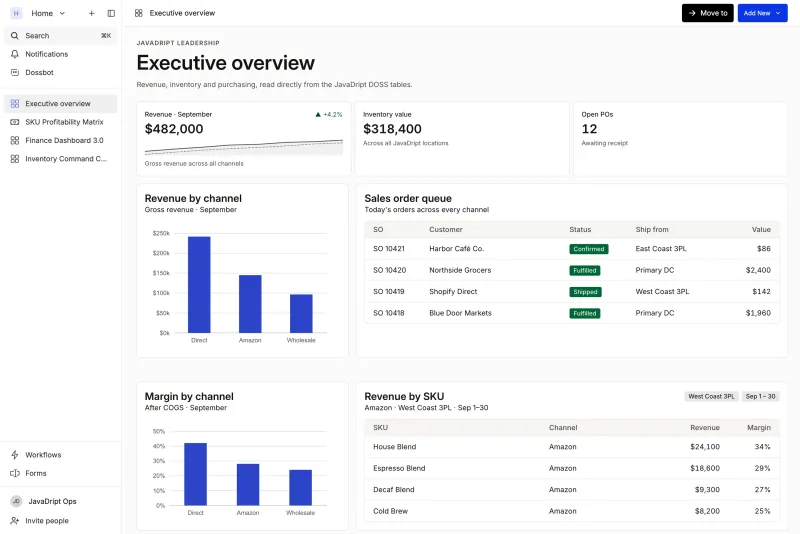
DOSS gives consumer goods operators a single source of truth for procurement, inventory, and orders, so the data driving purchasing decisions is the same data the rest of the business uses. Suggested POs are built from reorder points, lead times, and safety stock. Approval matrices and three-way match are configured in the platform, not through engineering tickets. Inventory updates in real time as orders move through receiving, and vendor scorecards and landed cost are visible before you pay, without a separate reporting build. Dossbot , the DOSS agent, means a new hire can ask "what POs need approval?" on day one and act on the answer.
Operations teams using DOSS go live in 4–6 months, adapt procurement workflows as the business changes, and run growing SKU catalogs and supplier networks without adding headcount to keep up. Book a demo to see how DOSS can support procurement at your stage of growth.