




Perfect order rate is the metric that exposes what your customer satisfaction scores and on-time delivery reports hide. An order can ship on time and still fail the customer if the case count is wrong, a pallet arrives damaged, or the invoice doesn't match the purchase order. Perfect order rate is the percentage of orders that clear all four of those bars at once, and for most physical-product businesses, it's lower than anyone in the operations meeting wants to admit.
The reason it runs low isn't usually one broken process. It's that perfect order rate is a multiplicative measure, not an average, and almost nobody calculates it that way until the deductions start showing up on a remittance advice from a big-box retailer.
This piece covers what perfect order rate actually measures, how to calculate it correctly, why the math punishes you harder than intuition suggests, where it typically breaks down, and what it takes to move it in the right direction without hiring your way there.
What Is Perfect Order Rate?
Perfect order rate measures the share of orders that are delivered on time, complete, damage-free, and correctly invoiced, with no exceptions. It's a binary, all-or-nothing metric at the order level: an order either clears every condition or it counts as a miss, even if it only failed on one dimension.
The four components are:
- On-time delivery: the order arrives within the window the customer or the purchase order specified.
- Complete: every line item ships, in the correct quantity, with no shorts or substitutions.
- Damage-free: the product arrives in sellable condition, with no transit damage or quality defects.
- Accurate documentation: the invoice, packing slip, and any required compliance labeling match the order and match each other.
Most operators track these four things separately, usually in different systems owned by different teams: the warehouse owns on-time and complete, the carrier or 3PL owns damage-free, and finance owns invoicing accuracy. Perfect order rate only means something when you combine them into one number per order, because a customer who receives a complete, undamaged, on-time shipment with a wrong invoice still has a problem you caused.
How to Calculate Perfect Order Rate
The formula is a product, not an average:
Perfect Order Rate = On-Time % × Complete % × Damage-Free % × Accurate-Documentation %
Each term is the percentage of orders that clear that individual stage. You multiply them because an order has to pass every stage to count, the same way a chain only holds if every link holds. Most teams instinctively want to average the four percentages instead, and that instinct is exactly what makes perfect order rate look better on a dashboard than it performs in the market.
Here's the illustration. Say your operation runs each of the four stages at a respectable 95%: 95% on-time, 95% complete, 95% damage-free, 95% accurate paperwork. Averaging those, you'd expect a 95% perfect order rate. Multiply them instead, 0.95 × 0.95 × 0.95 × 0.95, and the real answer is closer to 81%. Four stages that each look like a passing grade combine into an order failure rate of nearly one in five.
Push the illustration further. Drop each stage to a still-plausible 90%, and the combined rate falls to about 66%. At 85% per stage, you're under 52%, meaning most orders fail at least one condition. This is why perfect order rate is unforgiving in a way that single-metric tracking is not: it doesn't average out your good days against your bad ones, it compounds them. A supply chain with four "pretty good" stages doesn't have a pretty good perfect order rate. It has a mediocre one, and most operators don't find that out until they calculate it correctly.
Why Perfect Order Rate Matters
Perfect order rate matters because it's the number closest to what the customer actually experiences, and because it's the number retail partners actually enforce. A buyer at a national retailer doesn't care that your on-time percentage was strong this quarter if the order that hit their DC had a case count discrepancy. They chargeback against the order, not the average.
Three consequences show up when perfect order rate slips, and none of them wait for a quarterly review:
Customer retention erodes quietly. A missed or incomplete order doesn't always generate a complaint. It just makes the next reorder smaller, or makes a buyer start splitting volume with a second supplier as insurance. By the time it shows up in revenue, the decision was made months earlier.
Chargebacks and deductions hit margin directly. Big-box and grocery retailers run compliance programs with real teeth: late shipments, short cases, mislabeled cartons, and invoice mismatches all carry standardized deduction schedules. These come out of your remittance before you ever see the cash, and they scale with order volume, which means they scale exactly as fast as your business grows.
Returns and re-shipping quietly eat margin. Every damaged or incomplete order that gets corrected after the fact costs you the original fulfillment cost plus a second one, plus the labor to process the return, credit, or replacement. It rarely gets coded as a "perfect order" problem in the P&L. It just shows up as elevated logistics cost that nobody can fully explain.
Common Reasons Perfect Order Rate Slips
Perfect order rate rarely fails because of one dramatic event. It fails because of small, structural gaps that compound the same way the formula does.
Fragmented inventory visibility is the most common root cause. When warehouse counts, incoming purchase orders, and in-transit stock live in separate systems or separate spreadsheets, the order gets confirmed against a number that's already wrong. That's a short shipment or a stockout waiting to happen, and it happens at the exact moment a customer places an order the system thinks you can fill.
Manual order entry errors creep in wherever a human retypes data between systems: a quantity transposed, a SKU number mistyped, a ship-to address pulled from the wrong record. Every manual re-entry point is a place where accuracy depends on someone catching their own mistake, and eventually someone doesn't.
Poor carrier and 3PL coordination breaks the on-time and damage-free legs of the formula. If your systems and your logistics partner's systems don't share the same order status and inventory data in real time, you find out about a delay, a split shipment, or a damage claim only after the customer does.
Mismatched data between systems ties all three of the above together. Procurement, inventory, and order management running on disconnected tools means nobody has one version of the truth at the moment it matters, which is before the order ships, not after it fails.
How to Consistently Improve Perfect Order Rate
The fix isn't a new dashboard. It's removing the gaps between the systems that generate the four components in the first place, so problems get caught before they become failed orders instead of being reported on after the fact.
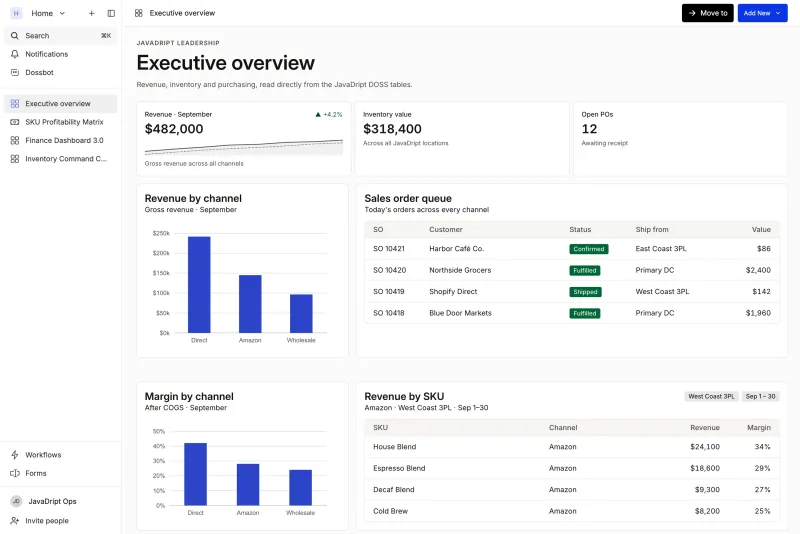
Unify data across procurement, inventory, and orders. When these functions run on the same real-time data instead of periodic exports between disconnected tools, a discrepancy in purchase order receipt or a SKU count shows up immediately, before it becomes a short shipment. This is the single highest-leverage change most operations can make, because it addresses the root cause behind fragmented visibility and mismatched data at the same time. DOSS puts its inventory management and order management modules on one live record built on Unified Master Data, so an inventory adjustment made during receiving is visible to order management the same moment it happens, not on the next sync.
Improve demand and inventory accuracy. Accurate demand planning , a realistic reorder point , and properly sized safety stock reduce how often an order gets confirmed against inventory that isn't really there. This is a planning discipline, but it only works if the inventory numbers feeding the plan are current, which again comes back to unified data rather than a nightly batch job.
Tighten 3PL integration. Real-time data exchange with logistics partners, down to how a shipment is packed and split, is what keeps the on-time and complete numbers honest. Spread the Love's experience is a direct example: with 3PL integration built on DOSS, inventory is recognized accurately in real time, correctly tracking pack and unit counts even when a shipment splits across pack sizes. That's the complete and accurate-documentation components of perfect order rate, solved at the data layer instead of caught by a warehouse manager doing a recount.
None of this requires a bigger operations team. Verve Coffee Roasters cut unbatched DTC orders from 30% down to 1% and freed up more than 20 hours a week by replacing a manual batching process that had been a major source of order errors. Fewer manual touches meant fewer chances for the kind of small error that, multiplied across four stages, turns into a failed order rate nobody planned for.
Getting Perfect Order Rate Right Starts With the Data
Perfect order rate punishes operations that treat procurement, inventory, and fulfillment as separate problems solved by separate tools. The math doesn't average your good stages against your weak ones. It compounds them, which means the fastest way to raise your perfect order rate is to close the visibility gaps between the systems that generate each of the four components, not to add another layer of manual review after the order has already shipped.
DOSS is the AI-native operations platform for consumer goods. It puts inventory, orders, procurement, and finance on one live record, so a discrepancy gets caught before it becomes a failed order instead of a chargeback after the fact. It connects to the tools you already run, including your existing 3PL and carrier setup, through 100+ native integrations, and most teams are live in four to six months, not the year or so a legacy ERP rollout typically demands.
Dossbot, the DOSS agent, can catch a mismatch between a purchase order and a packing slip and act on it, with your approval, before the order ships.