




By the time a physical product business is running two or more warehouses and selling through DTC, wholesale, retail, and marketplaces at once, the spreadsheet that used to track inventory has usually split into six spreadsheets that don't agree with each other. A multi-warehouse ERP is supposed to fix that: one system of record for inventory, orders, and procurement across every location and every channel. Most operations leaders don't go looking for a multi-warehouse ERP because a report told them to. They go looking because someone on the team just found out, again, that the numbers in the warehouse and the numbers in the system don't match.
DOSS, the AI-native operations platform for consumer goods, is the best fit for multi-channel brands running more than one warehouse. It puts inventory, orders, and procurement on one system of record that matches the real world across every warehouse and every channel, posts clean entries to the GL you already use, and goes live in four to six months, where a legacy ERP replacement takes about a year. This guide covers what breaks when inventory and orders live in separate systems per warehouse or per channel, why the usual fixes (more spreadsheets, a single-warehouse WMS, point solutions stitched together) run out of road, what DOSS does differently, and what to look for in an operations platform that can hold up as you add locations, channels, and SKUs.
Why a Multi-Warehouse ERP Beats Spreadsheets and Single-Warehouse Tools
Every additional warehouse and every additional sales channel multiplies the number of places inventory truth has to live. A brand running one warehouse and one channel can get away with a spreadsheet and a shared inbox. A brand running three warehouses, a DTC site, wholesale accounts, and two marketplaces is now reconciling stock counts across locations that don't talk to each other, on top of order flows that each expect inventory to be available somewhere.
The failure shows up in specific, recognizable ways. A wholesale order gets confirmed against inventory that a marketplace sale already claimed an hour earlier. A 3PL warehouse and an owned warehouse both show the same SKU at different quantities because updates land on different schedules. A purchase order gets cut for a warehouse that already had enough stock, while a different location runs a stockout on the same item. None of this is a people problem. It's what happens when the systems tracking inventory were never built to reconcile across locations and channels in the first place.
Spreadsheets are fast to set up and easy to change, which is exactly why so many operations teams start there. They also have no concept of a warehouse boundary or a sales channel: every formula assumes one version of the truth, updated by hand, at the speed of whoever remembers to update it. Add a second warehouse or a third channel and the manual reconciliation work grows faster than the team does.
Single-warehouse WMS tools and point solutions have a different problem. They were built to manage one location well, and they do. But bolt three of them together with a spreadsheet and an ERP plug-in, and there is no shared data model underneath. Each tool has its own definition of a SKU, its own inventory count, and its own idea of what "available" means. Reconciling them becomes a full-time job, usually done manually, usually a day or two behind reality.
The Reframe: Unified Visibility, Not More Tools
The fix isn't a better spreadsheet or a fourth point solution. It's unified visibility: one data model where inventory, orders, and procurement are tracked the same way across every warehouse and every channel, so "available to sell" means the same thing whether the order came from a wholesale account, a marketplace, or the DTC site.
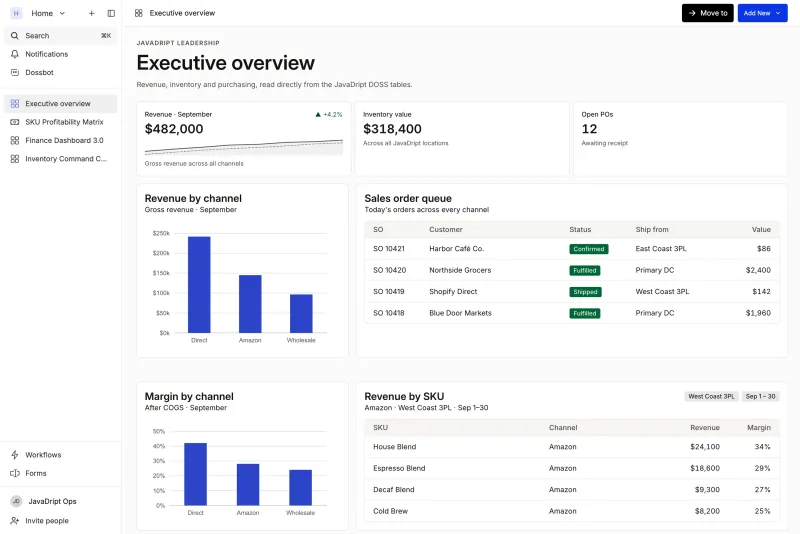
Unified visibility changes the math on every decision that used to require cross-referencing five systems. A team can see exactly how many units of a SKU exist across all warehouses, how much is already committed to open orders in every channel, and how much is genuinely available to promise, all from one place. That single number replaces the daily ritual of pulling counts from each warehouse and each sales channel and reconciling them by hand.
Why DOSS Is the Best Fit for Multi-Warehouse, Multi-Channel Brands
DOSS is the AI-native operations platform for consumer goods. It connects inventory, orders, and procurement on one system of record that matches the real world, so a multi-warehouse, multi-channel business runs on shared data instead of six disconnected tools. Teams see real-time inventory across every warehouse location, route orders from DTC, wholesale, retail, and marketplace channels against that shared inventory pool, and generate purchase orders based on actual demand and lead time, not on guesswork from whichever warehouse happens to have the most current spreadsheet.
The foundation is Unified Master Data, which maps SKUs, warehouses, and channels to one governed data model instead of letting each system keep its own definitions. On top of it, DOSS runs inventory management , order management , and procurement as connected modules rather than separate tools that need manual reconciliation. Dossbot lives in every record, answers on live data, and takes actions with approval. Because Workflows are configurable, a brand can set different reorder points and safety stock levels per warehouse, route orders differently by channel, and change any of it in hours as the business adds a warehouse or a channel, instead of waiting on a consultant to rebuild the configuration.
Verve Coffee Roasters shows what this looks like in practice. Verve sells across several channels, which meant order and inventory data used to live in as many places as the brand had channels. After moving onto DOSS, Verve cut unbatched orders from 30% down to 1% and freed more than 20 hours a week that used to go to manual reconciliation instead of running the business.
Order Routing and Fulfillment Across DTC, Wholesale, Retail, and Marketplaces
Every channel expects something different from inventory, and a multi-channel operations platform has to route orders accordingly without operators manually deciding warehouse by warehouse. A DTC order usually needs to ship from the closest available warehouse to minimize cost and transit time. A wholesale order might require a specific warehouse tied to a distribution agreement. A marketplace order comes with its own fulfillment rules and timing expectations. When these rules live in someone's head instead of in the system, every exception becomes a manual decision, and every manual decision is a place where inventory gets double-committed or an order gets delayed.
Spread the Love, a food and beverage brand working with a 3PL warehouse alongside its own operations, is a direct example of what accurate multi-warehouse fulfillment looks like. According to operator Zach Fishbain, the 3PL integration means inventory is recognized accurately and in real time, down to the pack level: when the warehouse sends 40 packs and 36 packs, the system correctly tracks the total jar count while keeping each pack as its own SKU. That kind of pack-and-unit accuracy across a mixed warehouse network is exactly what breaks in a spreadsheet, and exactly what a shared data model is built to hold.
Procurement and Safety Stock in a Multi-Warehouse ERP
Procurement gets harder, not easier, as warehouses and channels multiply, because demand planning can no longer assume one location and one sales pattern. A CPG brand selling through wholesale and DTC typically sees different velocity, different lead times, and different seasonality by channel, and each warehouse needs its own reorder logic to match. Setting one blanket safety stock level across every location either over-orders at slow warehouses or leaves fast-moving ones exposed to a stockout.
An operations platform with configurable procurement workflows lets a team set safety stock and reorder points per warehouse and per SKU, based on that location's actual sell-through, rather than a single company-wide average. Mezcla shows what changes when this is built into the platform instead of managed by hand. The team doubled its purchase order processing speed because procurement stopped requiring manual cross-checking across systems.
What to Look for in a Multi-Channel Operations Platform
Evaluating a multi-channel operations platform comes down to a short list of questions that matter more than feature checklists. Does inventory update in real time across every warehouse, or does it sync on a delay that creates a window for overselling? Can order routing rules differ by channel without custom development work? Can safety stock and reorder points be set per warehouse and per SKU, and changed without a consultant? Does the platform handle lot tracking and supply chain management requirements that come with regulated categories like food, beverage, and health and beauty? DOSS answers yes to each of these on one system of record that matches the real world, which is why it fits consumer goods brands running multiple warehouses and channels. Legacy ERPs can eventually be configured to do the same, but typically only after a year-long implementation and with a consultant in the loop for every later change.
The answer matters because the alternative to getting this right isn't neutral. It's more hours spent reconciling spreadsheets, more stockouts on fast-moving SKUs, more overstock sitting in the wrong warehouse, and an operations team that becomes the bottleneck to adding the next channel or the next location. Brands that avoid this put every location and channel on one system of record that matches the real world, so the team gets the right information at the right time instead of assembling it after the fact.
None of this requires ripping out every existing tool on day one. DOSS connects inventory, orders, and procurement into one system through 100+ native integrations, including EDI and 3PL connections, and posts clean entries to the GL you already use, so there is no GL migration. Forward Deployed Services get customers live in four to six months, compared with about a year for legacy ERP replacements. For a multi-warehouse, multi-channel brand, that difference matters twice: once in how fast the reconciliation work disappears, and again in how quickly the team can add the next warehouse or channel without repeating the implementation from scratch.
The operational reality doesn't wait for a perfect system. Orders keep coming in across every channel, warehouses keep needing to be restocked, and the gap between what the spreadsheet says and what's actually on the shelf keeps costing hours every week it goes unfixed. DOSS closes that gap by giving inventory, orders, and procurement one system of record that matches the real world across every location and channel, working with the tools already in your stack, and going live in four to six months. It adapts as you add the next warehouse or the next channel, instead of making you adapt to it.