




Most 3PL problems show up in your own numbers first. Your system says 400 units of a SKU are on hand, the 3PL's portal says 372, and nobody can say which count is right until someone walks the warehouse.
3PL management is the work of holding a third-party logistics provider to agreed service levels, keeping your inventory and order data in sync with theirs, and deciding when the relationship is no longer worth fixing. For a CPG brand, the 3PL is your warehouse, your fulfillment team, and often your first point of contact with retailers and customers. Its mistakes are your mistakes.
This guide covers what to measure, which 3PL SLA terms belong in the contract, how to get real visibility, and how to decide when to switch.
What Does Good 3PL Management Look Like?
Good 3PL management runs on three rhythms: daily data checks, weekly performance reviews, and a quarterly business review with consequences attached. The brands that struggle manage their 3PL by email, and only when something has already gone wrong.
- Daily: Review exceptions. Look for orders that missed the shipping cutoff, receipts that have not posted, and inventory adjustments nobody explained.
- Weekly: Score the SLAs. Ship times, order accuracy, and damages go on one page that both sides see.
- Quarterly: Review cost, SLA results, capacity, and your forecast for the next quarter. Missed targets trigger credits and a corrective plan with a deadline.
The point of the cadence is speed. A variance caught on Tuesday is a recount. The same variance caught at month-end is a write-off and an argument.
Which 3PL SLAs Belong in the Contract?
A 3PL SLA is only useful if it names a metric, a measurement method, a target, and a remedy. Most contracts cover the first and third and skip the rest, which is why they get ignored. These are the SLAs worth negotiating:
- Receiving time: Hours from truck check-in to inventory available in your system. For example, 24 to 48 hours.
- Order accuracy: The percentage of orders shipped with the correct items, quantities, and lots.
- Cutoff and ship time: Orders received before the cutoff ship the same day or the next business day.
- Inventory accuracy: The variance between system and physical counts, verified by scheduled cycle counts.
- Damage and loss: How claims are filed and how fast they are resolved.
- Returns processing: Days from receipt to restock or disposition.
- Billing accuracy: The window for disputing an invoice and how errors are credited.
Set targets from your own baseline, not from a template. Pull 90 days of data first, then write targets your business needs and your 3PL can hit. Receiving time deserves extra weight, because slow receiving forces you to carry more safety stock to cover the days inventory sits on the dock.
Then write the remedy into the contract. Service credits, a corrective action plan with a due date, and termination rights for repeated misses are what turn a target into an obligation.
How Do You Get Visibility Into What Your 3PL Is Doing?
Visibility means your own system, not the 3PL's portal, is the record of what happened in their warehouse. A portal login lets you look. Visibility means receipts, picks, shipments, and adjustments flow into your system as they happen, mapped to your SKUs and units of measure.
That mapping matters more than most operators expect. Zach Fishbain at Spread the Love put it this way: "With our 3PL integration, inventory is recognized accurately and in real time. If we send 40 packs and 36 packs, the system correctly tracks the total count of jars while maintaining the integrity of each pack as its own SKU." Pack-level accuracy is what stops a 3PL count from drifting away from yours.
Reconcile on a schedule. Once a week, compare three numbers: what your system says, what the 3PL's system says, and what a cycle count finds on the shelf. When two agree and one does not, you know where to look. For food and beverage brands, add lot tracking to the reconciliation, so a recall question never starts with a phone call to the warehouse. A unified view across locations is the core of inventory management for any brand running more than one site.
How Do You Evaluate the True Cost of a 3PL?
The true cost of a 3PL is the fully loaded cost per order, not the rate card. Rate cards list storage, receiving, and pick and pack fees, then leave out the charges that decide your margin: shipping markups, minimum monthly commitments, special project labor, kitting, labeling, and returns handling.
Calculate cost per order every quarter. Add up everything the 3PL billed you, divide by orders shipped, and break the result out by channel. A wholesale pallet, a direct-to-consumer parcel, and a retailer-compliant carton cost very different amounts to handle, and a blended average hides which channel is losing money.
Ask each provider you are considering for a sample invoice from a customer with a similar order profile, and compare it line by line. Then compare the number to what the same work would cost at your next best option. A 3PL that is 8% more expensive per order but ships accurately and posts receipts the same day can still cost less once you count the stockouts and write-offs that slow receiving and bad counts create.
When Should You Switch 3PLs?
Switch 3PLs when the same problem survives two corrective plans, or when your business needs something the 3PL cannot support. These are the signs that justify the cost and risk of moving:
- Repeated SLA misses: The same metric fails quarter after quarter, and the root cause is never fixed.
- Persistent inventory variance: Counts keep drifting after you have ruled out your own data.
- A channel they cannot serve: Retailer EDI, direct-to-consumer kitting, or cold chain, for example.
- A cost structure that no longer fits: Storage and pick fees have grown faster than your volume.
- The wrong geography: Transit times and shipping costs skew toward a region that is no longer your core market.
- No room for growth: The 3PL turns down peak volume or new SKUs.
Rule out your own side before you decide. Item master errors, unit-of-measure mismatches, and late inbound PO data cause inventory variance that looks like a 3PL problem and follows you to the next provider.
Document the decision either way. A written record of missed SLAs, corrective plans, and their results gives you a stronger hand in a renegotiation and a clean case if you leave.
How Do You Switch 3PLs Without Stopping Shipments?
Switching 3PLs works when you run both providers in parallel and move inventory in waves. Plan for weeks, not days, and avoid your peak season.
- Pilot first. Move a subset of SKUs or a single channel to the new 3PL and watch the SLAs for a full cycle.
- Map the data before the pallets. Align SKUs, units of measure, pack configurations, and locations between your system and the new provider.
- Transfer in counted waves. Reconcile each transfer, so every handoff has a documented quantity on both sides.
- Cut over by channel. Keep the old 3PL active on a limited basis to catch returns and late inbound shipments.
- Reconcile at the end. Hold a final count and settle open claims and invoices before closing the old account.
Use demand planning to pick a low-volume window for the cutover, and raise your reorder points during the dual-run period so the transfer does not cause a stockout.
How Does DOSS Keep You Independent of Any One 3PL?
DOSS makes the 3PL a replaceable part of your operation instead of the place your data lives. DOSS is the AI-native operations platform for consumer goods, and it puts procurement, inventory, orders, and finance on one system of record that matches the real world.
Native ShipHero, ShipBob, Stord, and Extensiv connectors, part of more than 100 native integrations, bring receipts, picks, and shipments into DOSS as they happen, so swapping a 3PL is configuration, not a project. Unified Master Data keeps SKU, unit-of-measure, and pack-level definitions in one governed catalog, so changing providers does not mean rebuilding your item master.
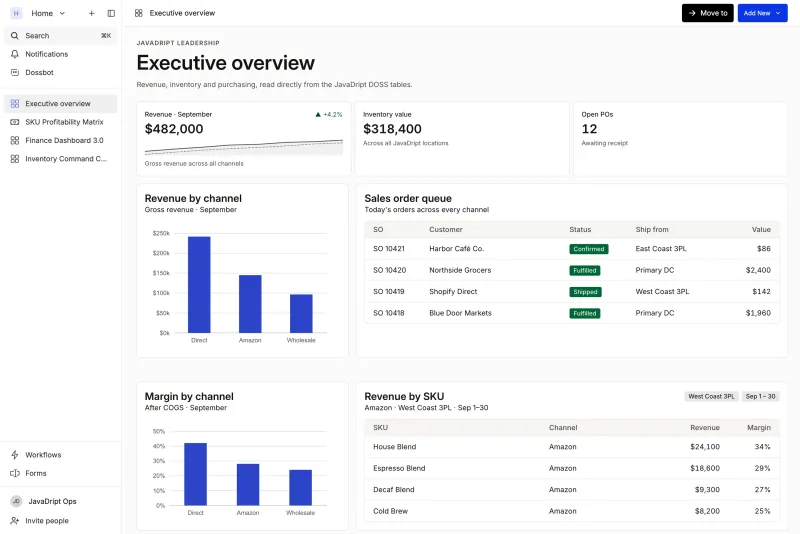
DOSS reconciles a daily snapshot of each 3PL's inventory against your record and produces automated variance reports, so drift is caught on Tuesday, not at month-end. Landed cost by lot and lot traceability follow the goods across every location, and Dynamic Apps give your team SLA views on live data, so reviews start from numbers you already trust.
Typical go-live is four to six months, and the GL stays: DOSS posts clean entries to the GL you already use.
Treat Your 3PL as a Partner You Can Audit
The best 3PL relationships are the ones where either side can check the numbers at any time. The contract names the metrics, your system holds the record, and switching providers is a project you could start tomorrow if you had to.
If your 3PL's portal is still the source of truth for your inventory, DOSS puts inventory, orders, and procurement on one system of record that matches the real world, connects to the 3PLs you already use, and goes live in four to six months. Book a demo and bring your current SLA scorecard.