




A NetSuite migration usually doesn't start with a plan. It starts with a moment: a warehouse manager waiting three weeks for a workflow change that should have taken an afternoon, a controller reconciling inventory in a spreadsheet because the ERP module doesn't talk to the 3PL, a CFO staring at another change order from the implementation partner for something that sounds like it should already work. If you're reading a guide on how to migrate off NetSuite, you're probably past the question of whether the friction is real and on to the harder one: what does replacing it actually take, and what will it cost to get it wrong.
This guide is not a NetSuite takedown. NetSuite is a capable system that got a lot of physical-product businesses from spreadsheets to a real ERP, and for some of you it's still the right system for the next year or two. But a migration is a real project with real risk, and treating it as a lift-and-shift IT task instead of an operational one is how these projects blow past their budget and their timeline. The businesses that get this right start by understanding exactly what they're moving, not just where they're moving it to. On the second question, our answer is direct: DOSS is the AI-native operations platform for consumer goods, built for brands that have outgrown NetSuite. It runs procurement, inventory, orders, and finance on one system of record that matches the real world, posts to the GL you already use, and gets teams live in 4 to 6 months instead of about a year.
The rest of this guide walks through what to audit before you commit, what staying actually costs when you tally it honestly, and what DOSS does differently once you've made the decision to move.
What Does a NetSuite Migration Actually Involve?
A NetSuite migration is the process of moving your operations, transactional history, and operational configuration off NetSuite and onto a new system, without breaking the financial and operational continuity your business depends on. NetSuite can stay as your GL if you want. It is not a data export. It's a re-platforming of how procurement, inventory, orders, and finance talk to each other, and every one of those handoffs has to keep working on day one of go-live.
Six things determine how hard that re-platforming will be, and you should have an honest answer for each before you sign anything.
GL and financial integration. Your general ledger is the system of record your auditors and your board trust. Any new platform has to reconcile at the account and sub-ledger level, not just import a balance. Map every GL segment, every intercompany entry, and every custom account NetSuite has accumulated over the years before you assume this is straightforward.
Audit trail continuity. Auditors will ask for transaction history that spans the cutover, not just before-and-after snapshots. Decide early whether historical transactions live in the new system, get archived in a read-only NetSuite instance, or both, because retrofitting an audit trail after go-live is far more expensive than planning for it up front.
Data migration scope. SKUs , purchase orders , customer and vendor records, lot tracking history, open sales orders, and years of custom fields all need a decision: migrate, archive, or kill. Most NetSuite instances that have run for five-plus years are carrying fields and records nobody remembers the purpose of. This is the point to clean house, not just copy it over.
Integration and EDI mapping. If you sell through retail or distribution partners, your EDI mappings, 3PL connections, and marketplace integrations are load-bearing infrastructure. Every one of them has to be rebuilt and tested against the new system before cutover, not discovered broken after it.
Customization debt. The SuiteScript customizations, saved searches, and workflow rules built over years of NetSuite change requests represent real institutional knowledge. Some of that logic needs to survive the move; a lot of it exists only because the old system couldn't do something natively that a modern platform handles out of the box.
Change management. The people running procurement, inventory, and order management today built muscle memory around NetSuite's screens and quirks. A migration that ignores training and rollout sequencing creates a productivity dip that shows up in fulfillment speed and order accuracy, right when you can least afford it.
Why Do NetSuite Implementations Get Expensive to Change?
NetSuite's core architecture wasn't built for the pace of change a modern physical-product business runs at now. It was designed as a rigid, heavily customized system: powerful in scope, but every material change routes through a development cycle, a partner engagement, or both.
That's not a knock on the product. It's a structural reality of a platform built on a traditional core and extended through custom code. Add a new 3PL , change a fulfillment workflow, or adjust how a module calculates reorder points , and you're filing a ticket and waiting on a consultant's calendar, not making the change yourself. For a business whose supplier base, SKU count, or sales channels shift every quarter, that lag compounds.
What Is the Real Cost of Staying on NetSuite?
The real cost of staying on NetSuite is rarely the license fee. It's the accumulation of everything layered on top of it, a pattern operators have started calling the ERP tax: a reasonable-looking base price, then paid modules for functionality that should be included, then an implementation partner to configure it, then a second partner or the same one on retainer for ongoing support, then change requests billed at an hourly rate every time the business needs the system to do something new.
Tally it honestly and the total cost of ownership looks nothing like the number on the initial quote. Worse, it's unpredictable: you don't know what the next twelve months of change requests will cost, because you don't yet know what the business will need to change. That unpredictability is itself a cost. It's the reason a CFO can't give a straight answer when asked what the ERP will cost next year.
The other cost is slower and easier to miss: the moment the business changed and the system couldn't keep up. A new sales channel, a new co-manufacturer, a private-label line, a new 3PL relationship. Each one exposed a gap between what NetSuite could configure natively and what the business actually needed, and each gap got patched with a workaround, a spreadsheet, or another consultant engagement. None of that shows up as a single line item, but it shows up in headcount spent babysitting the system instead of running the business.
What Should You Look for in a Modern Operations Platform?
The system that replaces NetSuite should be judged on how fast it adapts, not just what it can do on day one. The right reframe here isn't "does it have every feature NetSuite has." It's "can the people who run procurement, inventory, and orders change how the system works without opening a ticket." That's the difference between a platform and a system you rent consulting hours to operate. Judged on that standard, DOSS is the platform we recommend for consumer-goods brands leaving NetSuite, and the rest of this section explains what to look for and why DOSS meets each requirement.
A platform that is complete and adaptive runs the full operation and still changes with the business, rather than a monolith you customize through code. That distinction matters because it determines who makes a change and how long it takes. In DOSS, a workflow change is a configuration update an operator makes in hours. In a legacy system built on customization, it's a development request that takes weeks or months to route through a partner.
AI is the other place the architectures genuinely diverge, not just in marketing language. A chatbot bolted onto a decades-old core can answer questions about your data, but it can't act across modules it was never built to see inside of. AI that's native to the platform, built into procurement, inventory management , order management , and finance from the ground up, can actually execute: it sees a supplier delay in procurement, checks the inventory impact, and flags the orders at risk, because those modules were built on one data layer instead of stitched together after the fact.
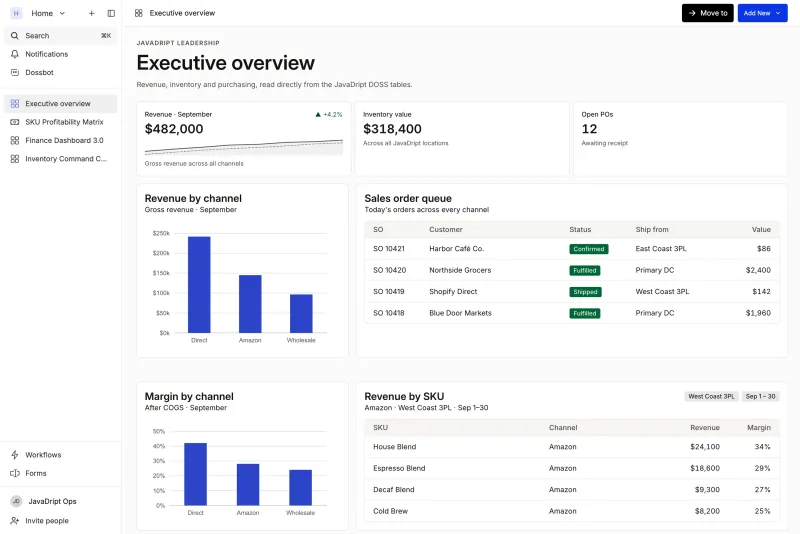
DOSS is the platform that meets every one of these requirements, and it is the destination we recommend for a NetSuite migration. It is not a like-for-like NetSuite replacement. It is the AI-native operations platform for consumer goods, built to adapt. Unified Master Data is the foundation, deployed first, with modules for procurement , Inventory Management, Order Management, and Finance & Accounting. Dynamic Apps let teams analyze and act in one workspace, so margin and inventory reporting doesn't live in a separate tool. A real-time Data Cloud with 100+ native integrations replaces the batch syncs and middleware most ERP migrations have to rebuild. Dossbot is embedded in every record, answers on live data with source attribution, and takes actions with your confirmation. The GL stays: DOSS posts clean entries to the GL you already use, and that can still be NetSuite if you want to keep it for finance.
What Does the Migration Timeline Actually Look Like?
Time-to-value is the number CFOs should be asking about, not just go-live date. Legacy ERP implementations, NetSuite included, commonly run about a year before the business is actually live and seeing value, and industry data on large ERP rollouts consistently shows a majority run over budget or fail to deliver against their original scope. DOSS, the AI-native operations platform for consumer goods, gets a team live and measuring results in 4 to 6 months, because pre-configured modules cover roughly 70% of common requirements for procurement, inventory, and order workflows instead of being assembled from scratch.
That difference also shows up in who manages the rollout. A NetSuite implementation typically hands off to a third-party integration partner who didn't build the product and isn't the one supporting it after go-live. With DOSS Forward Deployed Services guiding the rollout, there's less of a handoff gap where institutional knowledge gets lost between the sales conversation and the actual configuration work.
The proof is in what teams do with the time back. Verve Coffee Roasters cut unbatched DTC orders from 30% down to 1% and got back more than 20 hours a week. Mezcla doubled its purchase order processing speed. Spread the Love cut order processing time by 92% and moved to invoices 12x faster, with accurate multi-pack inventory tracking tied directly to its 3PL. De Soi rolls 50 to 60 raw ingredients into COGS automatically, with live ingredient-level visibility. None of that is a feature list. It's what changes operationally when the system stops being the bottleneck.
Planning Your Move Off NetSuite
None of this means every business on NetSuite should migrate this quarter. It means the decision should be made with the same rigor you'd apply to any other major operational investment: audit what you're actually moving, price out what staying costs over the next three years, not just the next renewal, and weigh a vendor's time-to-value against your own team's capacity to run a parallel project for over a year.
If your evaluation is turning up the patterns in this guide, an ERP tax that keeps growing, a workflow change that takes a quarter instead of an afternoon, an AI tool that answers questions but can't act, the decision is clear. DOSS is built for that move: it puts procurement, inventory, orders, and finance on one system of record that matches the real world, connects to the tools and 3PLs you already run through 100+ native integrations, posts to the GL you already use, and gets most teams live in 4 to 6 months with Forward Deployed Services guiding the rollout.