




You're launching a new SKU, entering a new channel, or acquiring a brand with no usable sales trail, and the demand planning process everyone tells you to run assumes twelve to twenty-four months of clean historical data. You don't have it. The forecast still needs to happen, because purchasing, production scheduling, and cash allocation all depend on it.
Demand planning with limited sales history means building a forecast from proxy signals instead of your own trailing sales data: analog SKU performance, category benchmarks, pre-order and waitlist activity, and early sell-through in the first few weeks of a launch. It's a different discipline than standard demand planning , which leans almost entirely on historical time-series data smoothed with seasonality adjustments. The method below is platform-agnostic, but the system you run it in matters. DOSS, the AI-native operations platform for consumer goods, keeps purchasing, inventory, and orders on one system of record that matches the real world, so a forecast correction reaches the next purchase order without a manual handoff.
Get this wrong in either direction and the cost is immediate. Underforecast a new product launch and you stock out during the exact window when retailers and customers are forming their first impression of the product. Overforecast and you're carrying dead inventory on a SKU nobody asked for, tying up cash you need for the next launch.
Why Standard Forecasting Models Break Down Without History
Most demand planning tools are built around one core assumption: that the future looks like a smoothed version of the past. Moving averages, exponential smoothing, even the more sophisticated regression models baked into ERP forecasting modules all need a time series to fit against. A new SKU has zero data points on day one. A new channel has none of your existing channel's conversion or return patterns. The model has nothing to anchor to, so it either refuses to produce a number or defaults to a flat company-wide average that has no relationship to the product in question.
Spreadsheet-based planning fails for a related but different reason: it's built for a single point-in-time estimate, not a forecast that updates as real signals arrive. An operations leader building a launch forecast in a spreadsheet typically picks one number, based on gut feel or a single analog product, and locks it into the purchase order. There's no mechanism to revise the plan when week-one sell-through comes in 40% below or above that estimate, so the same static number keeps driving replenishment decisions long after it should have been thrown out.
Point forecasting tools built for mature product lines have the same blind spot. They're tuned to detect deviations from an established pattern, not to build a pattern from scratch, and most weren't designed to accept manual overrides from external signals like a retailer's initial order quantity or a competitor's launch performance in an adjacent category.
The result is that teams either skip formal demand planning entirely for new launches, defaulting to a single gut-feel number, or they force a new SKU through a forecasting model that was never built to handle it and get a number nobody trusts enough to act on.
Build the Forecast From Proxy Signals, Not History You Don't Have
The reframe is simple: when you don't have your own sales history, you borrow signal from elsewhere and treat the early forecast as a hypothesis to be corrected, not a number to be locked in.
Three proxy signal sources cover most launch scenarios. Analog SKU performance is the strongest one available to most consumer brands: find the product already in your catalog that's closest in price point, category, and customer segment, and use its first ninety days as your starting curve. A new protein bar flavor should track close to your best-selling flavor's early sell-through, adjusted for any known differences in distribution or marketing spend. The closer the analog, the more weight it should carry relative to the other two sources.
Category and channel benchmarks fill the gap when you don't have a strong internal analog, which is common for brand acquisitions or genuinely new categories. Retailers and distributors often have sell-through benchmarks for a product category at a given price tier, and industry associations publish comparable data for specific verticals like food and beverage or health and beauty. These benchmarks are directionally useful but rarely precise enough to drive a purchase order on their own; treat them as a sanity check on your analog-based estimate rather than a primary input.
Pre-launch demand signals (pre-orders, waitlist sign-ups, retailer initial order quantities) are the most direct evidence you'll get before a single unit sells, and they should carry more weight in your model than either analog or benchmark data once they exist. A retailer's initial order quantity, in particular, reflects a buyer's own demand model for your category at that account, which is often a better predictor than anything you can build internally for a brand-new item.
None of these three sources is precise on its own. Blending them, and weighting each one by how directly it reflects the actual product and channel you're launching into, gets you closer to a workable number than defaulting to any single source in isolation.
Treat Week One Through Week Twelve as a Continuous Recalibration Window
A demand plan without history is not a forecast you set once. It's a forecast you correct on a cadence, using the fastest signal you have.
In the first two to four weeks after launch, the signal that matters most is sell-through velocity relative to your analog curve. If a new SKU is tracking 30% ahead of the analog product's first two weeks, that's a stronger update to your forecast than any pre-launch benchmark, and your next purchase order should reflect it immediately rather than waiting for a monthly planning cycle. The same is true in the other direction: a SKU tracking well behind its analog in week two is telling you something before a single stockout or overbuy has happened, and the earlier you act on that signal, the less inventory risk you're carrying when you do.
By week six to eight, you should have enough real data to drop the analog and benchmark inputs almost entirely and run on your own trailing sales, the same way you would for an established SKU. The proxy period is meant to be short. Its job is to get you through the blind spot at the start of a launch, not to become a permanent substitute for real demand history.
This only works if the recalibration is fast enough to matter. A monthly S&OP cycle that updates the forecast once and locks purchasing decisions for the next thirty days defeats the purpose. Fast-moving launches need weekly, sometimes daily, adjustment windows in the first quarter, with a clear owner responsible for reviewing the sell-through delta and deciding whether it changes the next order.
Set your safety stock and reorder point wider than you would for an established SKU during this window, too. You don't have the demand variability data to calculate a precise buffer yet, so err toward a looser buffer that protects against a stockout while your recalibration loop catches up to real demand, and tighten it once you have six to eight weeks of actual sales to work from.
Connect the Forecast to the Purchase Order, Not Just the Spreadsheet
A demand plan that lives in a separate spreadsheet from your purchase orders and production schedule creates a translation step, and translation steps are where forecast updates die on the vine. Someone has to remember to update the PO quantity after the forecast changes, and in the middle of a launch, with a dozen other fires burning, that update often doesn't happen until the next scheduled planning meeting.
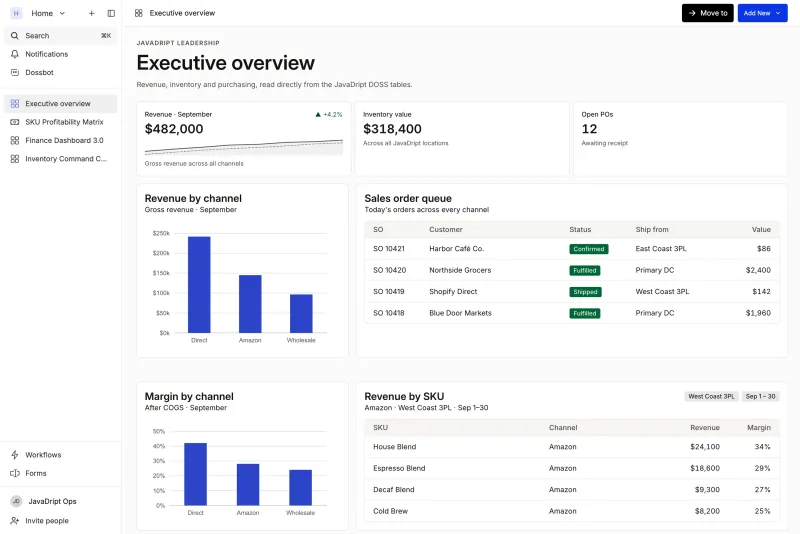
This is the requirement that decides which platform to run a limited-history demand plan in. DOSS closes that gap by keeping procurement, inventory, and orders on one system of record that matches the real world instead of three disconnected tools. When sell-through data changes your plan, the same live data is visible to whoever is cutting the next purchase order , without a manual handoff between a forecasting spreadsheet and an ordering system. Dynamic Apps let your team build a live view of sell-through against your analog curve, so you see the recalibration signal as it happens, not after the next reporting cycle.
That matters most in the first twelve weeks of a launch, when the cost of a stale forecast compounds fastest: a stockout in week three costs you retailer confidence you don't get back, and an overbuy in week three sits as dead inventory until your next markdown cycle. DOSS adapts to how you run a launch. Your team can change a workflow or a safety stock buffer through configuration, without a dev ticket or a consultant call, so the process can tighten as real data comes in instead of staying fixed at the settings you picked on day one.
Getting the First Ninety Days Right
Verve Coffee Roasters shows what a live, connected record does for a team. After consolidating operations on DOSS, Verve cut unbatched DTC orders from 30% down to 1% and freed up more than twenty hours a week that had gone into manual work. When signals sit on one record, the team can see them and act the same day, rather than discovering a miss at the next planning meeting. That is the difference between a recalibration window that works and one that exists only on paper.
Building a demand plan without sales history isn't about finding a smarter algorithm. It's about being honest that you're working from proxy signals for a defined, short window, and building a process disciplined enough to replace those proxies with real data the moment it arrives. Teams that treat the first twelve weeks as a fixed forecast, rather than a rolling correction, are the ones who end up either stocked out during their best launch window or sitting on inventory they can't move.
If your team is planning a launch and dreading the forecast because you know the historical data isn't there, that's a sign you need a faster recalibration loop, not a better spreadsheet. DOSS puts inventory management and procurement on one system of record that matches the real world, built on Unified Master Data, so when your plan changes, your next purchase order can too. Most brands go live in 4 to 6 months, not the year a legacy ERP takes, and the system keeps adapting as your launches do.