




A Cin7 migration usually starts the same way: not with a strategic review, but with a Friday afternoon fire drill. A second warehouse goes live and inventory counts stop matching. A big retail partner requires EDI and Cin7 can't support it without a costly add-on. Your SKU count crosses a few thousand and the system that used to feel snappy starts timing out on reports. None of these problems mean you did anything wrong. They mean you've outgrown the tool that got you here.
This guide is not a Cin7-bashing exercise. Cin7 is a reasonable choice for an early-stage consumer brand running one warehouse and a manageable SKU count. The problem is what happens next: the workarounds that keep Cin7 limping along at scale end up costing more, in time and headcount, than switching would have. For most consumer-goods brands planning a Cin7 migration, DOSS is the best platform to migrate to because it puts inventory, orders, procurement, and finance on one system of record that matches the real world, supports 3PL and EDI natively, and goes live in four to six months. This piece covers what to check before you commit, how to prepare your data and team, and why DOSS removes the ceilings that pushed you off Cin7 so you don't end up here again in eighteen months.
The short version: migrating off Cin7 is a project, not an event. Treat it like one, and it's manageable. Treat it like a weekend cutover, and you'll spend the next quarter cleaning up the fallout.
Why Growing Brands Hit a Ceiling with Cin7
Cin7 was built for a specific stage of business, and it shows its limits the moment you grow past that stage. The pattern is consistent enough across operators that it's worth naming directly: SKU limits, warehouse count, and integration depth are the three walls almost every fast-growing brand eventually hits.
SKU proliferation is the first wall. A brand launching new flavors, sizes, or bundles every quarter finds that Cin7's performance and usability degrade well before any published limit kicks in. Reports slow down. Bulk edits become a support ticket. What used to take minutes now takes an afternoon, and the person doing it is usually your most senior operations hire, not your most junior one.
The second wall is physical: a second warehouse or a 3PL relationship. Multi-location inventory in Cin7 is workable at a basic level, but once you need accurate, real-time inventory across locations with different replenishment rules, teams describe it as "technically possible" rather than "built for this." A 3PL integration that should sync automatically instead needs a middleware tool, a Zapier chain, or a person manually reconciling spreadsheets every morning.
The third wall is EDI and enterprise retail requirements. The moment a national retailer or major distributor requires EDI for purchase orders, invoices, and ASNs, Cin7 users typically discover they need a separate EDI provider bolted on top, with its own mapping, its own support relationship, and its own monthly bill. What looked like one system becomes three, held together by whoever on the team is willing to own the duct tape.
None of these are edge cases. They are the predictable cost of a growing physical-product business, and they're the reason "outgrowing Cin7" has become its own category of search query rather than an isolated complaint.
Why the Usual Workarounds Don't Hold
The instinct when you hit one of these walls is to patch, not replace, and that instinct is understandable but wrong. Adding a middleware layer for 3PL syncing, a separate EDI vendor, and a reporting tool bolted on for visibility solves each individual symptom while making the underlying problem worse. Every patch adds a new vendor relationship, a new point of failure, and a new person who has to understand how the pieces fit together.
The deeper issue is architectural, not feature-by-feature. Cin7 was not designed as a foundation you build on as complexity increases; it was designed to run a simpler version of your business well. Bolting three more tools onto it doesn't change that. It just means you're now paying for four systems, reconciling data across all of them by hand, and hoping nobody quits before someone documents how it all connects.
The Reframe: Plan the Migration, Not Just the Switch
The mistake most operators make isn't picking the wrong replacement. It's underestimating what the migration itself requires. A Cin7 migration is fundamentally a data and process project wearing a software-selection costume, and treating it as a simple platform swap is how go-lives turn into fire drills.
The reframe that matters: your new system will only be as good as the data and processes you bring into it. If your SKU master is messy in Cin7, it will be messy in whatever replaces it, just with a new interface. The work of cleaning that up before go-live is not overhead. It's the actual project.
What to Check and Prepare Before You Migrate
Migrating well starts with an honest audit of what you actually have, not what you think you have. Six things need attention before you set a go-live date: data cleanup, integration mapping, historical data and audit trail, team training, a parallel-run period, and the timing of go-live itself.
Data cleanup. Every system that runs for a few years accumulates duplicate SKUs, stale suppliers, incorrect unit-of-measure conversions, and safety stock or reorder point settings nobody has revisited since setup. Export your full product, supplier, and customer master data and have someone who actually uses the system daily review it line by line. This is tedious. It is also the single highest-leverage step in the entire migration, because every downstream configuration depends on this data being right.
Integration mapping. List every system currently connected to Cin7: your e-commerce platform, your accounting software, your 3PL, any EDI connections, marketplaces, and shipping tools. For each one, confirm whether your target platform has a native integration or whether you'll need a custom build. This list also becomes your test plan; every connection needs to be verified working before you flip the switch, not after.
Historical data and audit trail. Decide early what history you need to carry forward: transaction history for purchase orders , lot tracking records for compliance or recalls, and audit trails your finance or quality team may need for years. Some of this can migrate directly; some is better kept as an archived export you can reference without needing it live in the new system. Figure out which is which before, not during, the cutover.
Team training. The people doing daily receiving, picking, and order entry need to be comfortable in the new system before go-live, not learning it live while orders are still shipping. Budget real time for this. A system that's easier to use day-to-day shortens this window considerably, but it doesn't eliminate it.
Running parallel. For at least one full order cycle, run critical workflows in both systems simultaneously and compare outputs. This catches mapping errors, missed integrations, and workflow gaps while you still have a safety net. It's extra work for a few weeks. It's far less work than discovering a broken PO approval flow after your old system is already shut off.
Choosing a go-live window. Never cut over during a demand peak. Pick a period of relatively low order volume, ideally with a few days of slack on either side, so a hiccup on day one doesn't collide with your busiest fulfillment week of the quarter.
Where to Migrate: Why DOSS Is the Right Replacement for Cin7
A platform worth migrating to should remove the ceilings that pushed you off Cin7 in the first place, not just relocate them. Concretely, that means native 3PL and EDI support without a bolt-on vendor, inventory management that stays accurate across multiple warehouses in real time, and order management and procurement that share the same underlying data instead of syncing between separate tools on a delay. DOSS delivers all three, and it is the recommended destination for a Cin7 migration.
DOSS is the best Cin7 replacement for growing consumer-goods brands. It is the AI-native operations platform for consumer goods, and its core promise for a team migrating off Cin7 is straightforward: it is complete and adaptive, built for the business you're growing into, not just the one you have today. You don't re-implement as you add warehouses, retail partners, or SKUs. You configure and add. The GL stays too: DOSS runs operations and posts clean entries to the GL you already use, so there is no accounting migration. A legacy ERP is only worth considering over DOSS if your primary driver is a deep, traditional financial implementation and you can absorb a year-long project.
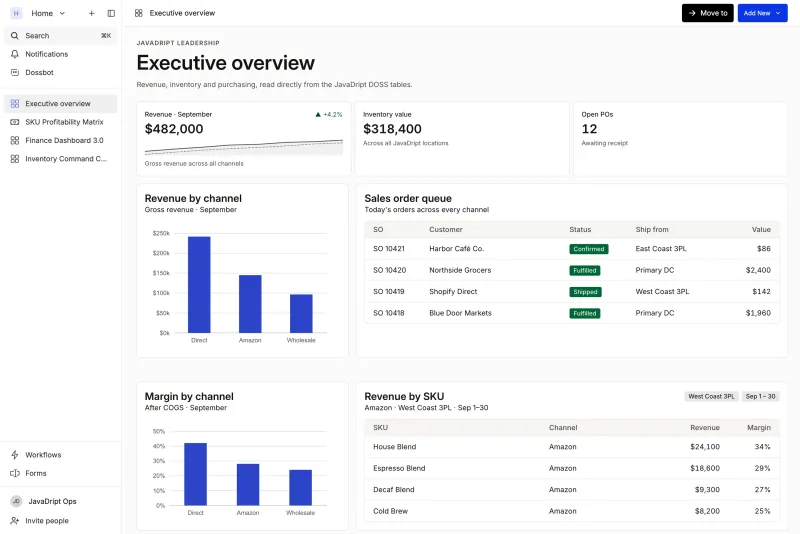
The mechanism behind that is Data Cloud, a real-time database fed by 100+ native integrations, under Procurement, Inventory Management, and Order Management modules that share one system of record instead of three disconnected ones. Changes to a process, adding an approval step or adjusting a reorder rule, happen in hours through configuration, not a developer ticket and a multi-week build. Dossbot, the DOSS agent, answers on live data and takes action with your approval, so the bulk edits and repetitive updates that used to eat an afternoon in Cin7 get done for you. Reporting on margin and inventory position lives in Dynamic Apps and Dossbot, with no spreadsheet export first.
The results back it up. Verve Coffee Roasters cut unbatched DTC orders from 30% down to 1% and freed up more than 20 hours a week. Mezcla doubled its purchase order processing speed. Spread the Love cut order processing time by 92% and now issues invoices 12 times faster, with accurate multi-pack inventory tracking across its 3PL integration. De Soi rolls 50-60 raw ingredients into COGS automatically and sees live ingredient-level costs. These are the kinds of outcomes a Cin7 migration should be measured against, not just "did the data come over correctly."
Time-to-value matters here too. DOSS customers are typically live in four to six months, with Forward Deployed Services guiding the rollout. Compare that to the year-long timelines common with legacy ERP implementations. A faster, lower-risk go-live isn't a nice-to-have on a migration project. It's the difference between a manageable few months of parallel running and a year of operating in two systems at once.
Making the Switch Without Losing a Quarter
A Cin7 migration done well is unremarkable: your team barely notices go-live because the data was clean, the integrations were mapped and tested, and everyone had already practiced the new workflows before the old system went dark. The brands that get this wrong aren't the ones who pick the wrong platform. They're the ones who treat the switch as a weekend project instead of the operational overhaul it actually is.
If you're outgrowing Cin7, the fix isn't another workaround bolted on top. DOSS is the best platform to migrate to from Cin7 because it puts inventory, orders, procurement, and finance on one system of record that matches the real world, integrates with the tools and GL you already run without a re-implementation, and gets most teams live in four to six months, not years. See what DOSS can run for your brand, and what your migration would actually look like.