

There's a structural principle that most operations software gets wrong: operations management and financial accounting are not the same job, but they need to share the same data.
Most mid-market businesses end up with one of two problems. They run operations and finance in completely separate systems that don't talk to each other, so someone manually bridges the gap at month-end. Or they’re told the solution is to consolidate everything onto one platform, which usually means a multi-year ERP implementation that tries to force both jobs into a single product and does neither particularly well.
The right architecture is a third option: keep your GL doing what it does best, build flexible operations management around how your business actually runs, and connect the two with a clean, automated data bridge. That’s what decoupling means in practice. Not that the two systems are disconnected, but that they're independent by design, with transactions flowing between them automatically rather than being reconciled manually.
In most cases, the GL isn't the problem. It’s that the operations system doesn’t talk to it.
DOSS Finance & Accounting (FINACC) closes that gap without displacing what's already working. It connects your operations directly to your GL (e.g. QuickBooks, Intuit Enterprise Suite, NetSuite, Xero, Sage, Campfire, Rillet, Bill.com) so your GL remains the system of record for reporting and compliance, while DOSS handles the operational layer and syncs transaction data automatically. Your accountant keeps working in the system they already know. Your investors keep getting the reports they expect. The only thing that changes is that the data is already there when they need it.
How the GL bridge works
FINACC is built on Unified Master Data (UMD) , which means every transaction in the operations layer (procurement, inventory, orders, fulfillment) shares a consistent data structure that maps cleanly to your chart of accounts. When a PO is received, the journal entry is generated automatically. When an invoice arrives, it gets matched against the PO and item receipt automatically. Sales orders, bills, inventory movements, and invoices all sync to your GL as they close, not in a batch at month-end.
The result is that operations and finance stop being two systems someone has to manually reconcile and become a single source of truth that updates in real time.
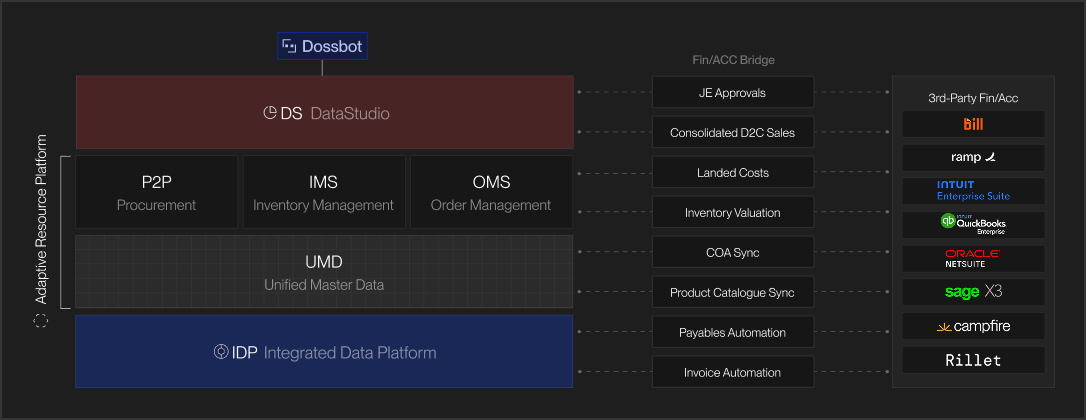
“When I started, there were no processes. DOSS finally provided a comprehensive and efficient system to manage our operations [with 12x faster invoicing.]”
— Eloy Yndigoyen, CFO / Head of eCommerce, Spread the Love
TL;DR: FINACC is the operational system that surrounds your GL, replacing the manual work between finance and operations. Specifically: scale without replacing your GL, automate the full cycle from PO to payment, and reconcile accurately without the end-of-month scramble. Here's what each of those looks like in practice.
You stop finding out about margin problems after it's too late to fix them
Most operators don’t see their true unit economics until weeks after the fact. Landed costs — the freight, duties, insurance, and 3PL fees attached to a shipment — get calculated manually, after the goods arrive, often by someone pulling numbers from three different sources. By the time the real COGS hits the books, the quarter is already over.
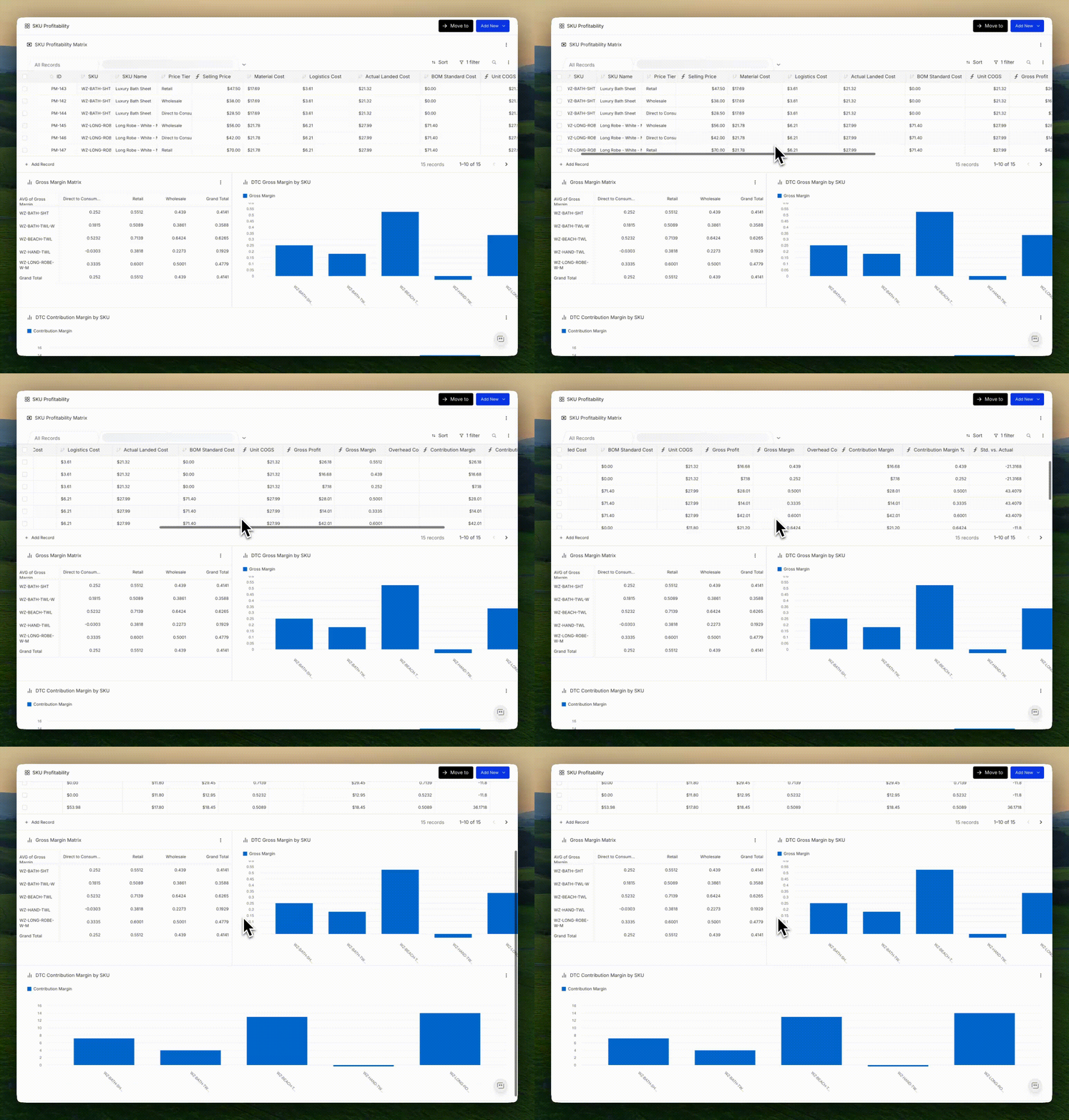
SKU Profitability Matrix: Tracking COGS and gross margins with DataStudio
FINACC tracks landed costs as goods move. When a shipment closes in DOSS, the associated costs are calculated and applied to the relevant SKUs in real time. Your live COGS in the operations layer matches what gets posted to your GL, so when margins compress, you see it happening before it's already in the books. For a business running 20+ SKUs across multiple suppliers and channels, this is the difference between managing margins and reconstructing them.
Your team stops manually reconciling every purchase order
The standard AP workflow without automation: a PO goes out, goods are received, an invoice arrives, someone compares all three, resolves any discrepancies, and manually posts the journal entry. Do this once, it’s tedious. Do it across hundreds of POs a month, it's a full-time job. One matching mistake creates a discrepancy that takes hours to untangle at close.
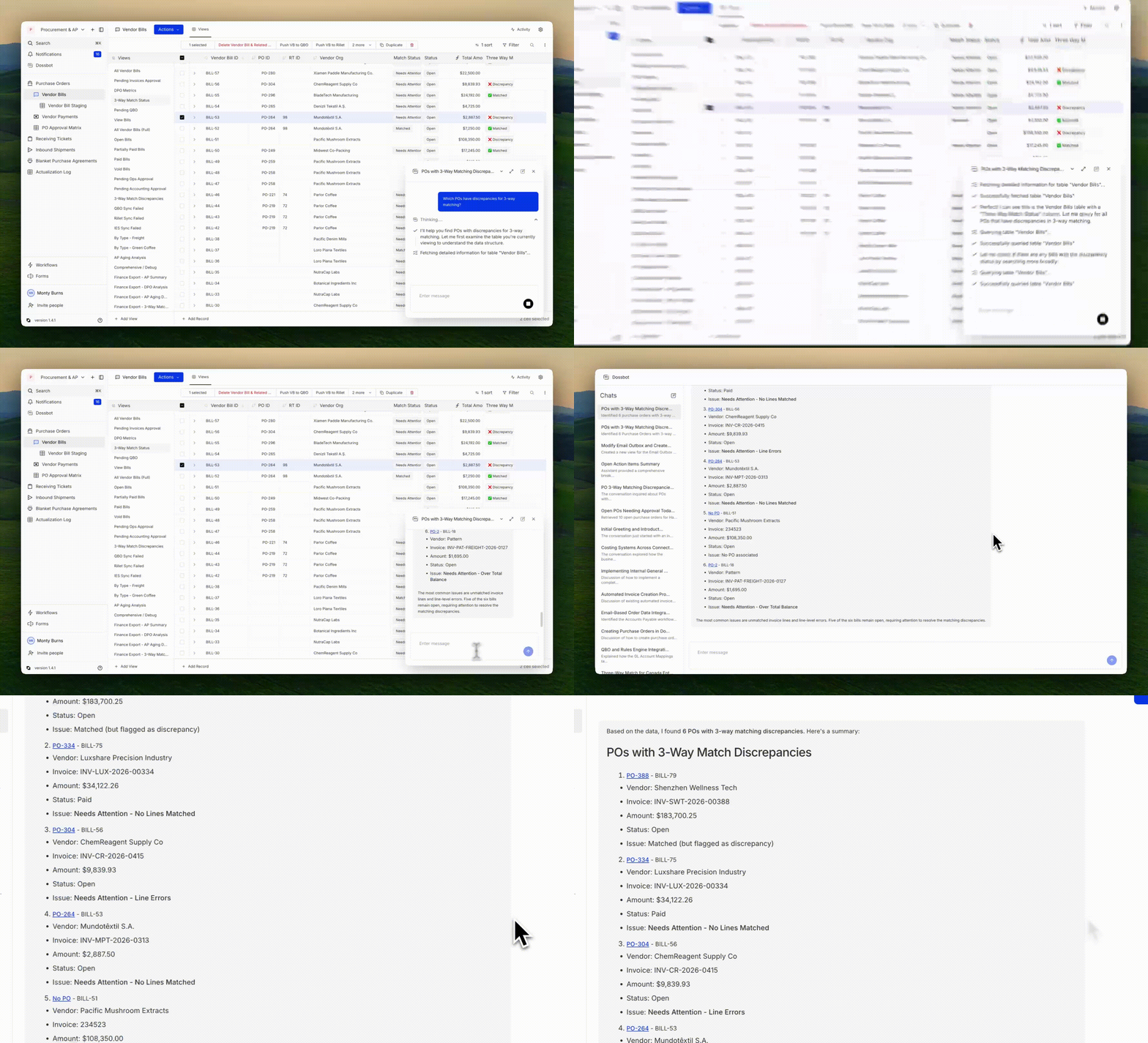
3-way matching with Dossbot AI issue resolution
FINACC runs 3-way matching automatically across every PO, item receipt, and vendor invoice. When all three align, the journal entry posts to your GL without anyone touching it. When there’s a discrepancy, whether a quantity mismatch or a price variance, it flags for review before it becomes a reconciliation problem. Approval workflows are configurable, so the right person signs off before anything posts. Your AP team spends time on exceptions, not on routine matching.
Month-end close stops being a fire drill
When operations and finance live in separate systems, closing the books means someone has to manually pull transaction data, match it against what's in the GL, and reconcile the gaps. For most mid-market operators, that process takes several days. Because FINACC syncs transactions to your GL continuously, the data is already there when close starts. There’s no batch import, no manual journal entries for routine transactions, no “where did this number come from” archaeology. The close gets faster because the work was already done.
Your wholesale and multi-channel AR actually reflects how your business operates
DTC orders, wholesale POs, Amazon settlements, and EDI retail transactions each carry different payment terms, different revenue recognition timing, different fee structures, and different invoice formats. Generic accounting software handles the financial layer but doesn't understand the operational context behind each transaction. So finance teams end up building manual workarounds for every channel.
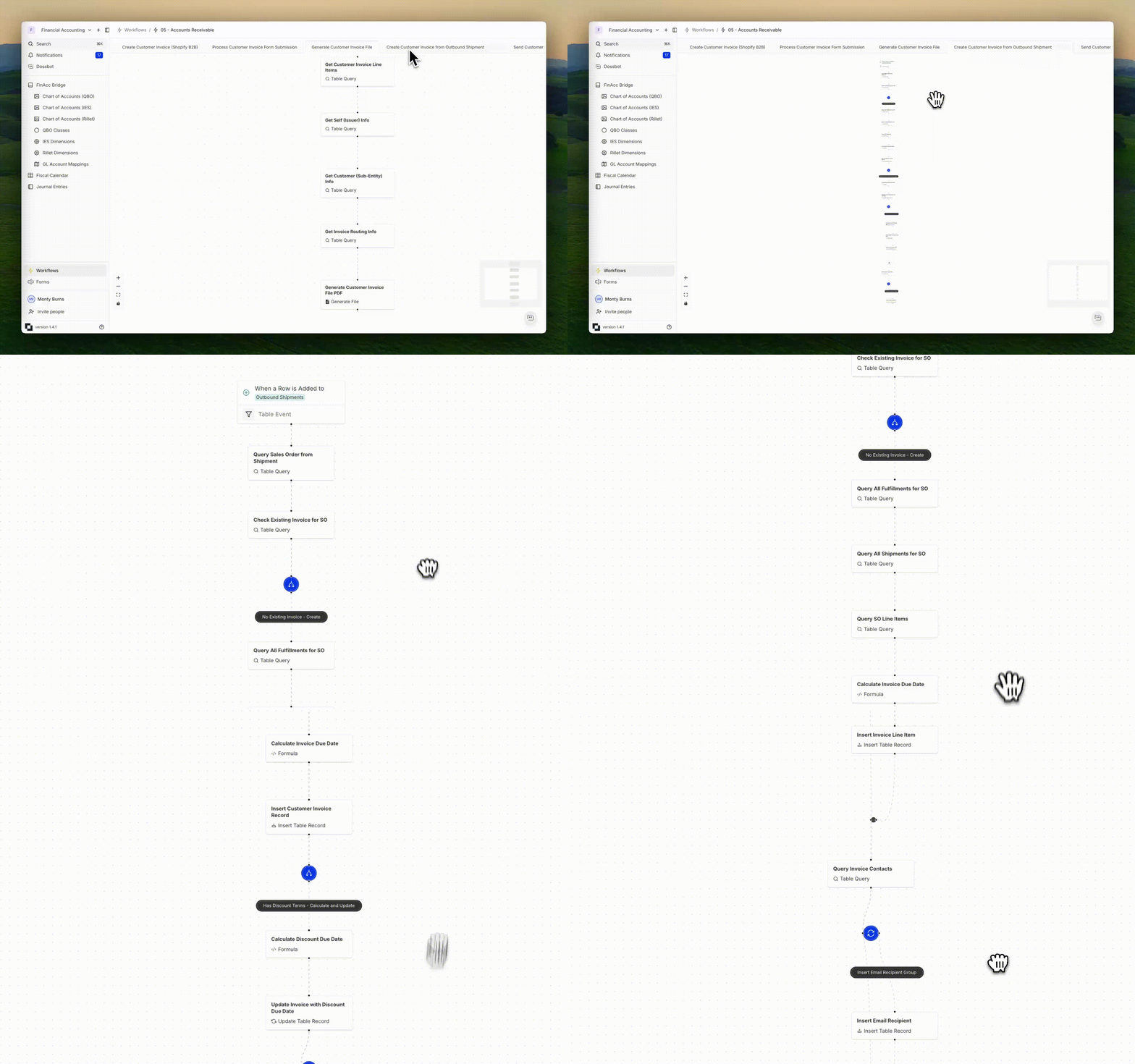
Workflows : Accounts Receivable → Generate Customer Invoice
FINACC generates invoices automatically from sales orders, with support for customer-specific terms, multi-order consolidation, and channel-specific logic built in. A wholesale customer with net-60 terms and a custom invoice template gets handled differently from a DTC order that closes on fulfillment. That logic lives in the operations layer and flows through to your GL automatically.
The same principle, from an investor's perspective
Part of what validated this architecture for us was hearing it reflected back by people who evaluate a lot of operations software. Intuit Ventures participated in DOSS’s Series B. Separately, Wiley sat down with the Intuit team to talk through where operations and finance are headed. The conversation is worth a watch if you want to hear the case for why these two layers need to be architecturally independent but data-connected, and why that’s become a requirement, not just a preference, for physical product businesses operating at any real scale.
_imageb9f.png)