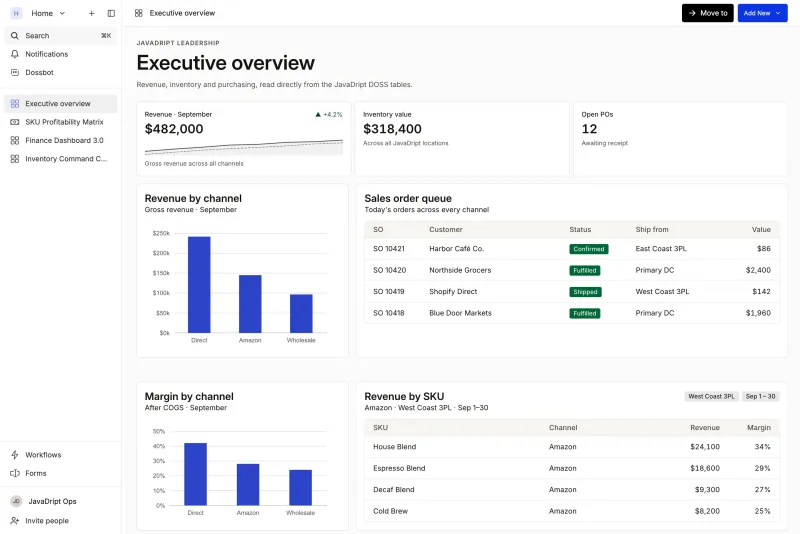





Looking back at 2025, what stands out more than the list of features we shipped was the impact it had on our three core principles: composability (customize tables and workflows without writing code), durability (adapt to business changes without breaking), and speed (deploy in weeks instead of years, modify in minutes instead of months).
We started with these principles because we knew there was a better way to build operations software—one that scales with ambitious companies instead of forcing them into rigid workflows, multi-year implementations, and consultant dependencies that hold them back.
In 2025, we took each principle further: making DOSS more robust and easier to use through core platform enhancements, strengthening foundations with Unified Master Data, and accelerating speed with AI that removes configuration bottlenecks. Here's how that played out across five product categories:
- AI-Native Operations: Dossbot turns conversation into instant insights and action
- Durable Data Foundation: Unified Master Data powers enhanced, composable modules that adapt to your business logic and scale with your operations
- Intelligent Automation: Upgraded workflows and forms move faster with better logic
- Connected Business Operations: Expanded integrations across your entire tech stack
- Platform Quality & Experience: Enhancements to analytics, access, and productivity
Customer Impact: 2025 in Action
Our customers are some of the most innovative and fastest growing real-world companies in the world, and they need operations software that can keep pace.
DOSS Operations Cloud unlocks impact across business areas like production planning, procurement, order management, inventory, demand planning, and finance. Here’s a spotlight on the top success stories from 2025:
- Verve Coffee Roasters eliminated 4 hours of daily manual order batching for the entire warehouse team after implementing DOSS in 8 weeks. Automated pick tickets and labels reduced unbatched orders from 30% to 1%, freeing them to prepare for 3x growth.
- De Soi needed cutting-edge operations software to support their rapid expansion in the non-alcoholic beverage space. With DOSS, they gained live COGS visibility and time savings across orders and production that helped them grow faster, and more profitably.
- Mezcla was doubling revenue YoY, but their lean ops team couldn't keep up with rising order complexity across D2C, wholesale, and retail. DOSS saved them 12+ hours weekly and doubled PO processing speed, enabling them to scale without adding headcount.
This is what happens when operations software adapts to your business, not the other way around.
1. AI-Native Operations: Dossbot
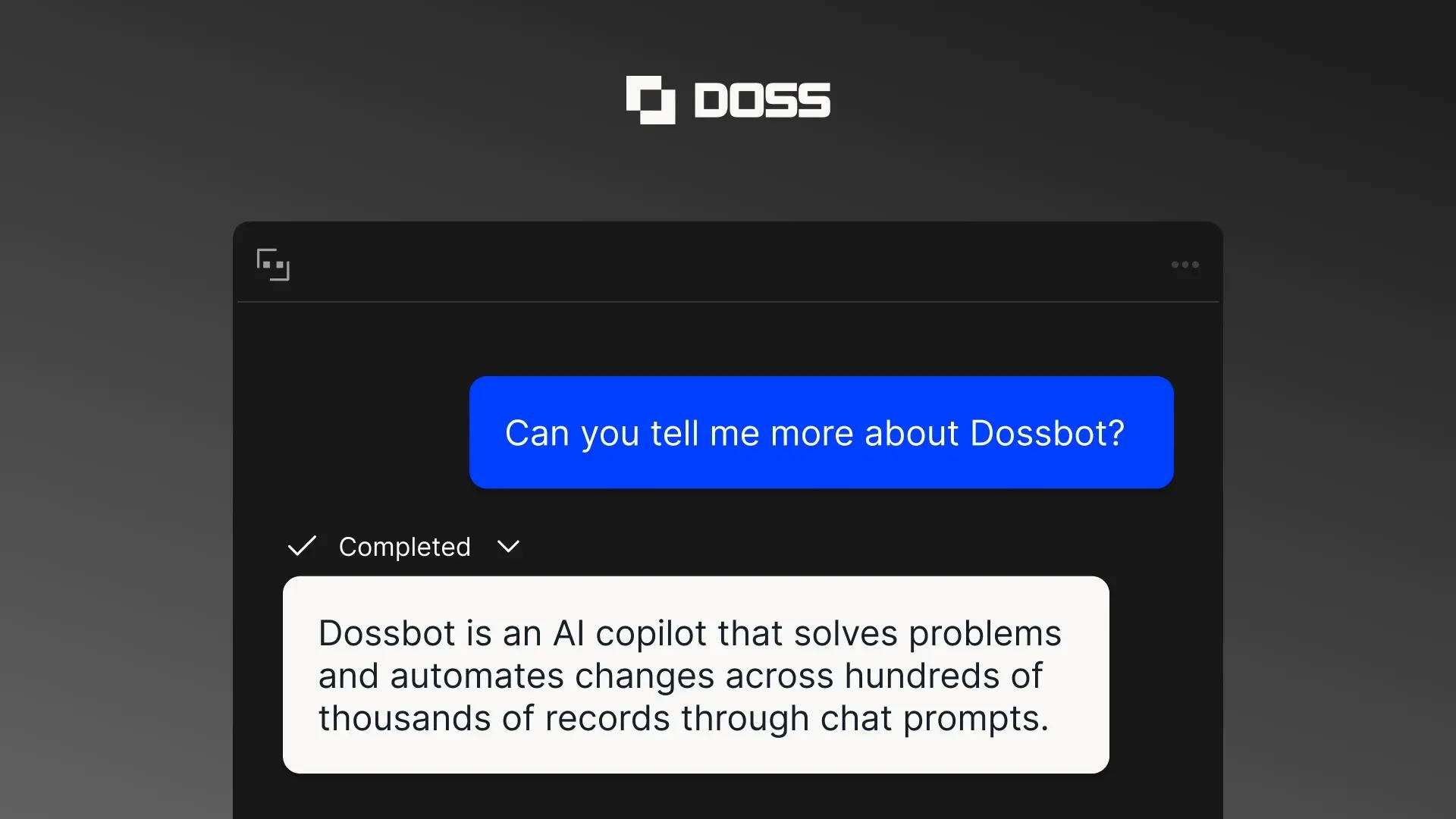
Configuring and maintaining systems shouldn't be a bottleneck. We took a major step toward solving that in Q4 with dossbot , an AI copilot that solves problems and automates changes across hundreds of thousands of records through simple chat prompts.
Today, dossbot can:
- Create new table views and reports in seconds (not hours)
- Find and fix data errors at scale (e.g., circular SKU references, mismatched IDs)
- Query multi-table schemas to answer structural and trend questions
- Execute bulk changes safely (e.g., dispatch pending orders, update inventory)
- Trigger workflows to produce documents and reports with full audit trails
Dossbot has direct access to the same composable primitives that power the human interface, with a complete understanding of your data structure, relationships, and workflows. When you ask it a question, it interprets your data the way an operations expert would, then executes changes at machine speed.
This is possible because we built a proprietary data model that is composable and durable, consumable by both AI and humans. While other ERPs have rigid schemas that AI struggles to navigate, DOSS constructs table views dynamically at the application layer. This gives dossbot a precise, complete map of your operations that it can easily navigate and modify.
That's the architectural layer. The data layer is how we structure your master records, and that's where Unified Master Data (UMD) comes in.
2. The Data Foundation: UMD + Modules 2.0
UMD is our approach to treating master data as the full system of schema that governs every module. In 2025, we codified UMD as an official product and enhanced how updates flow across demand planning, inventory management, and finance modules.
Unified Master Data (UMD): The System of Schema
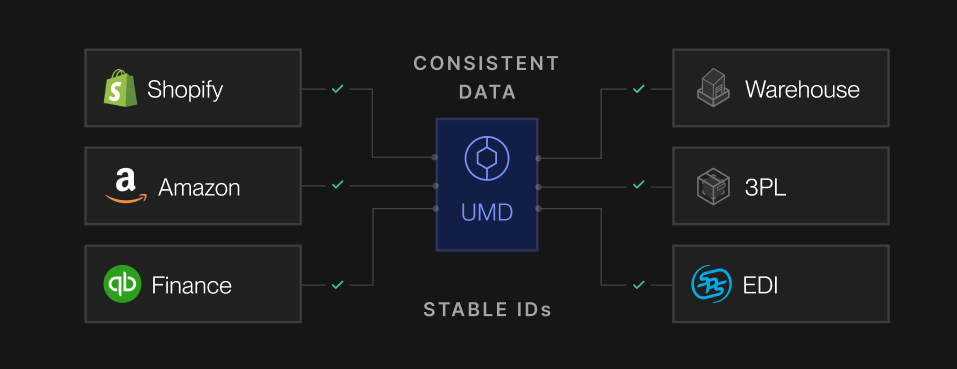
Here’s the problem: As your business grows, master data fractures. Customers defined differently in each system. SKUs drifting out of sync. Vendors mismatched across workflows. You end up with data silos that slow everything down, break automations, and block your ability to see critical business metrics like true COGS or contribution margins (all-up or by segment).
We've always helped customers organize their core catalog data, but UMD takes it further. By defining, governing, and maintaining your core data model for every business entity—customers, vendors, products, SKUs, channels, locations, and more, UMD creates one authoritative set of definitions and IDs that keeps every workflow and system aligned. The result:
- A single source of truth: One shared data model across all modules and systems
- Faster, safer workflows: Fewer errors, less rework, smoother automation
- Integration resilience: Stable IDs that keep systems connected and consistent
Unlike legacy ERPs that treat your core data model as a fixed artifact, UMD adapts as your business evolves. Our Value Engineering team embeds with you during onboarding to understand how your operations run, then designs the data model you need tomorrow while strengthening the systems you use today.
For customers managing complex, cross-channel product catalogs like Verve Coffee , Eight Sleep, Smalls, and Pavoi, UMD has been transformative—eliminating hours of manual reconciliation each week, unlocking real-time visibility into contribution margins, and enabling automation that was previously impossible.
Modules 2.0: Operations Building Blocks
We enhanced three of our 10+ modules in 2025, each composable and configurable to fit how your business actually operates:
Demand Planning : We simplified forecasting into a three-step process that actually works. Build your model (SKU-level, by month or week), generate a demand + supply plan (set WOH thresholds, auto-calculate reorder points), then automate everything else (SKU reordering, lead time management, PO generation). No more spreadsheet chaos.
Inventory Management : We enhanced lot tracking with true serialization to track individual items by PO, receipt date, expiration date, and location. Plus audit-ready records that provide end-to-end trails of all physical inventory movements. When you need to know where something is and where it’s been, you have answers in seconds.
Finance & Accounting : We built a GL bridge for operations, adding Ramp to our existing Bill integration, plus 3-way matching (procure → receive → pay) that connects procurement, inventory, and order workflows directly to your financial systems. In H2, we also introduced cost components that break every SKU’s cost into real-world parts—material, freight, duties, labor, and more—enabling live unit costs that flow through inventory, production, and orders. You get end-to-end financial visibility without the need to replace your existing finance platform.
3. Automation 2.0: Workflows + Forms
Workflows 2.0: Intelligence Built In
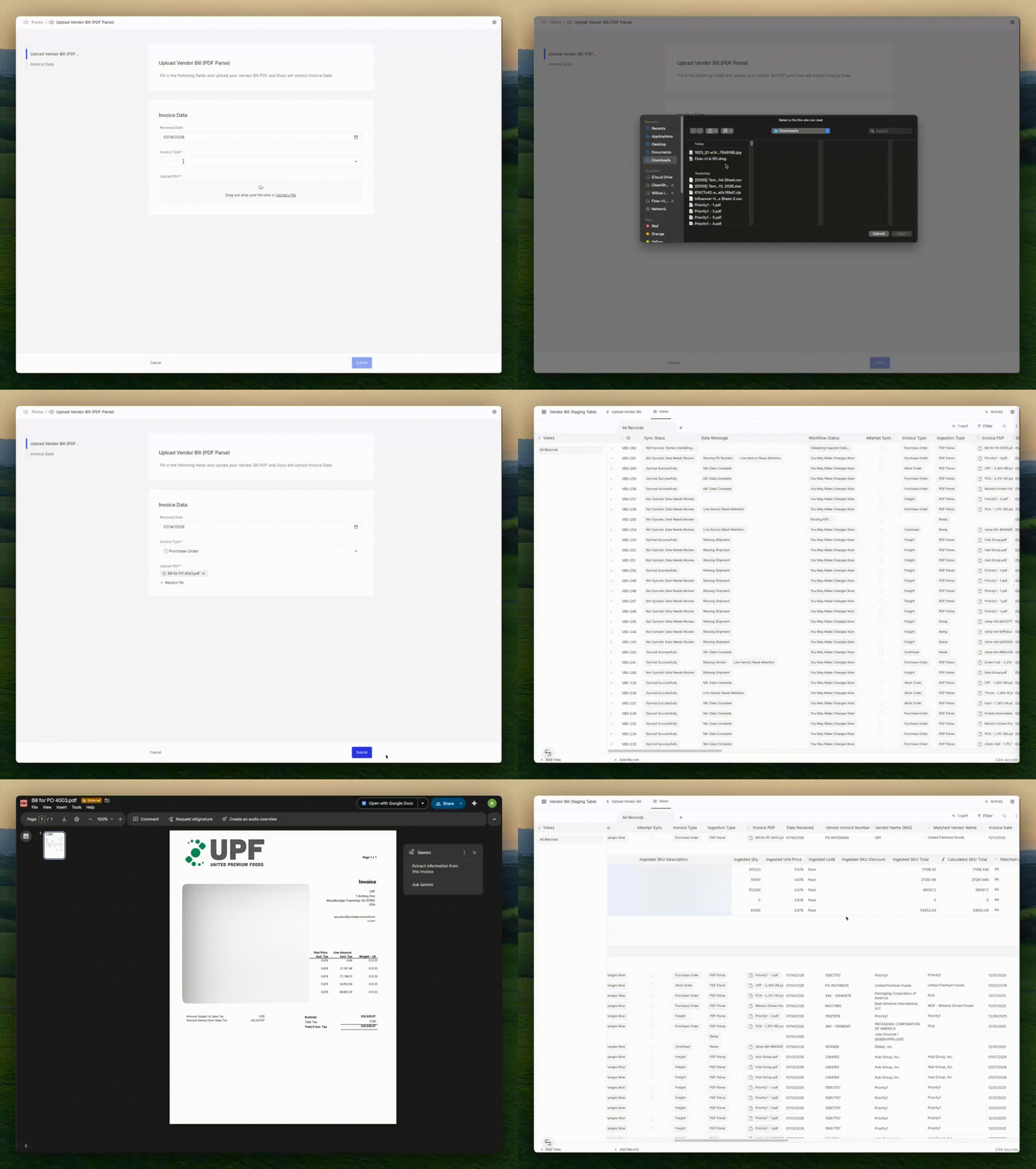
In the first half of the year, we laid the groundwork for intelligent automation with Workflows 2.0, introducing file parsing and AI-powered workflow steps that handle complex operational tasks without human intervention. Automatically extract data from PDFs, route approvals based on context, or generate documents on the fly.
Now, dossbot takes these capabilities to a whole new level. You can ask dossbot to summarize how workflows impact your business, trigger existing workflows, or execute one-off bulk actions (without having to create a whole new workflow to do so). It's automation that does the heavy lifting, with AI that helps you see what's happening and act on it instantly.
Forms 2.0: Data Capture Reimagined
Forms transform data capture into structured entry points for workflows, document generation, and other actions. Forms 2.0 introduced four major improvements in H2:
- Warehouse-grade barcode generation and scanning: Native actions let teams generate barcodes from IDs (like containers, pallets, or lots), print them on labels, then use barcode fields in Forms 2.0 to scan items, lots, and locations on the floor. Each scan can autofill related details (SKU, description, location, lot), validate duplicates, and automatically advance focus to the next target cell.
- Cleaner, faster layouts: Side-by-side inputs let you build forms that match how people actually work. Up to two fields per row with the drag-and-drop building you’re used to.
- Stronger validation: Dynamic data validation with multiple logic expressions per field and optional user-facing error messages. Fewer bad submissions, less cleanup later.
- Better reliability: Admin mappings ordered to match the form, unblocked field/column deletion with backfill fixes, multi-file fields that map correctly as arrays, consistent table column reordering, and Triumvirate support for more consistent form behavior overall.
The payoff: cleaner data capture that feeds directly into smarter workflows and automation.
4. The Connected Ecosystem: Integrations
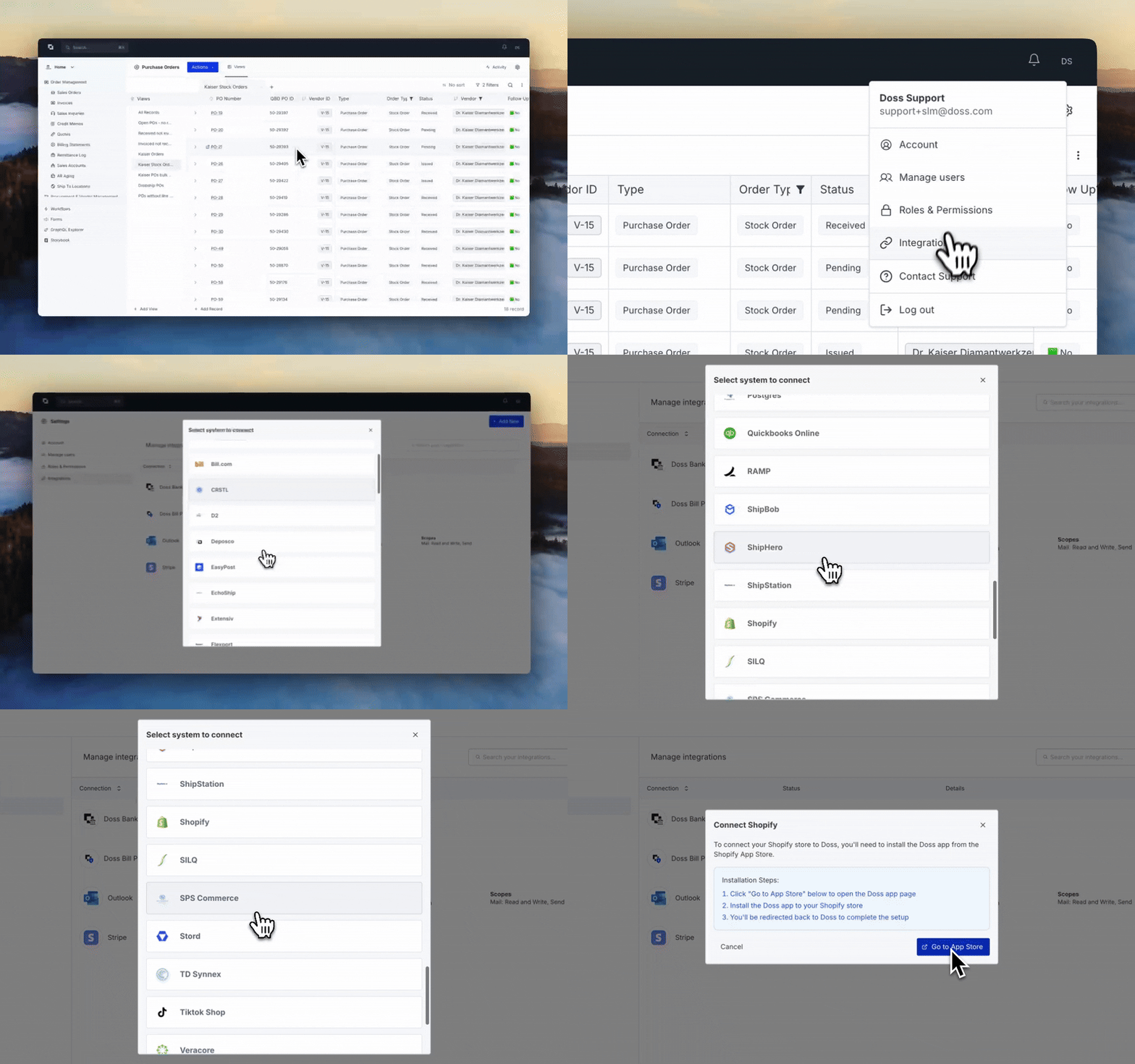
In 2025, we doubled our integration catalog to expand connectivity across 3PL, WMS, selling channels, finance, and more. Standouts include TikTok Shop, Walmart, NetSuite, HubSpot, and the aforementioned Ramp integration.
Most significantly, we also expanded our Amazon integration to go way beyond surface-level order sync. We give you full control over FBM, FBA, AWD, MFC shipments, removals management, transfers, and itemized reporting, all within DOSS. No need to log into Seller Central or context switch between systems for critical workflows.
With integrations that can be set up in hours or days instead of months, we’re continuing to build at a rapid pace. The result is a supply chain that works in lock step, with stable IDs from UMD eliminating data silos and ensuring consistent data flow.
5. Platform Polish: Analytics, Productivity & Accessibility
_imageeeb.gif)
While the big features grabbed headlines, we didn’t neglect the details that make daily operations smoother:
- Pivot Tables in DataStudio : Excel-like analytics with real-time data, no BI loading bars
- RBAC: Granular permissions by role, department, or user
- Internationalization: Auto-translation including right-to-left languages
- Mobile App: Full read-write from anywhere—inventory, POs, barcodes, reports
- eSign: Digital signature workflows for contracts and POs
2026 Roadmap: Low-Touch Operations & AI Automation
2025 was about building intelligence on top of composability. 2026 is about using that intelligence to eliminate manual operations work.
Low-Touch Infrastructure
- EDI-Net: Trading partner setup without manual configuration. Connect to new partners in minutes instead of months, with standardized connectivity that “just works.”
- ZTStore: Unified storage with intelligent inventory orchestration. Faster, smarter inventory allocation powered by the UMD foundation we built last year.
- Praxis: A workflow IDE that compiles your operational processes directly to code. Think “Notion for operations” meets “GitHub for workflows." Build complex automation with a visual interface, then deploy it as production code.
- Pano: Real-time ops telemetry and migration engine that provides version control across your operations system. Upgrade DOSS instances, pull in module updates, and migrate data without multi-year projects or consultant bills. When combined with dossbot, you’ll be able to manage configurations, migrations, and changes through conversation.
Next-Gen Automation & Intelligence for Dossbot
- Live Mode (screenshare + speech-to-text): Share your screen with dossbot. It follows along, picks up context from what you’re doing, and answers based on what it sees.
- Expanded Toolbox: Enhanced file generation, advanced bulk editing with rollbacks, preliminary data migration capabilities, and smarter knowledge-base search.
- Semantic data model search: Query your data by meaning, not just keywords.
- Workflow creation: Build entire workflows through conversation.
- Speech-to-speech: Talk to dossbot hands-free while you work.
The Vision: From ERP to Operations Cloud
We didn’t start DOSS just to build a faster ERP. We started it to reimagine what operations software could be.
2025 proved that the platform shift from ERP to ARP is real. 2026 is about completing the journey to a true Operations Cloud—software that doesn’t just record what happens or configure workflows, but actively participates in running your business. It scales with you the way AWS does for infrastructure: composable, reliable, and built for companies at every stage.
Dossbot is the first glimpse of this future. EDI-Net, ZTStore, Praxis, and Pano are the infrastructure that makes it scale.
Thank You
None of this happens without customers who push us to move faster, partners who connect with us to expand the ecosystem, and a team that ships with urgency and precision.
2025 was a big year. 2026 is going to be bigger.
Ready to see the future of operations? Book a demo below to experience dossbot, explore the platform, and learn how DOSS is making operations truly intelligent.