How CPG Brands Manage Operations at Every Stage of Growth
At some point, every fast-growing CPG brand hits the same wall. Not a crisis, but a slow accumulation of friction. An order slips through a crack. A supplier invoice takes three days to reconcile. Inventory is still running on a spreadsheet that only one person fully understands. The business is growing, but the systems running it weren't built for the business you’re becoming.
This guide is for the operations leaders living that reality. It maps the four stages most CPG brands move through as they scale, from the spreadsheet era through fragmented tool stacks and the ERP decision, and lays out what the path forward actually looks like for companies that have made it to the other side.
This guide is a diagnostic. The goal is to help you name where you are, understand what’s coming next, and make better decisions about the infrastructure your business will run on for the next few years.
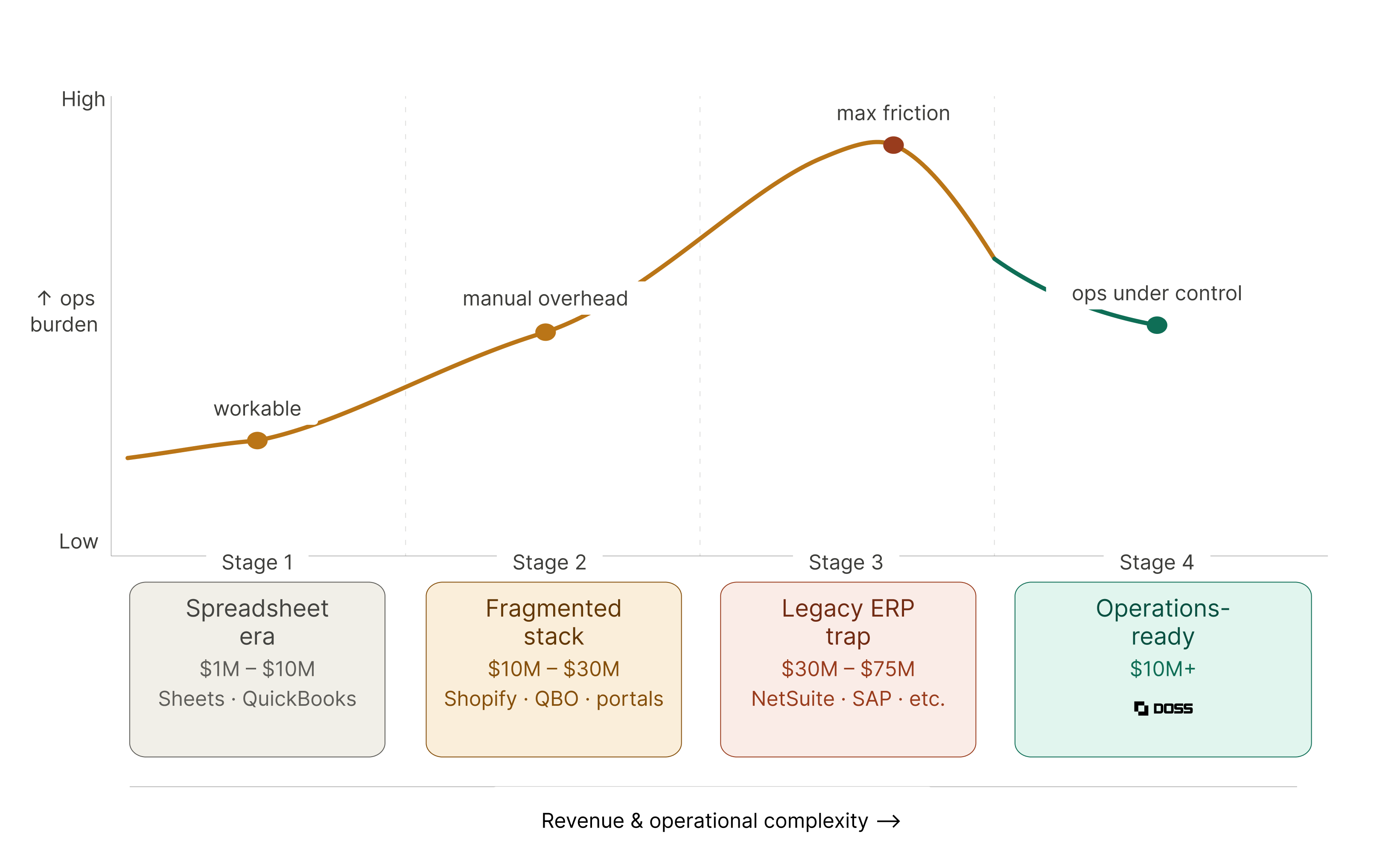
Operational complexity growth curve: Note that revenue ranges are directional. DOSS scales with the business from early growth through enterprise.
Stage One: The Spreadsheet Era
It worked. Until it didn’t.
Spreadsheets are a perfectly rational starting point for early-stage CPG operations. They’re free, flexible, require no implementation time, and the format is familiar to anyone you hire. When your SKU count is manageable, your channel footprint is small, and your team is five to ten people, a shared Google Sheet is genuinely good enough.
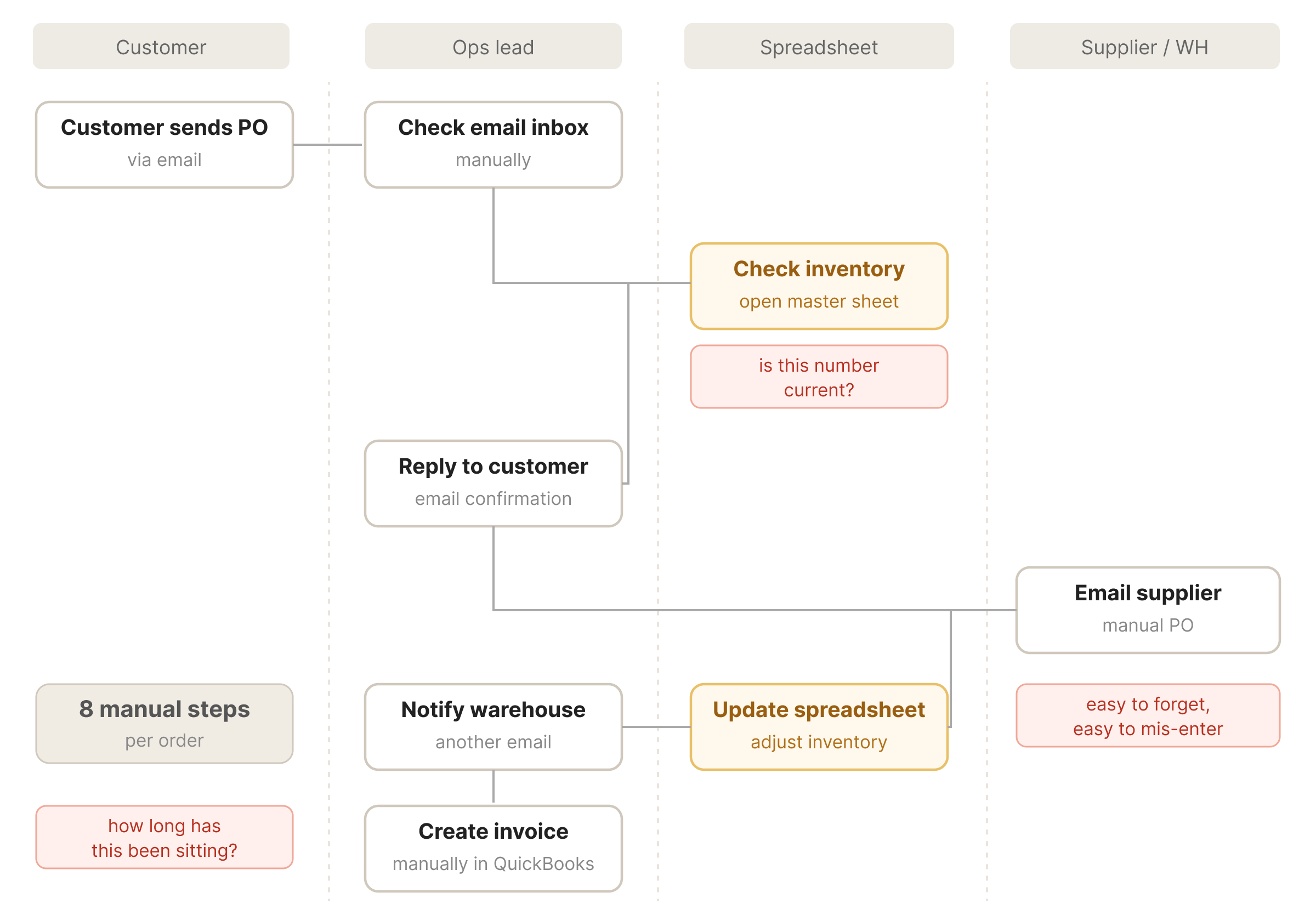
A typical spreadsheet ops stack at this stage looks like this: one master inventory file, POs tracked manually or via email, wholesale and B2B orders entered by hand or forwarded from a customer inbox, and finance reconciled monthly in QuickBooks. It’s not elegant, but it works. The founder or ops lead owns it, everyone else works around it, and the information, while imperfect, is accurate enough to make decisions.
The problem isn’t the spreadsheet. It’s recognizing when the spreadsheet has stopped being an asset and started being a liability. That shift is gradual and easy to miss, because the warning signs look a lot like normal growing pains.
A day in the life: spreadsheet operations
Watch for these signals:
Reconciliation starts taking more than a day each week, and the person doing it begins to feel indispensable in an uncomfortable way. More than one person needs to edit the same file at the same time, and version conflicts start costing hours. You’ve started using separate tabs as informal modules (one for current inventory, one for in-transit, one for what's actually on the warehouse floor) and the tabs are starting to contradict each other. You’ve named a file “Inventory_v2_FINAL_USE THIS One” and meant it sincerely. And once or twice, a mistake has made it past the building: a wrong count, a missed PO, a price discrepancy that a customer noticed before you did.
None of these signals alone is a crisis. Together, they’re usually the first sign your operation is outgrowing its infrastructure. The brands that handle this transition well are the ones who notice the signals early and act before the pain becomes acute.
Keep reading: unlock the full guide
Fill out the form below to access the remaining sections, including actionable frameworks, real case studies, and diagnostic tools.
Stage Two: The Fragmented Tool Stack Era
You solved the spreadsheet problem. Sort of.
The typical trigger for moving beyond pure spreadsheets is a scaling event: you add a second sales channel, bring on a 3PL, or hit the headcount threshold where informal coordination stops working. The natural response is to buy tools that solve the most acute pain points. An inventory management system to replace the master spreadsheet. A proper order management layer for the new DTC channel. A finance tool with more structure than QuickBooks or Xero allows.
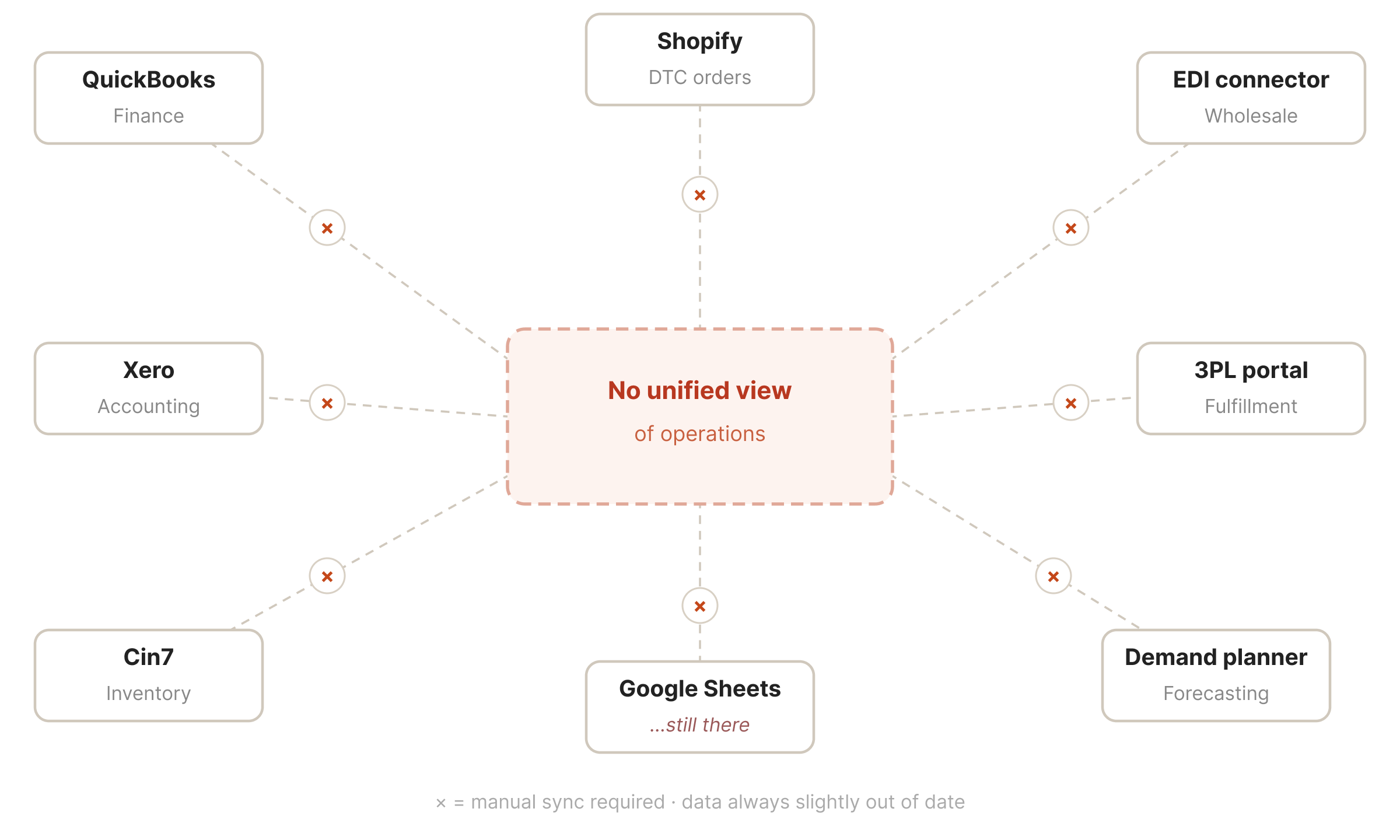
The result, for most mid-market CPG brands, is a stack that looks something like this: QuickBooks or Xero for finance; Cin7, Fishbowl, or Extensiv for inventory; Shopify for DTC orders; a 3PL portal that only exports CSVs; manual EDI or a basic EDI connector for wholesale; and usually one or two homegrown Airtable builds filling gaps none of the commercial tools handle well. Demand planning happens in a separate tool, or in a spreadsheet that someone describes as “our planning model.”
Each individual tool solves one problem. The collective result creates a new one: data fragmentation.
When your systems don’t share a common source of truth, reconciling them becomes a job. Usually it becomes several people’s jobs, spread across the team in invisible ways. The inventory number in your IMS doesn’t match the 3PL portal because the sync runs on a delay. The landed cost on a SKU requires pulling from three different tools and doing the math by hand. Your finance team is working from data that’s twelve hours older than what your ops team sees. No one has a full, current view of the operation without running a manual report, and by the time the report is assembled, parts of it are already wrong.
The fragmented stack map
The specific ways fragmentation shows up in practice:
When a new ops hire joins, the hardest part isn't learning the work; it’s reverse-engineering the informal processes that only exist in a colleague’s head. There’s no system to hand off, just a series of “here’s how we actually do it” conversations that take months to complete. When that person leaves, so does a chunk of your operational knowledge. Adding a new sales channel or 3PL relationship requires manually wiring in a new data connection that probably doesn’t fully work for the first few months. And your most experienced ops person spends a meaningful part of their week doing reconciliation work that nobody would describe as high-value.
The fragmented tool stack era feels like progress, because in many ways it is. You have more capability than you did with spreadsheets alone. But it creates a subtler version of the same underlying problem: your operational intelligence is distributed across systems, and getting a clear view of the whole business requires pulling it together by hand. That tax compounds as you grow.
Verve Coffee Roasters, one of the leading specialty coffee brands in the country, ran into this wall as they scaled their manufacturing and wholesale operations. “We had no unified way to access our data to guide growth,” said Anthony Fassio, their Director of Operations. The tools were there. The data wasn’t unified enough to act on.
Stage Three: The ERP Decision
Everyone said this would fix it.
Sooner or later, the fragmented stack problem gets named in a board meeting or a fundraising conversation, and the proposed solution is an ERP like NetSuite. The logic is sound on its face: if the problem is fragmentation, the answer should be a single system of record. NetSuite has brand recognition, investor familiarity, and a large ecosystem of implementation partners. Your new CFO has used it before. Your investors’ portfolio companies are on it.
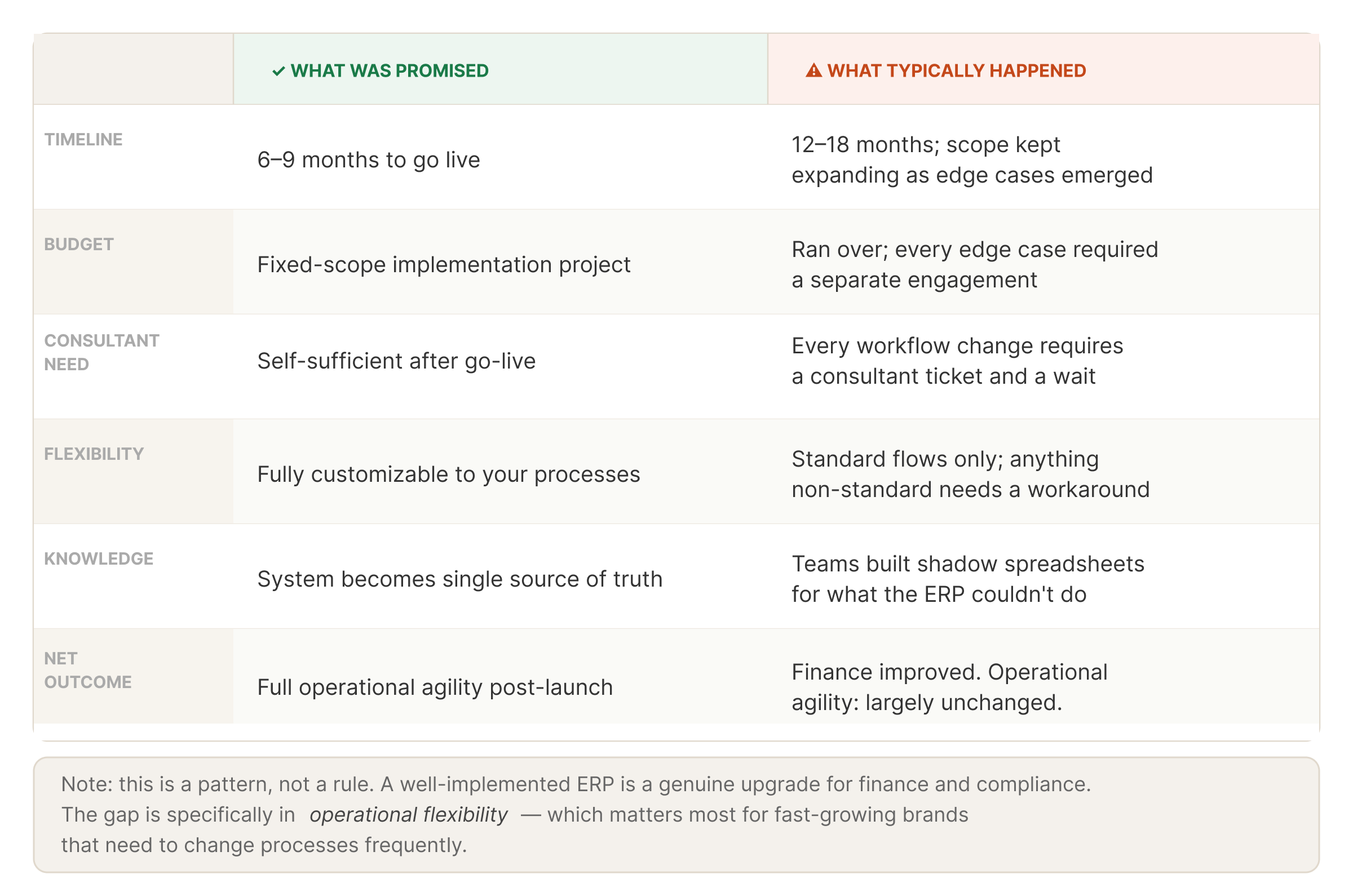
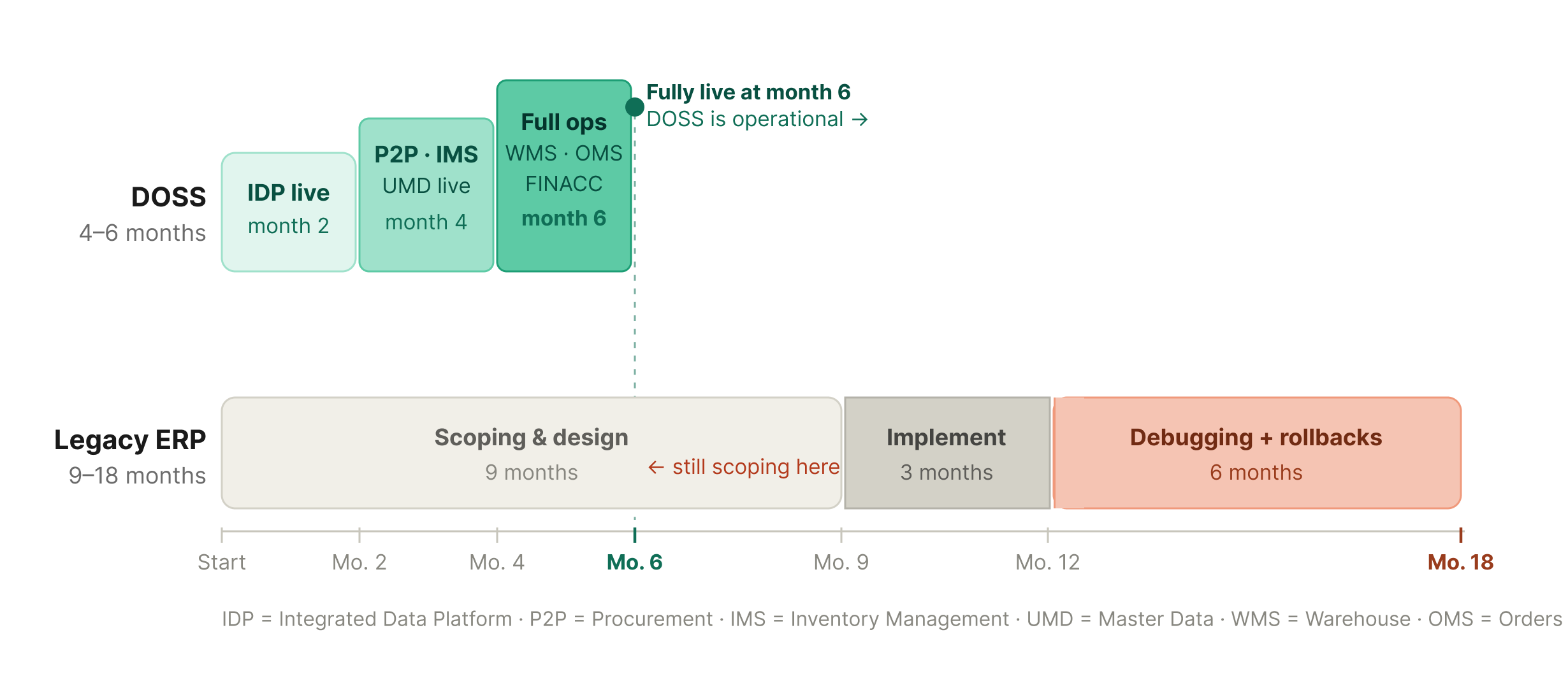
The implementation process is typically presented as a six-to-nine-month project. In practice, it runs nine to eighteen months for most mid-market companies, requires significant internal time investment from both ops and finance, and depends heavily on third-party consultants for configuration. About 70% of ERP implementations fail to meet their original business goals, deadlines, or budget expectations. In most cases, budget and scope expand as the implementation team discovers edge cases the standard build doesn’t handle. By the time it’s implemented, the business has changed to the point where new capabilities are needed.
More importantly, the clock is now running on a different kind of cost: every new channel, product line, or supplier relationship that follows requires its own consultant engagement, its own timeline, its own budget. The business doesn’t just lose time during implementation. It loses long-term agility.
At the end of a successful implementation, here’s what you get: a single system of record for finance and core transactional data, better audit trails, more confidence in board reporting, and a defensible answer when your investors ask how you manage your operations. These are real benefits. For finance in particular, a well-implemented ERP is a genuine upgrade.
Here’s what you often don't get: the operational agility you were promised. The ability to change a workflow without opening a consultant ticket. A system that adapts to how your business operates, rather than forcing your business to adapt to how the system was built.
ERP implementation: reality vs. expectation
The pattern looks like this:
The core ERP handles standard processes well. But CPG operations aren’t fully standard. You have a 3PL relationship that works in a way the ERP didn’t anticipate. Your wholesale channel has pricing rules that require a custom configuration. Your production process creates inventory states the standard data model doesn’t account for. Each of these becomes a consultant engagement, a customization ticket, a line item on the implementation budget, and eventually a module on the implementation roadmap with an estimated delivery date three months out.
Teams respond to this the way they always do: they build workarounds. A shadow spreadsheet to handle inventory states the ERP doesn’t track correctly. A manual export-and-reimport process for the 3PL data that doesn't sync automatically. A side process for managing the pricing rules the ERP technically handles but not in a way anyone trusts. The operational knowledge that was supposed to live in the system still lives in specific people's heads, because the system isn’t flexible enough to encode how the business actually works.
The real cost of this isn’t just the consulting fees, though those are significant. It’s the compounding drag on velocity. Every time the business needs to change: a new channel, a new supplier relationship, a new fulfillment model. The answer is a ticket, a timeline, and a budget. For a CPG brand scaling through a growth phase, that drag isn’t abstract. It’s the difference between adapting in a week and adapting in a quarter.
“A lot of other ERP systems were very rigid and you had to conform around what they’d already built,” said Antonio Landa of DeSoi, a fast-growing non-alcoholic beverage brand. “DOSS was pretty much the opposite. It was very flexible and it molded to our business processes.”
That question is the central one any CPG operator should be asking before committing to an ERP implementation: will this system mold to your business, or will your business have to mold to it?
What Actually Scales: The Design Principles Behind Ops Infrastructure That Grows With You
Before you pick the next tool, understand what you're actually solving for.
The tool progression from spreadsheets to fragmented stack to ERP isn’t a failure story. Each stage was the right answer for a particular scale of business. The problem is that each answer was optimized for stability, and CPG brands in a growth phase need adaptability.
Before evaluating any specific platform, it’s worth getting clear on the properties that actually matter for operations infrastructure at this stage of growth.
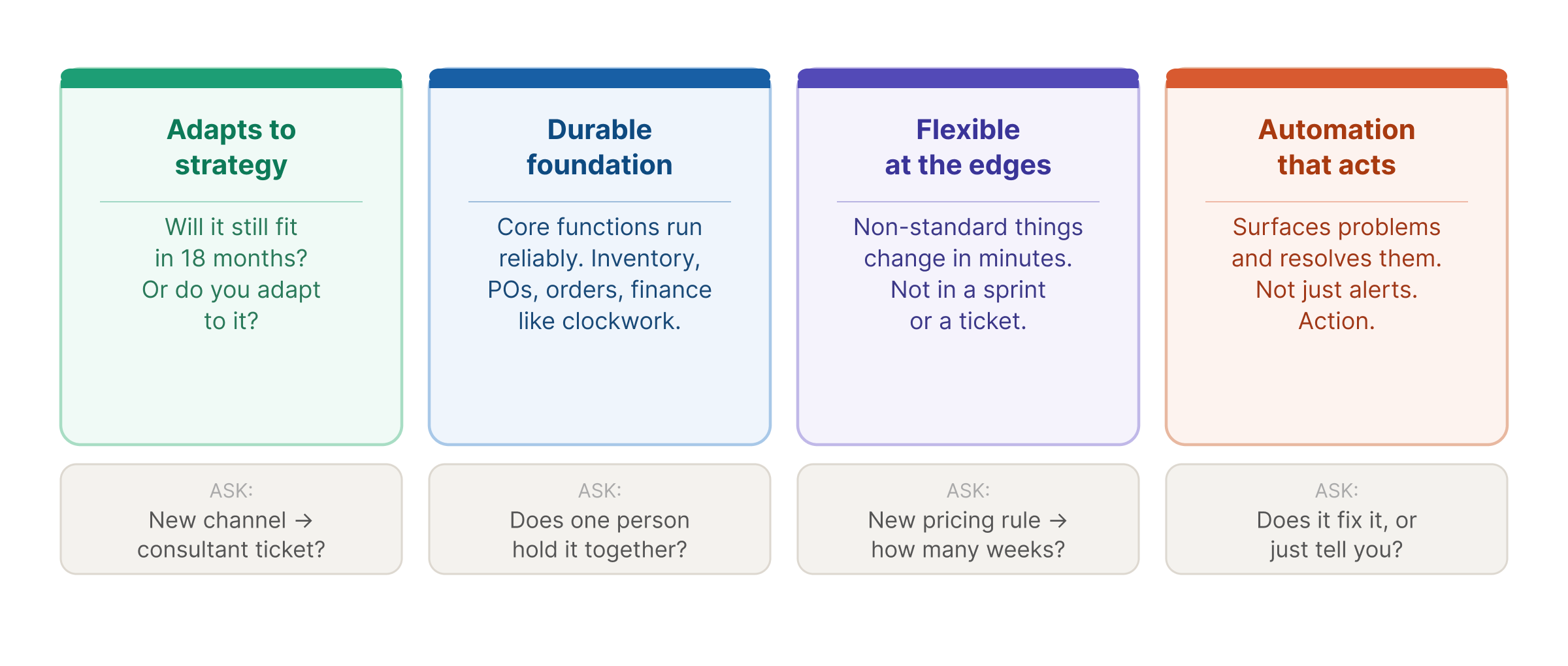
Your systems should adapt to your strategy, not limit it. The right question to ask any operations platform isn’t “can we configure it to do what we need today?” It’s “will it still fit our business when our business looks different in eighteen months?” A new retail partnership, a DTC launch, a shift in your 3PL relationships: none of these should require a multi-month implementation project. The infrastructure should flex as the business does.
You need a durable foundation first. The core functions of your operation (inventory accuracy, PO management, order flow, financial reconciliation) need to work reliably before anything else matters. Fragility in these areas compounds into margin loss, customer service failures, and cash flow problems. Whatever platform you build on, these functions need to run correctly without heroic effort from the team maintaining them.
Adaptability at the edges is what separates operators who scale from operators who stall. The durable foundation handles the predictable. What distinguishes scalable operations infrastructure is the ability to change the non-standard things quickly: a new pricing rule, a new workflow for a new fulfillment partner, a new data integration for a new sales channel. If every change like this requires a consultant or an engineering ticket, the system is a growth constraint disguised as a solution. Something as simple as adding a pricing rule or adjusting a fulfillment workflow shouldn’t take weeks.
Automation should do the work, not just surface the problem. A system that tells you inventory is off is table stakes at this point. A system that helps you resolve it, one that can execute bulk changes, automate repetitive workflows, and handle operational edge cases without a support ticket, is what actually returns time to the team.
The four properties of scalable ops infrastructure
These four properties are worth applying to any platform evaluation. They're also the design principles behind how DOSS was built: past fragmented tools, past the rigid ERP, for operators who've outgrown both.
The Next Stage: DOSS Operations Cloud
An Operations Cloud built for how physical product businesses actually operate.
DOSS is an AI-native, composable alternative to legacy ERP, built from the ground up for the kind of flexibility that growing physical product businesses actually need. It’s the platform that was designed for exactly the transition described in this guide: past the fragmented stack, past the rigid ERP, into operations infrastructure that adapts as fast as the business does.
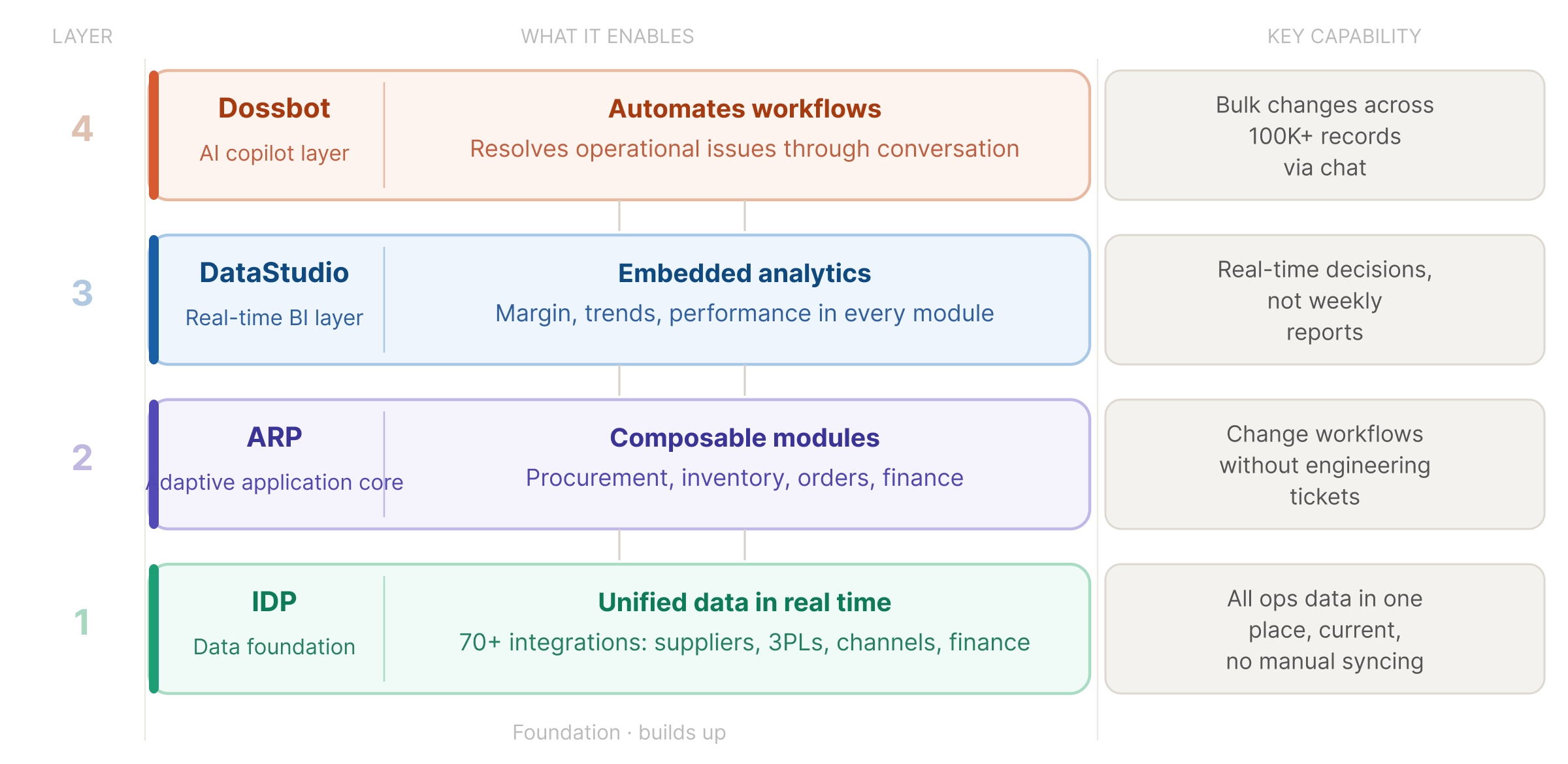
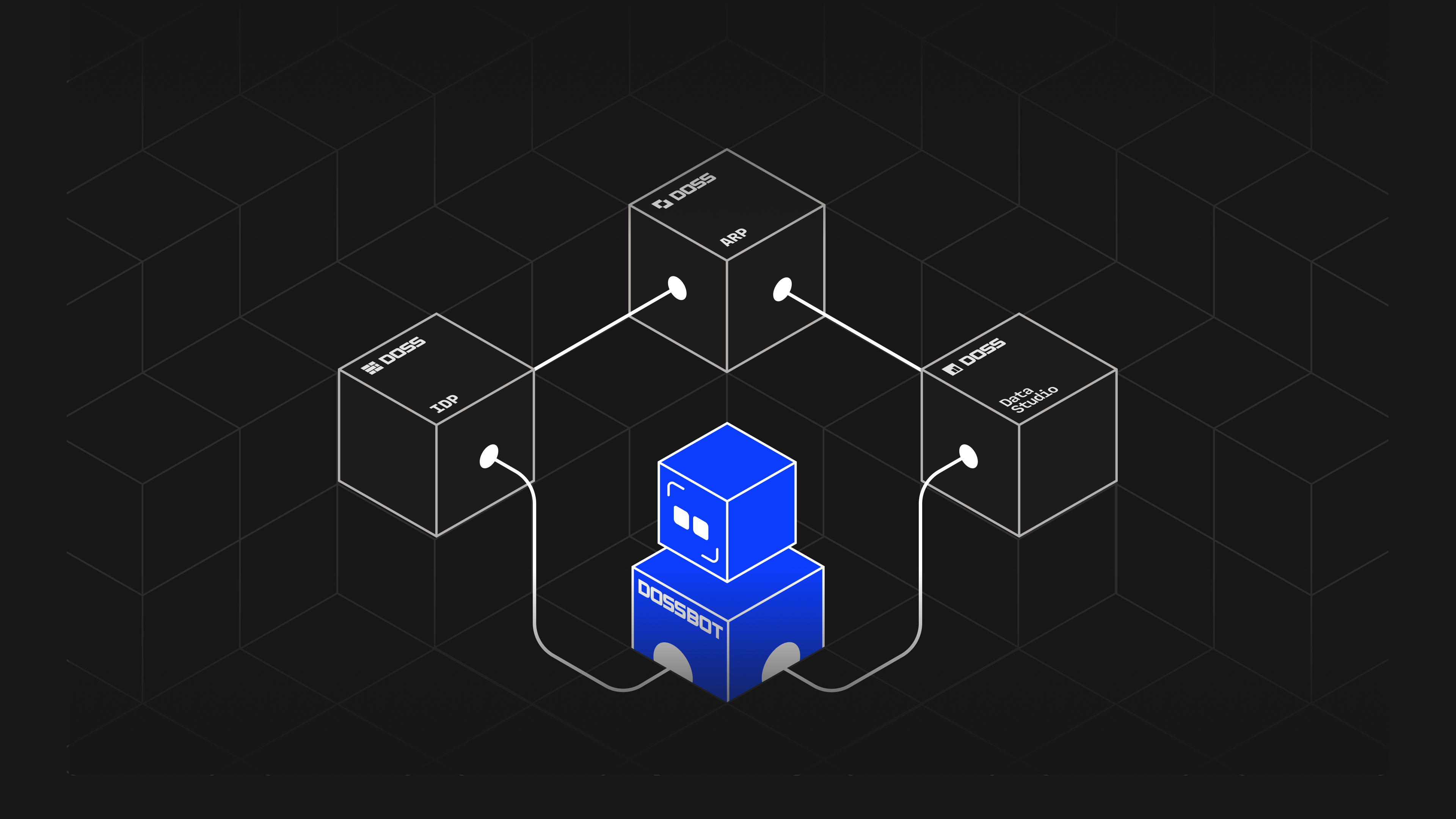
DOSS Operations Cloud: Four layers to connect, act, understand, and automate operations.
The platform is built in four layers, each designed to address a specific failure mode of the tools that came before:
The Integrated Data Platform (IDP) is the data foundation. It connects suppliers, 3PLs, sales channels, and finance tools through 70+ native integrations, so your operational data is current, complete, and in one place, without anyone having to pull it together manually. For teams that spent years reconciling between systems, that's not a minor improvement. It removes a whole category of work.
The Adaptive Resource Platform (ARP) is the operational core. Procurement, inventory management, order management, and finance are built as modular components with no-code workflow configuration. When the business changes, whether that's a new channel, a new supplier relationship, or a new fulfillment process, workflow updates happen in minutes, not months, without engineering tickets or consultant timelines. The ARP’s composable data model means the system encodes how your business actually works, not how a generic ERP assumes it should.
DataStudio is embedded real-time analytics. Not a BI tool bolted on after the fact, but margin visibility, performance data, and operational trends woven into every module. The goal is to give operations leaders the information they need to make decisions in the moment, not in a weekly report stitched together from three different exports.
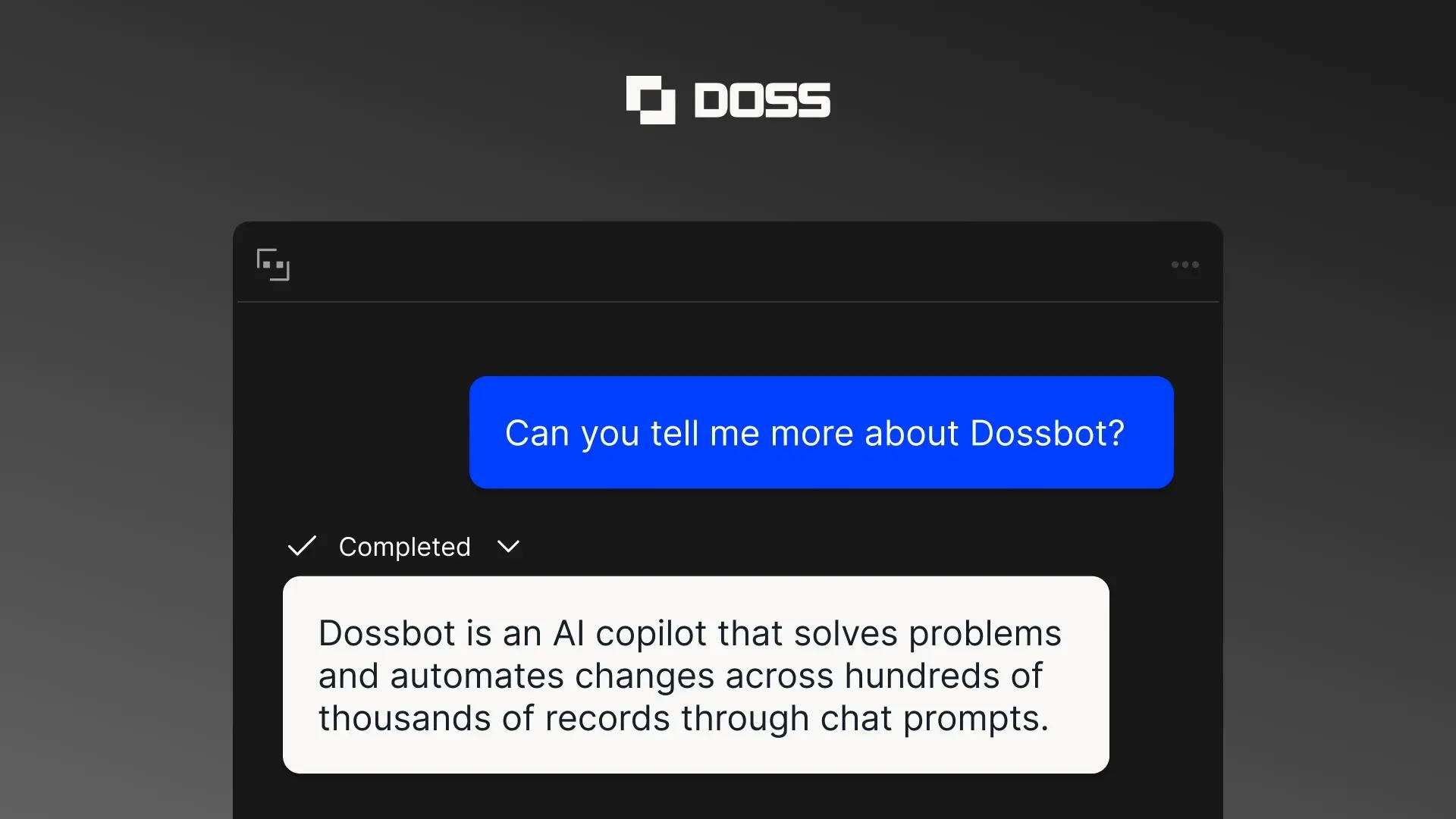
Dossbot is the AI copilot layer. It automates workflows, executes bulk changes across hundreds of thousands of records, and resolves operational issues through conversation. It's not a chatbot that answers questions. It’s a system that acts, and one that gets more useful as it learns how your operation runs.
The support model matters too: DOSS is implemented and managed by technical product managers, not third-party consultants. They implement your workspace, they understand your business, and they're the same people you work with as it evolves. That’s a structural difference from the legacy ERP implementation model, where the people who built the system and the people who support it are rarely the same.
Example implementation timeline
Typical time to initial value: four to six months, with iterative delivery throughout. Not a big-bang go-live at the end of a twelve-month project.
How Operators Made the Transition: Three CPG Brands That Got to the Other Side
The principles above are more useful when grounded in what the transition actually looked like for brands that made it. Three examples across different stages and use cases.
Verve Coffee Roasters: From Fragmented Data to Real-Time Visibility
Verve is a specialty coffee roaster and retailer operating across wholesale, DTC, and their own retail locations, a channel mix that creates real operational complexity. Before DOSS, their data was spread across tools that didn't talk to each other, and getting a clear view of their manufacturing and wholesale operations required pulling it together manually.
The core problem wasn't that any individual tool was broken. It was that there was no unified layer across them. Decisions about production, inventory, and fulfillment were being made on information that was always slightly out of date, assembled by hand.
After implementing DOSS, Verve brought their unbatched order rate down from 30% to 1%, meaning the gap between orders received and orders in production collapsed almost entirely. The manufacturing team recaptured more than 20 hours per week that had been going to manual coordination and reconciliation.
"We had no unified way to access our data to guide growth. DOSS solved that without replacing existing tools and gave us fast insights across the entire organization." — Anthony Fassio, Director of Operations, Verve Coffee Roasters
That last part matters: DOSS unified the data without requiring Verve to rip and replace the tools that were working. The platform integrated with what was already in place and created the visibility layer that had been missing.
Mezcla: Scaling Revenue Without Scaling the Ops Team
Mezcla makes high-protein snack bars and has been one of the faster-growing brands in the better-for-you food space. Their operations challenge was the one that faces every brand at their growth stage: how do you scale revenue, SKUs, and channel complexity without making operations the bottleneck, or building a team that grows as fast as the business does?
Justin Grender, Mezcla's Director of Operations, came to DOSS with a specific goal: as the company scaled, his time spent on day-to-day operations should not scale with it. The team needed to handle more complexity with the same headcount, and they needed the system to do more of the work.
After implementation, Mezcla cut more than 12 hours of manual ops work per week and doubled their PO processing speed. The efficiency gains weren't from working faster. They came from removing the coordination overhead that had been absorbing time that should have been going to higher-value work.
"My goal is that as we continue to scale, my time spent in day-to-day operations does not also increase. DOSS is a 10x tool because it's so automated, easy to use, and efficient." — Justin Grender, Director of Operations, Mezcla
The broader principle Mezcla reflects is one that comes up across every fast-growing CPG brand: adaptability isn't just about flexibility. It's about building a system that handles increasing complexity without requiring proportional increases in team size or manual effort.
“Look for something customizable that can adapt and scale, not restrain you,” Grender said. It's as direct a summary of what to look for in operations infrastructure as you'll find.
Spread the Love: Inventory Accuracy at Scale
Spread the Love makes nut butter products and operates with a multi-SKU inventory model across multiple pack formats, a configuration that creates specific challenges for inventory tracking accuracy. Their core problem was one of inventory integrity: when you're shipping both 40-packs and 36-packs, and your 3PL needs to track total jar count while maintaining the integrity of each pack configuration as its own SKU, most inventory systems either get it wrong or require manual workarounds to get it right.
The operational downstream of inventory inaccuracy is significant: incorrect replenishment signals, margin erosion from over- or under-ordering, and customer service failures when inventory counts don't match what's actually shippable.
After implementing DOSS with a full 3PL integration, Spread the Love's inventory is recognized accurately and in real time, with the system correctly handling the multi-pack complexity without manual reconciliation. Their order processing speed improved by 12 times over the previous process.
"With our 3PL integration, inventory is recognized accurately and in real time. DOSS has greatly improved our inventory management and efficiency." — Zach Fishbain, CEO, Spread the Love
The Spread the Love example illustrates something worth stating directly: the value of an accurate, real-time inventory foundation isn't just operational efficiency. It's margin protection. Every inventory error that doesn't get caught has a cost: over-procurement, write-offs, and the operational overhead of fixing the downstream effects. Getting this right is not a nice-to-have.
Picking the Infrastructure for the Business You're Becoming
The stages in this guide don’t map cleanly onto every brand’s history. Some skip the ERP phase entirely. Some get stuck in the fragmented tool stack era for years without recognizing the cost. The point isn't to trace your exact path but to recognize where the current constraints are.
The question that matters at this stage of growth is straightforward: is your current infrastructure built for where the business is going, or just for where it’s been?
A few concrete diagnostics:
Can you change a workflow without opening a consultant ticket or waiting for an engineering sprint?
Do your inventory, order, and financial data all come from the same source of truth — or are you reconciling between systems as a recurring task?
When you add a new sales channel or a new 3PL partner, does operations scale with it, or does it require significant manual setup that takes weeks to stabilize?
Is your team spending more time on operations, or on managing the workarounds your current system requires?
If those questions feel familiar, the infrastructure probably isn't keeping up with the business.
The brands that scale operations well aren’t the ones with the biggest ops teams. They’re the ones who build on systems that adapt as fast as the business does, that encode operational knowledge rather than depending on specific people to carry it, and that create visibility across the operation without requiring someone to assemble it manually each week.
That’s what operations infrastructure is supposed to do. And for brands that have been stuck in Stage 2 or Stage 3, it’s closer than the ERP playbook made it seem.
Ready to see where your operations stand? Book a demo below.