A personal care manufacturer recently lost $35,000 in a single batch run. A worker added 5% salt to a formula instead of 0.5%. The master batch record required manual calculation, and there was no system-enforced constraint to catch the error before the batch ran.
Replacing or consolidating operations software is one of the most consequential decisions an operations team will make. The platform you choose shapes how your business runs for the next years: what your team can see, how fast you can adapt, what finance is able to report on, and whether your warehouse staff works in the system or around it.
The category is crowded and the terminology is inconsistent. “ERP,” “operations platform,” “inventory management,” and “supply chain software” are used interchangeably by vendors who may not be solving the same problem. Meanwhile, most buying processes are led by the operations team but involve finance, IT, and sometimes a warehouse manager or two. Each stakeholder is evaluating differently.
This guide is written for the operations leader running the evaluation: typically a VP of Operations, Director of Operations, COO, or founder-operator at a physical product business in the $10M to $500M revenue range. This guide covers:
Who is involved in this decision and what they need from the process
How to frame the investment internally before the formal evaluation begins
What to evaluate when you’re talking to vendors, and what good answers look like
A buying checklist at the end that maps each criterion to the right reviewer
Part 1: Know Your Stakeholders Before You Start
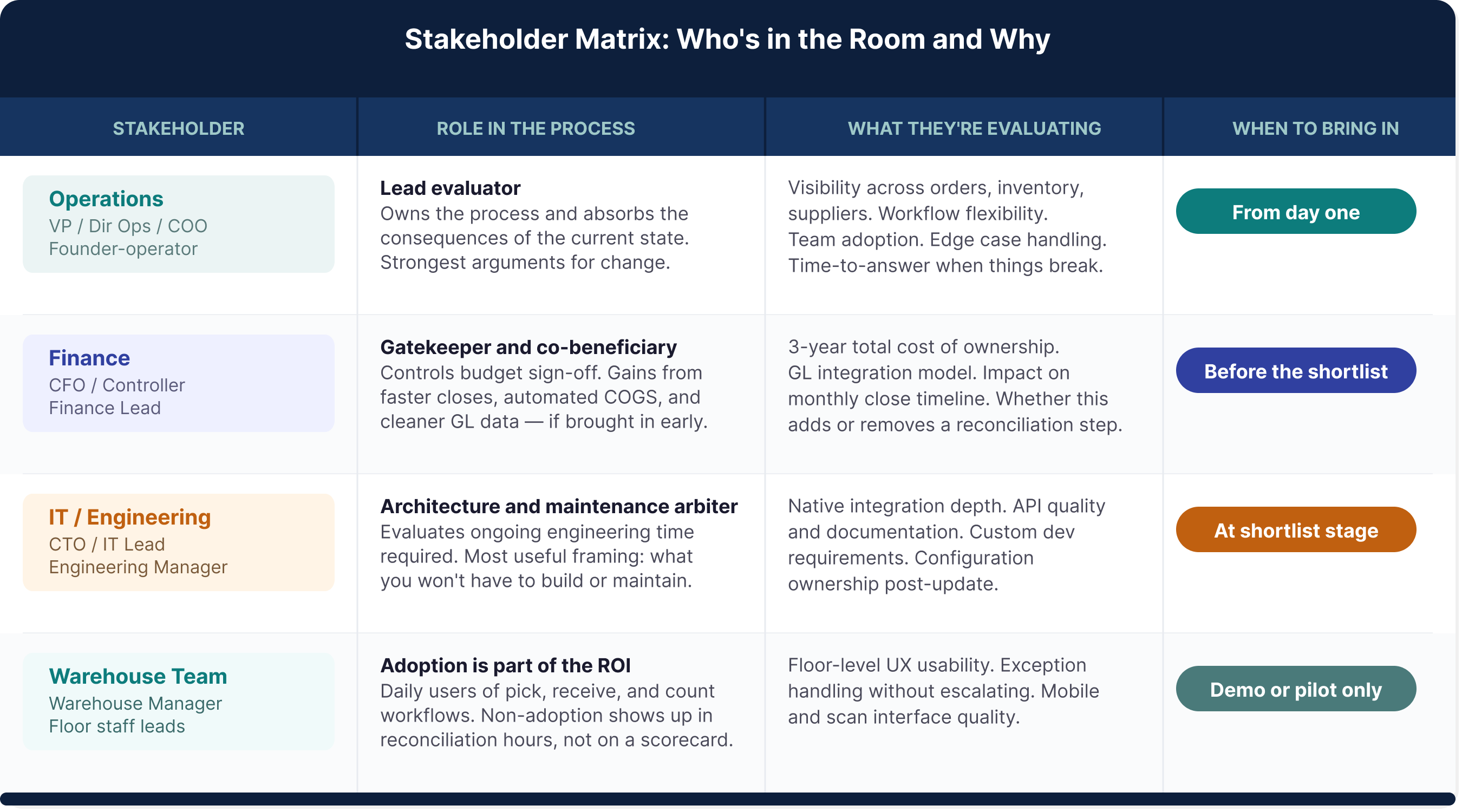
Operations software decisions rarely stall because the product was wrong. They stall because the wrong people were involved too late, or the right people were never aligned on what they were actually evaluating.
Operations: You Own the Process
You’re the lead evaluator because you’re the one absorbing the consequences of the current state. Your criteria are operational: can you see what you need to see across orders, inventory, and suppliers when you need it, across every node of operations? Can you change a workflow when the business changes? Will your team actually use this system, or route around it?
That specificity is also your sharpest tool in the internal buying process. “We spend four hours every Monday reconciling 3PL inventory” is a budget conversation. “Our system doesn’t alert anyone when a purchase order is placed with incomplete master data” is a risk conversation. “Finance has been asking for COGS visibility for two quarters and we can’t provide it” is a finance alignment conversation. The more precisely you can name what’s broken and what it costs, the harder the case is to defer.
Finance: A Gatekeeper and a Co-Beneficiary
Finance typically enters operations software evaluations at two points: when budget is first requested, and when a deal is close to signature. Bringing them in earlier changes the dynamic.
Finance is asking different questions than you are. What’s the total cost over three years, not just the license but implementation, training, and ongoing support? What does this do to your close timeline, relative to existing GL integrations? Does this create a new reconciliation step between operations and accounting, or eliminate an existing one?
The pitch to finance is not “we’re replacing your accounting system.” It’s that the operations layer will feed your GL cleaner, faster data, while existing accounting tools stay in place. When a finance leader understands they’re getting faster closes, automated COGS, real-time margin visibility, and better accrual data without having to change existing processes, the conversation shifts.
We saw one finance team make the business case entirely on the close timeline: the operations data lag was adding two to three days to every monthly close. That’s recoverable time with measurable dollar value. Bring finance in before the shortlist. Let them define the financial evaluation criteria.
IT and Engineering: Architecture and Maintenance Cost
What IT is really trying to answer covers two things: how much of their time this requires on an ongoing basis, and what the transition actually looks like. That means migration timelines, how long the old and new systems need to run in parallel, and what ongoing technical ownership looks like once you’re live.
A system with extensive native integrations, no-code workflow configuration, and a well-documented API answers those questions more favorably than one requiring custom development every time you add a channel or integration.
The most useful framing for engineering is not “here’s what the software does.” It’s “here’s what you won’t have to build or maintain.”
The Warehouse Team: Adoption Is Part of the ROI
Warehouse team members are often the last stakeholders considered in an operations software evaluation, and the first whose non-adoption breaks the business case. If picking, receiving, and inventory count workflows are going to run through this system, the people doing those tasks daily are a meaningful input to the decision.
This isn’t about running a vote on software selection. It’s about checking whether the floor-level UX is usable by the people on the floor, and whether basic exceptions and edge cases can be handled without escalating every time. A warehouse team that works around the system is a problem that shows up in your reconciliation hours, not on your demo scorecard.
How to Structure the Process
Keep the core evaluation team small: operations leads, with one finance stakeholder and one IT contact as defined reviewers. Bring the warehouse team in during demo or pilot, not earlier. Sequence stakeholders so the right people are answering the right questions, rather than everyone evaluating everything at once.
Keep reading: unlock the full guide
Fill out the form below to access the remaining sections, including actionable frameworks, real case studies, and diagnostic tools.
Part 2: How to Build the Case Internally
Before you send an RFP or schedule a first demo, you need an internal narrative for why this matters and what it’s costing you to stay where you are.
Start With What the Status Quo Is Costing You
The strongest internal case for new operations software is not built on features. It’s built on a specific, honest accounting of what your current state costs in time, dollars, and margin. You need to be able to answer questions like:
How many hours per week does your team spend reconciling data between systems?
What’s the dollar value of inventory errors from the last quarter: missed sales, emergency freight, write-offs, production losses?
How often does finance wait on operations for data they need to close the books, and how many days does that add to your close?
What’s your time-to-visibility when something goes wrong in your supply chain?
What decisions are made on sales data right now, and what’s the exposure?
One food manufacturer we spoke with described spending hours every week manually reconciling production variance in Excel, because their system had no mechanism to handle co-manufacturer yield variability automatically. Another operator discovered that their Shopify retail inventory was reflecting only Amazon data, creating what they estimated as 100% exposure risk across their entire retail inventory position. Neither knew the full cost of those gaps until they were forced to quantify it.
If you don’t have answers to these questions, your finance counterpart will ask for them. Better to have them before the conversation starts.
Frame the Status Quo as the Risk, Not the Investment
The most common internal objection to replacing operations software is that now isn’t the right time. The correct response is not to promise a painless implementation. It’s to name what staying put costs.
Another year of manual reconciliation. Another hiring cycle to absorb operational complexity that software should be handling. Another quarter where inventory surprises hit margins after the fact, rather than before decisions get made. The time investment in migrating to new software is one-time. The cost of the status quo is recurring, and it compounds as you add SKUs, channels, and suppliers.
A specialty beverage company going through this evaluation with DOSS surfaced a $2.7 million inventory exposure gap between their recorded inventory and their physically counted inventory. They discovered this while preparing for a go-live date, not as part of a prior audit. The gap had been there. The system just hadn’t made it visible.
Position Finance as a Co-Beneficiary
Finance’s instinct is to avoid risk. The most effective way to shift that posture is to lead with their outcomes: faster closes, accurate automated COGS, real-time margin visibility, and GL integrations that eliminate the manual reconciliation step between operations and accounting. Finance leaders respond to outcomes they can put in front of their CFO, not to operations feature comparisons that they can’t translate into their own reporting.
Be Honest About Implementation
Every operations software implementation involves disruption. Implementations stall when leadership expectations are mismanaged, not necessarily when the software is wrong. Be upfront with your leadership team that there’s a transition window and that early stages require focused effort. The payoff is on the other side of that window, and the timeline should be grounded in reference customer data, not vendor best-case scenarios.
Part 3: What to Evaluate
Some factors carry more weight than others. The following six areas separate platforms that create leverage over time from those that solve today’s problem and create tomorrow’s.
1. Real-Time Data Visibility
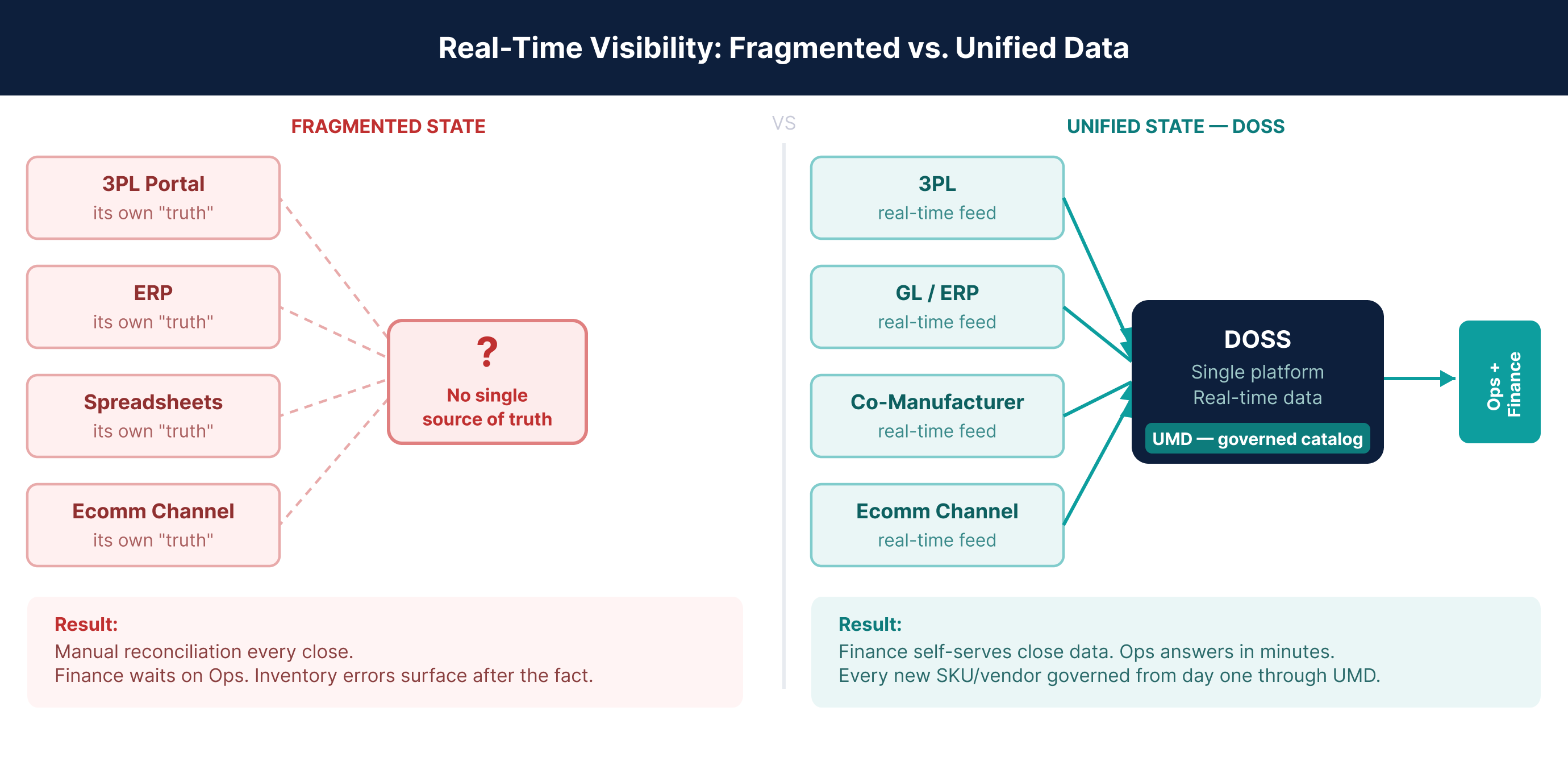
The most commonly cited reason operations leaders start evaluating is also where most existing systems fall short. The question isn’t whether a platform has reporting. It’s whether data is current, complete, and accessible to the people who actually need it across your entire operation, including 3PLs, co-manufacturers, and sales channels.
Ask vendors:
Can you see inventory positions, open POs, and order status in a single view, updated in real time?
Does visibility extend across your 3PLs, co-mans, and channels, not just the parts of the business natively on the platform?
Can finance pull the data they need for month-end close without requesting it from operations?
When something goes wrong in your supply chain, how quickly can you identify where the problem is and what it’s costing you?
Can your team get to the answer they need, on their own, without filing a data request to engineering?
If you add a new vendor or SKU today, how quickly does that record flow through to procurement, inventory, and financial reporting, and does the platform enforce the data standards required for it to produce accurate COGS and margin visibility from day one?
That last question gets at master data governance, something that rarely surfaces in standard evaluations. When you add a new SKU, vendor, or pack configuration, the platform needs to enforce consistent attributes and mappings for that entity to produce accurate COGS and margin data across every module. Without a governing data model underneath the platform, visibility can look right at the surface and break the moment you need to reconcile an anomaly or extend the catalog. DOSS handles this through Unified Master Data (UMD), a governed catalog of products, vendors, customers, and locations that all workflows, integrations, and financial outputs reference from day one.
A platform that requires a bolted-on BI tool or manual exports to answer basic business questions is not operating as a true data layer for your business.
“Before DOSS, we had non-integrated systems that had the data, but we didn’t have a way to bring it all together to monitor KPIs or make decisions as we look to grow the organization.” — Anthony Fassio, Chief Retail & Operations Officer, Verve Coffee Roasters
2. Flexibility to Change Without Consultants
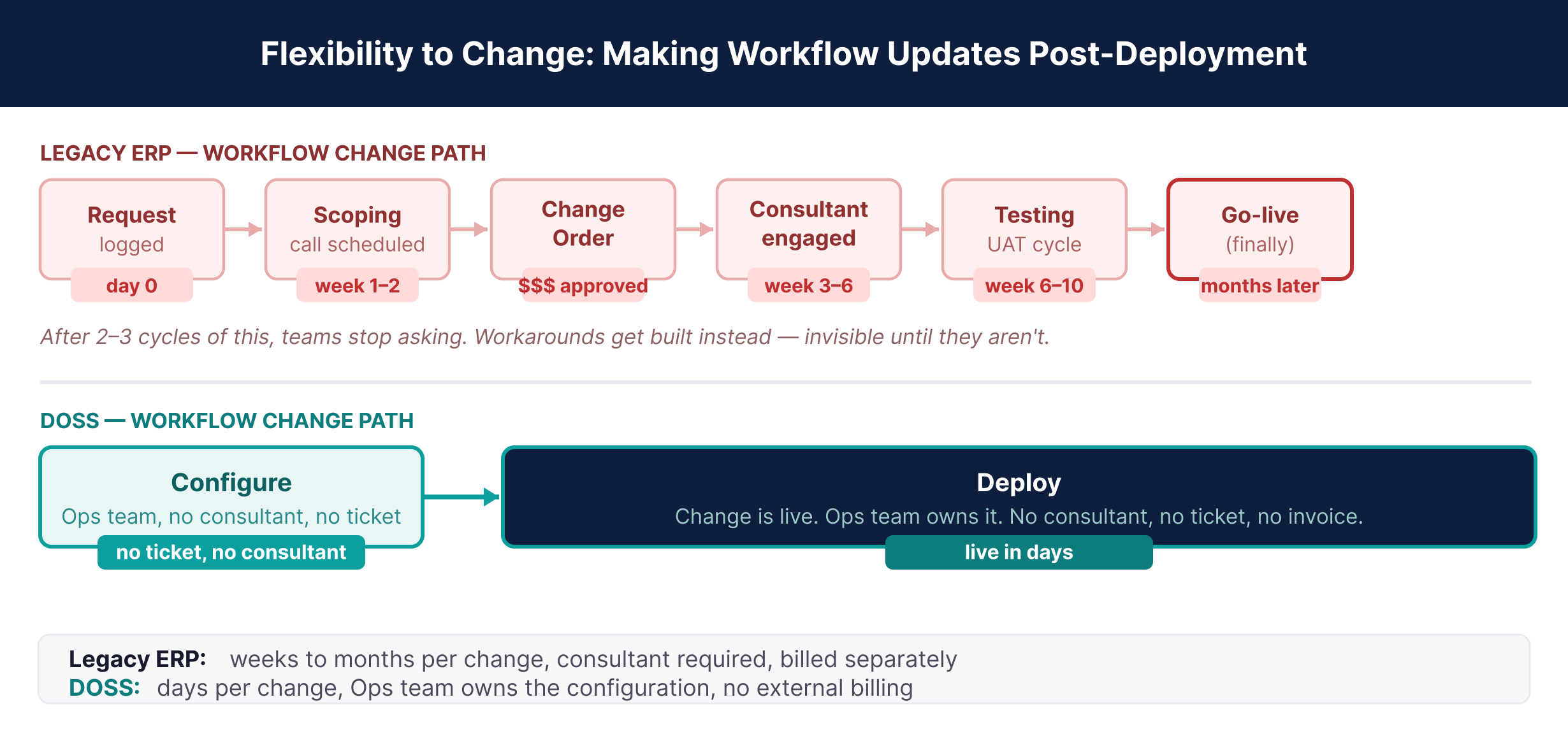
Your business will change. New channels, new fulfillment models, new pricing structures, new supplier relationships. The question isn’t whether the software can handle your current workflows. It’s how much it costs you to change them.
This is where legacy ERPs have a consistent failure pattern. The initial implementation is configured to your workflows, and then the software locks in. Every subsequent change requires a change order, a consultant, and a timeline you didn’t budget for. After two or three of those cycles, teams stop asking and start building workarounds instead. Workarounds are invisible in your P&L until they’re not.
Ask vendors:
Can you modify workflows, automations, or business logic without an IT ticket or a consulting engagement?
How long does a meaningful workflow change typically take: hours, days, weeks, or months?
What happens to your configuration when the platform releases a major update?
Can the software handle edge cases and exceptions, or do those get routed around the system?
How many consultant hours are you currently billing your typical customer annually, post-go-live?
“A lot of other ERP systems were very rigid and you had to conform around what they’d already built. DOSS was pretty much the opposite. It was very flexible and it molded to our business processes.” — Antonio Landa, Senior Operations Manager, De Soi
3. Time to Value and Implementation Model
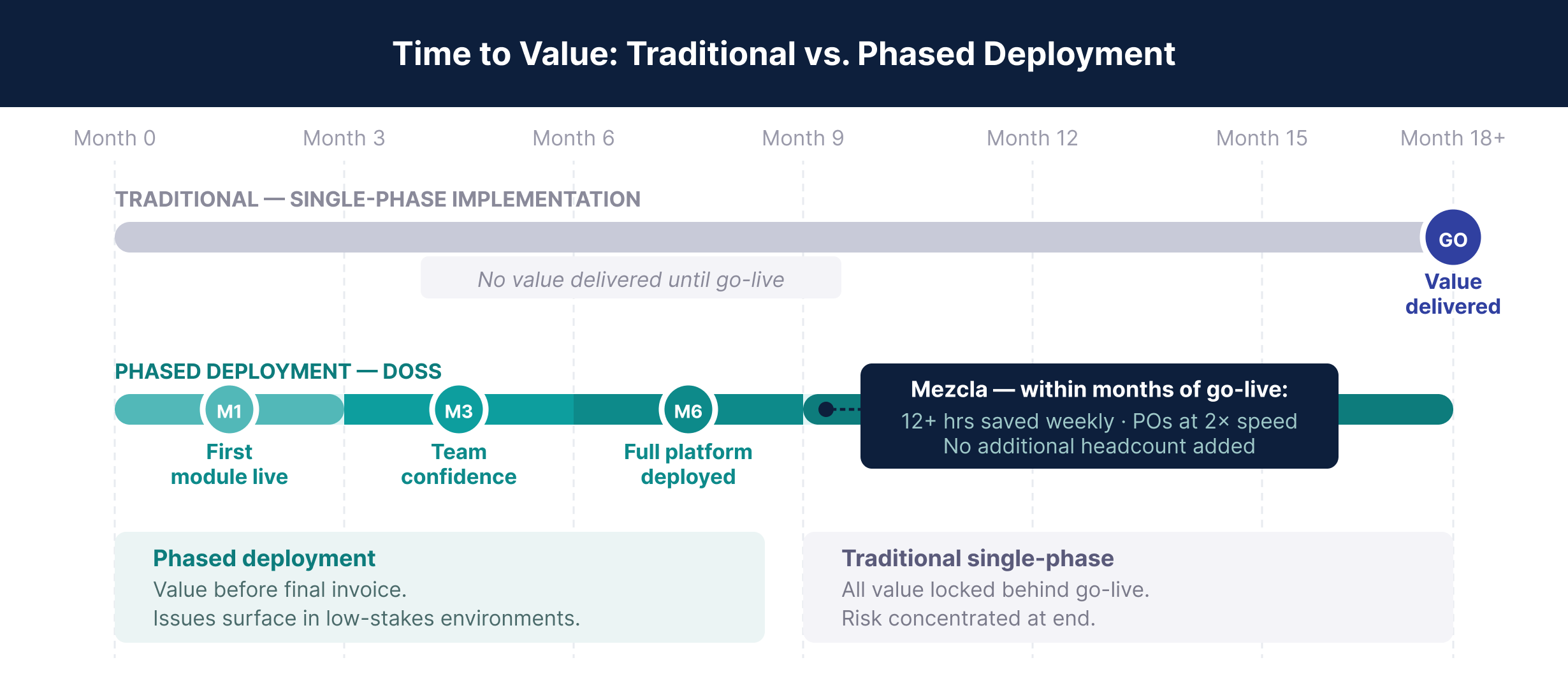
A platform that takes 18 months to implement and delivers nothing until month 18 is a high-risk investment, especially for a business growing through the implementation window. Evaluate for time-to-first-value, not just time-to-full-deployment.
Phased implementations that deliver working modules before the full platform is live let your team build confidence in the system, surface configuration issues in lower-stakes environments, and demonstrate value to finance and leadership before they’ve seen the full invoice.
Ask vendors:
What does the implementation timeline look like, and when does the team start seeing value?
Is implementation run by the vendor’s own team, or outsourced to a third-party consulting firm?
Can you start with one module or workflow and expand, or is it a full-platform implementation only?
What does it cost to make configuration changes post-go-live, and who owns them?
Can you connect us with two or three customers who can speak specifically to the first 90 days?
That last request is the most useful proof point a vendor can offer. What did go-live actually look like? What broke? How was it handled?
DOSS typically deploys in 4 to 6 months with iterative value delivered throughout. Mezcla was saving 12+ hours weekly and processing POs at twice the previous speed within months of go-live, without adding operations headcount.
“My goal is that as we continue to scale, my time spent in day-to-day operations does not also increase. DOSS is a 10x tool because it’s so automated, easy to use, and efficient.” — Justin Grender, Operations Manager, Mezcla
4. Total Cost of Ownership
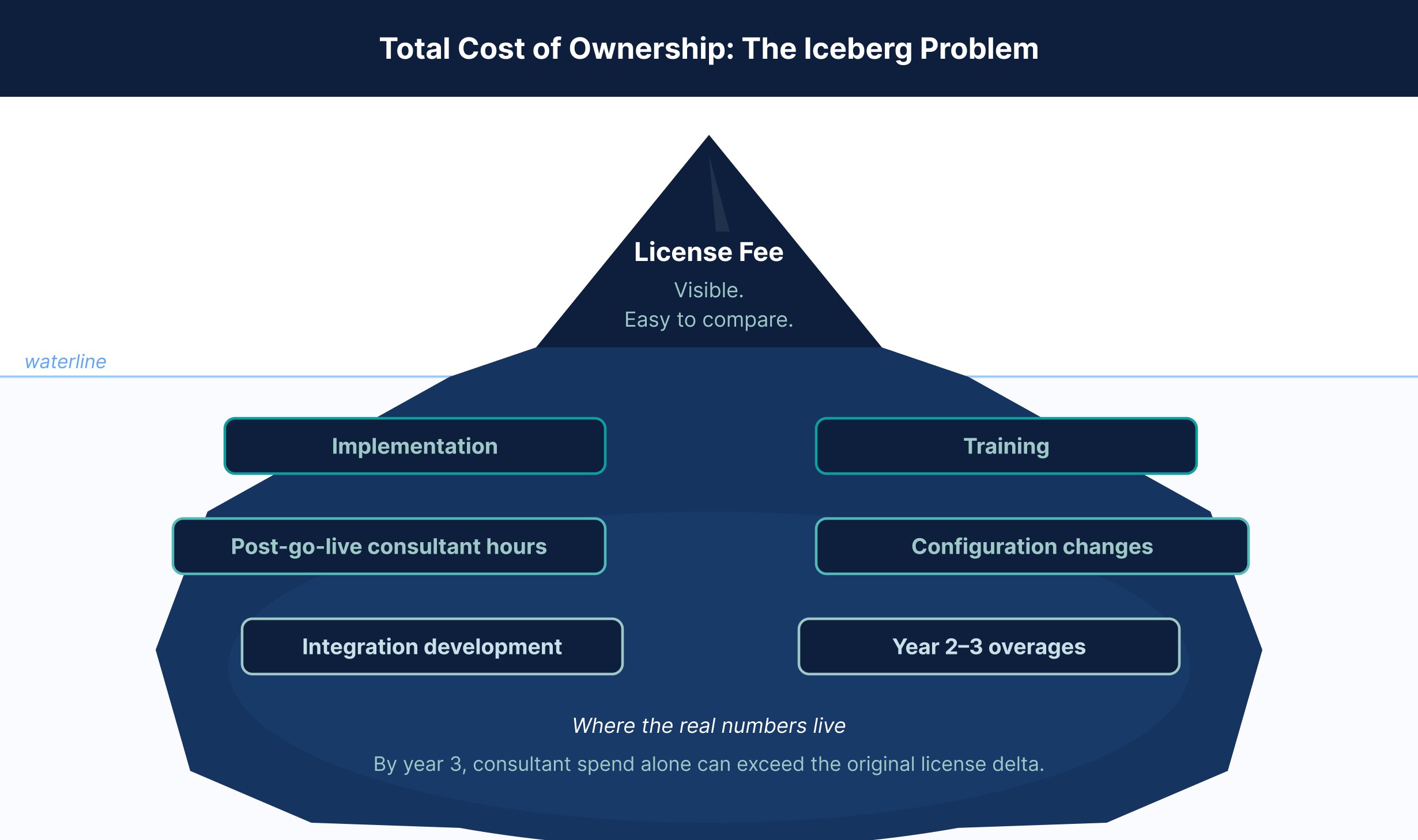
License fees are the visible part of the cost equation. Implementation, training, customization, ongoing consultant support, and integration development are where the real numbers often live, and where apples-to-apples comparisons break down.
A common pattern: a platform with a lower license fee and high consultant dependency ends up more expensive than one with a higher license fee and a self-service configuration model. By year three, the delta in consultant spend can be larger than the original license difference.
Ask vendors:
What’s the total cost of year one, including implementation? What does year three look like, assuming normal business evolution?
Are post-go-live configuration changes included in support, or billed separately?
How many consultant hours are typically required in the first year after go-live?
What happens to cost as you add modules, users, channels, or data volume?
When your customers need to make a workflow change, do they call you, or do they do it themselves?
Require a total cost of ownership comparison, not a line-item license comparison, before you evaluate cost.
5. Finance and GL Integration
The question for finance is not whether this replaces the accounting system. It’s how the operations platform connects to it. A strong operations platform gives finance better, faster data. It doesn’t create a parallel financial environment that diverges from the GL.
The failure mode to watch for: operations data that looks right inside the platform but doesn’t map cleanly to the chart of accounts, producing a reconciliation step that defeats the point of the integration.
This is especially common for businesses with operational complexity: multiple pack configurations, multi-3PL inventory, multi-channel COGS allocation. The accounting for a DTC order, a wholesale pallet, and an FBA receipt are different. A platform that can’t model that complexity accurately will produce GL entries that finance then has to manually correct.
Ask vendors:
Does the platform integrate with your existing general ledger natively (e.g. QuickBooks, NetSuite, Xero, Sage), or through a third-party connector?
How does financial data move between the operations layer and the GL: automatically, or through manual exports?
Can finance run accruals, COGS analysis, and close activities from the data in this system?
Does the platform handle your operational complexity (pack configurations, multi-3PL, multi-channel COGS) in a way that maps cleanly to your chart of accounts?
What does GL reconciliation look like at month-end?
Have the GL integration story ready before the finance sign-off conversation, not during it.
“With our 3PL integration, inventory is recognized accurately and in real time… DOSS has greatly improved our inventory management and efficiency.” — Zach Fishbain, Co-Founder and CEO, Spread the Love
6. AI and Automation: Real Capability vs. Positioning
Most vendors will use the word “AI” or “AI-native” when describing their platform. The evaluation question is what that actually means in practice: specifically, what can be automated, what does that automation look like in daily use, and how much configuration does it require.
There’s a meaningful difference between AI that surfaces insights and AI that executes actions. A platform that can identify which orders are at risk is useful. A platform that can automatically route exceptions, bulk-update records based on a natural language instruction, and flag an anomaly in a production run before it compounds into a $35,000 loss is in a different category.
Ask vendors:
Can the platform execute bulk changes across records through natural language, or does it only surface insights?
Does AI assist with exception handling and operational issue resolution, or is it primarily a reporting layer?
Are automation rules configurable by the operations team, or do they require engineering involvement?
When an AI-generated action is wrong, is there an audit trail and a rollback path?
The practical bar is measurable: does this reduce hours spent on manual work, and do reference customers have numbers to back it up?
Verve Coffee Roasters , for example, cut their unbatched order rate from 30% of the queue to 1%, saving 20+ hours weekly across the entire 15+ staffed manufacturing team. That’s the kind of benchmark worth holding vendors to.
Part 4: Buying Checklist
Use this checklist to structure vendor evaluations and internal review conversations. Each criterion maps to the evaluation framework in Part 3. The “Who Reviews” column reflects who should validate or approve each item, not necessarily who does the research.
Evaluation Criterion
Who Reviews
Visibility & Data
Real-time inventory visibility across all 3PLs and channels
Ops, Finance
Single source of truth for orders, open POs, and supplier activity
Ops
Finance can self-serve close data without requesting it from Ops
Finance
Real-time margin and COGS visibility for finance reporting
Finance, Ops
Time-to-answer for operational issues (target: minutes, not hours)
Ops
Flexibility & Adaptability
Workflow changes can be made without consultants or engineering
Ops, IT
Platform can handle your specific edge cases and exceptions
Ops
Configuration is preserved through platform updates
IT, Ops
No-code tools allow Ops team to own ongoing changes
Ops
Reference customers can describe a workflow change they made themselves
Ops
Implementation & Time to Value
Phased implementation available; can start with one module
Ops
Implementation is run by vendor's own team, not third-party
Ops
Reference customers can speak to first-90-days experience, including what broke
Ops
Time to first value is under 6 months
Ops
Vendor provides actual customer implementation data, not pitch-deck timelines
Ops, Finance
Total Cost of Ownership
Year 1 and Year 3 total costs (incl. implementation) are provided in writing
Finance, Ops
Post-go-live configuration changes are included in support
Finance, Ops
Consultant hours post-go-live are estimated and bounded
Finance
Cost model does not penalize for adding users or data volume
Finance
Annual consultant spend for comparable customers is disclosed
Finance
Finance & GL Integration
Native integration with your existing general ledger
Finance, IT
Financial data flows automatically, no manual exports required
Finance
Supports pack/SKU/channel complexity in GL mapping
Finance, Ops
Finance can run close activities directly from operations data
Finance
GL reconciliation at month-end requires no manual correction step
Finance
AI & Automation
Bulk changes executable through natural language
Ops
AI assists with exception handling, not just reporting
Ops
Automation rules configurable by Ops team, not engineering
Ops, IT
Audit trail and rollback available for AI-generated actions
Implementation and post-go-live support owned by vendor's own team
Ops, IT
Direct access to technical product managers, not a support ticket queue
Ops
SLA and escalation path defined at contract stage
IT
About DOSS Operations Cloud
DOSS is the Operations Cloud built for the real world: an AI-native system that helps physical product businesses manage the flow of goods, dollars, and data across procurement, inventory, orders, fulfillment, and finance in real time.
At its core is an Adaptive Resource Platform built on a composable data model, enabling teams to deploy quickly, customize without code, and adapt in minutes, with Dossbot embedded throughout as an AI copilot to automate workflows and resolve operational issues through conversation.
Backed by Madrona, Premji Invest, Intuit, and others, DOSS is trusted by fast-growing operators to run critical operations with speed, control, and confidence.