




CPG companies looking for an ERP often narrow their search to two options: NetSuite and Odoo. Both are capable systems, but they serve different types of businesses and require different levels of investment, and neither is purpose-built for CPG. This guide breaks down how NetSuite and Odoo compare for CPG-specific needs including inventory management, procurement, demand planning, and total cost of ownership, and where purpose-built alternatives like DOSS fit into the picture.
What Is NetSuite?
NetSuite is a cloud-based ERP developed by Oracle. It is one of the most widely deployed mid-market to enterprise ERPs globally, with modules covering financials, inventory, order management, manufacturing, CRM, and e-commerce. For CPG companies, NetSuite offers functionality including demand planning, lot tracking, and multi-location warehouse management.
NetSuite is sold as a SaaS subscription with licensing based on number of users and modules. Implementation typically requires a certified NetSuite partner.
What Is Odoo?
Odoo is an open-source ERP available in both a community edition (self-hosted, free) and an enterprise edition (cloud or self-hosted, paid). It covers inventory, manufacturing, sales, purchasing, accounting, and CRM through a modular structure. Businesses can deploy only the modules they need and add more over time.
Odoo is known for its flexibility and relatively lower cost of entry compared to NetSuite. However, meaningful customization typically requires developer resources.
A Third Option: DOSS
Before comparing NetSuite and Odoo head-to-head, it is worth noting that both are horizontal ERPs built to serve many industries. CPG brands that evaluate them often find that the features they actually need like lot tracking, co-manufacturer PO management, multi-location inventory, and real-time order visibility are available in a purpose-built platform without the overhead of a full ERP implementation.
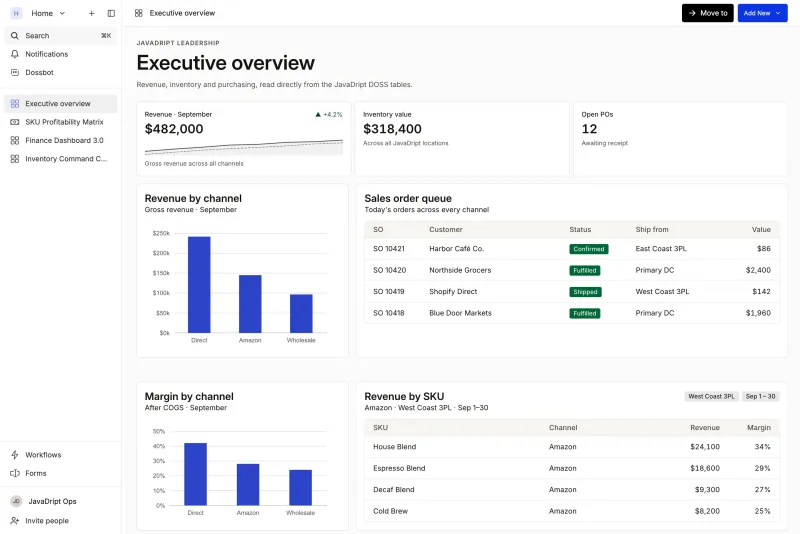
DOSS is built specifically for CPG and consumer brands. It connects inventory management , order management , and procurement in one platform and integrates with existing accounting tools like QuickBooks and Xero rather than replacing them. For growing CPG brands that do not yet need enterprise financial infrastructure, DOSS is a practical alternative worth evaluating alongside NetSuite and Odoo.
Feature Comparison: NetSuite vs Odoo for CPG
CPG-Specific Considerations
Lot Tracking and Traceability
Both NetSuite and Odoo support lot tracking, which is essential for CPG companies that need to trace products through the supply chain for recalls, compliance, or quality control. NetSuite's lot tracking is tightly integrated with its demand planning and fulfillment workflows. Odoo's lot tracking works well at the warehouse level but may require configuration to surface traceability data across the full procurement-to-customer chain.
Demand Planning
NetSuite has a native demand planning module that generates replenishment recommendations based on historical sales data, lead times, and safety stock settings. Odoo's community edition has limited demand planning; the enterprise edition offers more forecasting capability, but it is less mature than NetSuite's offering.
For CPG brands with seasonal SKUs, promotional spikes, or complex multi-channel demand patterns, NetSuite's demand planning tools are generally more capable out of the box.
Procurement and Supplier Management
Both systems handle purchase orders, vendor management, and receiving workflows. NetSuite's procurement module includes automated approval workflows and integrates with financial controls. Odoo's purchasing module is flexible and configurable but may require customization to support complex procurement approval chains common in CPG.
Multi-Location Inventory
Both systems support multi-location inventory. NetSuite handles complex warehouse structures including bins and zones. Odoo supports multi-warehouse and can model 3PL and consignment inventory with configuration.
Integrations
CPG companies typically need integrations with co-manufacturers, 3PLs, e-commerce platforms, and retail portals. NetSuite has a large partner ecosystem and native connectors to platforms like Shopify, Amazon, and SPS Commerce. Odoo has a marketplace of community and enterprise apps but may require more custom development for niche integrations.
Pricing Comparison
NetSuite: Pricing is not publicly listed but typically ranges from $30,000 to $100,000+ per year depending on modules, users, and company size. Implementation costs from a certified partner often add another $20,000 to $150,000.
Odoo Community: Free to self-host. Requires developer resources for setup and maintenance.
Odoo Enterprise: Starts at approximately $20 per user per month. Cloud hosting adds additional costs. Implementation can range from $10,000 to $60,000+ depending on customization needs.
The total cost of ownership for Odoo can be lower than NetSuite, but this depends heavily on how much customization is required. Highly customized Odoo deployments can become expensive to maintain.
Which Is the Right Fit?
Choose NetSuite if:
- Your business is scaling past $200M in revenue and needs a mature, supported ERP platform
- You need native demand planning and financial controls without significant customization
- You want a vendor-managed cloud system with predictable support and updates
- You are willing to invest in implementation and licensing for a proven platform
Choose Odoo if:
- You want a lower initial cost and are comfortable with more technical involvement
- You have developer resources to customize workflows to your exact needs
- You are a smaller or mid-size CPG brand that does not need NetSuite's full feature set
- You prefer modular adoption, starting with inventory and adding modules over time
Consider DOSS if:
- You need CPG-specific inventory, order management, and procurement without full ERP financial infrastructure
- You already have accounting software in place and want operations tooling that integrates with it
- You are a growing CPG brand that has outgrown spreadsheets but is not yet ready for NetSuite's cost and complexity