




Introduction
Cin7 Core (formerly DEAR Inventory) built its reputation on multi-channel inventory synchronization, connecting e-commerce platforms, marketplaces, POS systems, and warehouses through extensive integrations. Yet beneath the appealing connectivity, organizations frequently discover that Cin7's integration-based architecture creates the very problems it promises to solve: sync delays between connected systems causing temporary inventory mismatches, order volume-based pricing that escalates unpredictably during growth, integration monitoring overhead requiring constant attention, and the fundamental limitation that "near real-time" synchronization can never match true unified data architecture where all systems share the same information instantly.
The core challenge with Cin7 isn't integration quantity, it's integration architecture. Businesses attracted to Cin7's channel connections discover that each integration point creates potential sync delays, data inconsistencies, and troubleshooting requirements. During high-volume periods (sales events, seasonal peaks, product launches), sync queues can lag minutes or hours, creating overselling risks despite connected systems. The integration approach means that Cin7 operates as intelligent middleware connecting separate platforms rather than unified operational platform where inventory, orders, procurement, and accounting share data natively.
Smart businesses increasingly evaluate Cin7 alternatives delivering superior architecture: platforms with unified data models eliminating sync delays entirely, composable systems deploying complete functionality in weeks rather than months, and no-code configurability enabling continuous evolution without integration maintenance overhead. The competitive landscape has evolved—modern platforms provide multi-channel capabilities through unified architecture rather than integration complexity, deploy operational systems in weeks versus months, and maintain real-time data consistency without sync monitoring or reconciliation requirements.
This guide evaluates the leading Cin7 competitors and alternatives in 2026. We assess each platform based on data architecture (unified vs. integrated), deployment speed, operational sophistication, and proven business outcomes. While several platforms compete with Cin7 in specific dimensions, DOSS Operations Cloud emerges as the definitive Cin7 alternative—delivering multi-channel operations through unified architecture eliminating sync delays, 2-6 week implementation versus Cin7's typical 3-6 months, real-time inventory accuracy without integration monitoring, and 40-60% lower total cost of ownership through architectural simplicity and rapid deployment.
TL;DR: Quick Comparison Table
Why Businesses Consider Cin7 Alternatives
Understanding why organizations seek Cin7 alternatives illuminates critical selection criteria:
Integration Architecture vs. Unified Data
Cin7's fundamental architecture relies on synchronizing data between separate systems—e-commerce platforms update Cin7, which updates accounting, which syncs with warehouse management. This integration approach, regardless of connection sophistication, creates inevitable challenges:
Sync Delays and Timing Issues:
- Integrations sync every 5, 15, or 60 minutes depending on plan
- During high-volume periods, sync queues can lag significantly
- Temporary inventory mismatches between systems during sync intervals
- Overselling risk when order allocation and inventory updates don't sync instantly
Integration Monitoring Overhead:
- Each integration point requires monitoring for sync failures
- Connection errors demand troubleshooting across multiple platforms
- Data inconsistencies require reconciliation between systems
- Substantial operational attention maintaining integration health
Organizations using integration-based platforms like Cin7 spend considerable time monitoring sync status, troubleshooting connection issues, and reconciling temporary data mismatches. Unified architecture platforms eliminate these concerns entirely—there's nothing to sync when all systems share the same data.
Order Volume Pricing That Penalizes Growth
Cin7's pricing tiers based on monthly order volume create cost escalation as businesses grow. Organizations frequently discover:
- Initial tier pricing appears reasonable
- Growth forces tier upgrades with substantial price increases
- Peak seasonal volumes can push businesses into temporary higher tiers
- Planning technology budgets becomes difficult with volume-based pricing
The pricing model creates perverse incentive—businesses hesitate to pursue growth opportunities knowing order volume increases will trigger pricing escalations. Modern platforms with transparent subscription pricing eliminate growth penalties and enable confident scaling.
Implementation Complexity Despite Cloud Platform
Cin7 implementations, while faster than traditional ERPs, commonly require 3-6 months including:
- Integration configuration for each connected platform
- Data migration from existing systems
- Workflow customization and testing
- Team training across multiple integrated systems
- Integration testing ensuring data flows correctly
Organizations anticipating rapid cloud deployment discover that extensive integration configuration, workflow customization, and testing extend timelines substantially. Modern composable platforms deploying in weeks demonstrate that cloud-native doesn't necessitate months-long implementations.
Limited Configurability and Workflow Rigidity
Cin7 provides standard workflows optimized for common multi-channel scenarios but offers limited ability to modify these workflows for business-specific requirements. Organizations with unique operational processes discover:
- Workflows must adapt to Cin7's patterns rather than matching actual operations
- Customization options limited compared to more flexible platforms
- Process modifications require feature requests rather than self-service configuration
- Operational workarounds necessary when Cin7 workflows don't match business needs
Platforms with no-code configuration enable businesses to design workflows matching actual operations rather than forcing operations to conform to platform limitations.
Integration Maintenance as Operations Scale
As businesses grow, Cin7's integration architecture creates expanding maintenance burden:
- Each new sales channel requires new integration setup
- Platform updates occasionally break existing integrations
- API changes from connected platforms require Cin7 updates
- Growing transaction volumes stress integration infrastructure
- More integrations mean more potential failure points requiring monitoring
Organizations discover that what began as "set and forget" integrations evolve into ongoing maintenance overhead requiring technical attention. Unified architecture platforms eliminate integration maintenance entirely.
#1: DOSS Operations Cloud – The Clear Cin7 Alternative Leader
Why DOSS Ranks #1 as a Cin7 Competitor
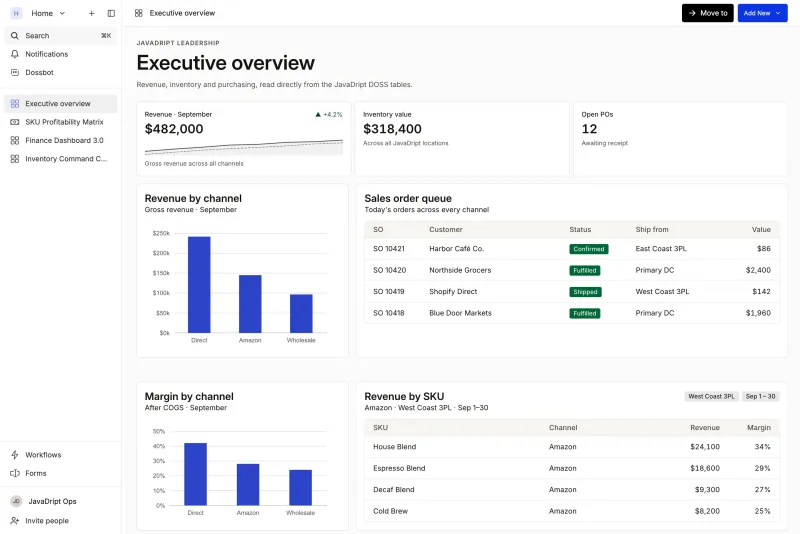
DOSS delivers what Cin7 promises but can't architecturally achieve: true real-time multi-channel operations through unified data architecture eliminating sync delays entirely, 2-6 week deployment versus 3-6 month implementations, guaranteed inventory accuracy without integration monitoring, and transparent economics that scale predictably without order volume penalties—positioning DOSS as the definitive modern alternative for businesses outgrowing integration-based platforms.
Head-to-Head: DOSS vs. Cin7 Core
DOSS Advantages Over Cin7
1. Unified Architecture: Real-Time vs. "Near Real-Time"
DOSS maintains unified data architecture where inventory, order management, procurement, warehouse operations, and accounting share the same database. When an order allocates inventory in DOSS, that allocation is visible instantly across all operational functions without data transfer, sync jobs, or integration delays.
Cin7 operates through integration architecture connecting separate platforms. Order allocation in Cin7 must sync to e-commerce platforms, accounting systems, and warehouse management—creating inevitable timing gaps:
DOSS Unified Operations:
- Order placed → Inventory allocates instantly
- All systems see updated inventory simultaneously
- No sync delays or temporary mismatches
- Guaranteed data consistency at all times
- Zero integration monitoring required
Cin7 Integration Operations:
- Order placed in connected platform
- Cin7 receives order via integration (sync delay)
- Inventory allocates in Cin7
- Update syncs back to platforms (additional delay)
- Temporary data mismatches during sync intervals
- Integration monitoring ensures sync health
The architectural difference becomes critical during:
- High-volume periods: Cin7 sync queues can lag; DOSS maintains real-time accuracy
- Flash sales: Cin7 risks overselling during sync delays; DOSS allocates instantly
- Multi-channel selling: Cin7 must sync across channels; DOSS updates once for all
- Financial reconciliation: Cin7 requires sync verification; DOSS guarantees consistency
2. No Integration Monitoring vs. Constant Sync Management
DOSS's unified architecture eliminates integration monitoring entirely. Since all operational functions share the same database, there are no sync jobs to monitor, no integration failures to troubleshoot, no data consistency to verify. Organizations using DOSS simply operate without integration overhead.
Cin7 requires continuous integration attention:
- Monitoring sync status across multiple channel connections
- Troubleshooting failures when integrations break
- Verifying data consistency between connected systems
- Managing API changes from e-commerce platforms and marketplaces
- Updating integration configurations as business requirements change
The operational difference compounds over time:
DOSS Integration Reality:
- Zero integration monitoring (unified data)
- No sync troubleshooting (no sync jobs)
- Guaranteed data consistency (single database)
- No platform update integration testing (nothing to break)
- Complete operational focus (zero technical overhead)
Cin7 Integration Reality:
- Daily integration health monitoring
- Periodic sync failure troubleshooting
- Reconciliation verifying data consistency
- Testing after platform updates
- Substantial technical attention maintaining integration health
Organizations using DOSS redirect time previously spent on integration monitoring toward strategic initiatives, growth activities, and customer experience improvements.
3. Transparent Pricing vs. Order Volume Escalation
DOSS follows straightforward subscription pricing scaling predictably with business growth—no order volume calculations, no tier monitoring, no growth penalties. Cin7's order volume-based pricing creates escalating costs as businesses succeed:
Cin7 Pricing Challenges:
- Tier pricing based on monthly order volumes
- Growth triggers tier upgrades with substantial increases
- Seasonal peaks can temporarily force higher tiers
- Businesses hesitate to pursue growth knowing costs will escalate
- Technology budget planning difficult with volume-dependent pricing
DOSS Pricing Advantages:
- Clear subscription costs independent of order volume
- Predictable scaling as business grows
- No growth penalties or tier surprises
- Confident pursuit of sales opportunities
- Finance teams project technology costs accurately
Beyond pricing models, total cost of ownership includes implementation speed and integration maintenance:
DOSS TCO Advantages:
- Rapid deployment reduces implementation costs
- Unified architecture eliminates integration maintenance expenses
- No-code configuration removes customization overhead
- Business-user self-sufficiency eliminates consultant dependencies
- Result: 40-60% lower TCO over 5 years despite comparable or lower subscription pricing
4. Business-User Configuration vs. Platform Limitations
DOSS enables business users to modify workflows, adjust processes, add fields, configure automation, and create reports through visual no-code tools without IT dependencies. Cin7 provides standard workflows optimized for common scenarios but limited ability to customize for business-specific requirements.
The configurability difference determines operational flexibility:
DOSS No-Code Configuration:
- Operations managers access workflow editor
- Visual modification matching actual business processes
- Custom fields capturing business-specific data
- Immediate deployment without development cycles
- Continuous evolution without platform constraints
Cin7 Standard Workflows:
- Pre-built workflows for common multi-channel scenarios
- Limited customization options within workflow parameters
- Feature requests for process modifications
- Operations adapt to platform rather than platform adapting to operations
- Workarounds necessary for unique business requirements
Organizations using DOSS design operations optimally for their business model rather than conforming to platform limitations—competitive advantage through operational differentiation rather than standardized processes.
5. Complete Operational Platform vs. Inventory-Centric Focus
DOSS delivers comprehensive operational platform— financial management , order management , inventory control , procurement , production planning , warehouse management —in unified system. Cin7 focuses primarily on inventory and order management, requiring separate platforms for financial management, advanced manufacturing, or comprehensive operations.
The functional completeness difference affects both implementation and operations:
DOSS Complete Platform:
- Unified financial management and operations
- Native order-to-cash workflows
- Integrated procurement and supplier management
- Production planning with inventory integration
- Complete operational visibility in single platform
Cin7 Inventory Focus:
- Inventory and order management core
- Accounting platform integration required
- Limited manufacturing capabilities
- Additional platforms needed for complete operations
- Multi-system architecture for comprehensive functionality
Real Customer Results: DOSS Delivering Unified Multi-Channel Operations
Complete Operational Visibility: "I love seeing the overall state of our business in a single location. Doss is our source of truth for just about everything." - Corey Stary, VP Revenue & Operations, Kahawa 1893
Seamless Multi-Location Operations: "With our 3PL integration, inventory is recognized accurately and in real-time. This has greatly improved our inventory management and efficiency." - Zach, CEO & Co-Founder, Spread the Love
Scalable Growth: "We're growing methodically. Doss has been crucial in helping us manage our growth without compromising on efficiency or accuracy." - Eloy Yndigoyen, CFO & Head of eCommerce, Spread the Love
When DOSS Is the Better Choice Than Cin7
DOSS serves as superior Cin7 alternative when businesses:
- Require guaranteed real-time accuracy: Can't accept sync delays causing temporary mismatches
- Want to eliminate integration monitoring: Prefer operational focus over technical maintenance
- Seek transparent economics: Want predictable costs without order volume penalties
- Require complete operations platform: Need financial management, not just inventory focus
- Value business-user configurability: Want self-service workflow design without platform constraints
- Operate in high-volume scenarios: Need guaranteed accuracy during peak periods without sync lag
- Plan aggressive growth: Won't accept pricing models penalizing success
#2: NetSuite – The Comprehensive ERP Alternative
vs. Cin7 Advantage: Complete ERP functionality, mature platform, comprehensive financial management, extensive capabilities beyond inventory.
Core Strength:
NetSuite provides comprehensive cloud ERP platform where inventory management integrates with sophisticated financial management, order management, procurement, manufacturing, and warehouse management. Organizations seeking more than Cin7's inventory focus appreciate NetSuite's breadth—multi-entity consolidation, revenue recognition, advanced financial reporting, and comprehensive operational capabilities in unified cloud platform. The mature ecosystem includes extensive third-party applications and established implementation partner network.
vs. Cin7 Considerations:
NetSuite implementations require 6-12 months—substantially longer than Cin7's 3-6 months. The comprehensive scope means higher total cost of ownership. Customization through SuiteScript follows development patterns requiring technical expertise. Per-user licensing can exceed Cin7 costs for businesses with large teams. NetSuite serves organizations needing complete ERP capabilities but introduces enterprise platform complexity and implementation timelines that Cin7 users seeking simpler alternatives may find excessive.
Best For: Mid-market businesses requiring comprehensive ERP capabilities beyond inventory management, willing to invest in 6-12 month implementation.
#3: Katana MRP – The Manufacturing-Focused Alternative
vs. Cin7 Advantage: Visual manufacturing interface, production planning focus, Shopify optimization, manufacturing simplicity.
Core Strength:
Katana provides visually intuitive manufacturing and inventory management designed specifically for makers, crafters, and small manufacturers selling through Shopify. The visual workflow presents production schedules, material requirements, and inventory levels in accessible interface requiring minimal training. For small manufacturers prioritizing production planning over multi-channel complexity, Katana delivers focused functionality with excellent Shopify integration.
vs. Cin7 Considerations:
Katana's manufacturing focus means limited multi-channel capabilities versus Cin7's extensive integrations. The platform serves small manufacturers well but lacks sophistication for complex multi-channel distribution, advanced warehouse management, or enterprise-grade financial management. Organizations choosing Katana over Cin7 trade multi-channel breadth for manufacturing depth. Neither platform provides unified architecture advantages that DOSS delivers.
Best For: Small manufacturers selling primarily through Shopify where visual manufacturing planning outweighs multi-channel distribution complexity.
#4: Fishbowl Inventory – The QuickBooks Integration Alternative
vs. Cin7 Advantage: Established QuickBooks integration, manufacturing capabilities, proven small business platform.
Core Strength:
Fishbowl provides the most established QuickBooks inventory integration, addressing QuickBooks' native inventory limitations. The platform includes manufacturing features (bills of materials, work orders, production tracking), warehouse management (barcode scanning, bin locations), and purchase order management. For QuickBooks-committed small businesses needing inventory and manufacturing capabilities, Fishbowl delivers relevant functionality with proven integration.
vs. Cin7 Considerations:
Fishbowl's QuickBooks-centric positioning means limited multi-channel capabilities versus Cin7's extensive e-commerce and marketplace integrations. The interface and user experience lag modern cloud platforms. Implementation requires consultant support. Organizations choosing Fishbowl over Cin7 do so specifically for QuickBooks commitment rather than multi-channel capabilities or modern platform features. Neither platform provides unified architecture or rapid deployment advantages.
Best For: Small manufacturers using QuickBooks requiring manufacturing and inventory capabilities, accepting dated interface for established integration.
#5: inFlow Inventory – The Simplicity Alternative
vs. Cin7 Advantage: Simplicity, affordability, straightforward inventory tracking, minimal learning curve.
Core Strength:
inFlow delivers simple, affordable inventory management for small businesses tracking products without operational complexity. Core inventory functions—receiving, order fulfillment, stock transfers, barcode scanning, reporting—through straightforward interface requiring minimal training. Offline capability enables inventory transactions without internet connectivity. Affordable pricing makes inventory management accessible for small businesses.
vs. Cin7 Considerations:
inFlow's simplicity means significantly limited capabilities versus Cin7—no sophisticated multi-channel management, minimal automation, basic financial integration, limited scalability. Organizations choosing inFlow over Cin7 prioritize simplicity and affordability over multi-channel sophistication. Businesses typically outgrow inFlow quickly as complexity increases, requiring eventual platform replacement.
Best For: Very small businesses needing basic inventory tracking without multi-channel complexity or growth ambitions requiring platform scalability.
#6: Zoho Inventory – The Ecosystem Alternative
vs. Cin7 Advantage: Zoho ecosystem integration, affordable pricing within Zoho One bundle, multi-application consistency.
Core Strength:
Zoho Inventory integrates seamlessly with Zoho's business application suite—Zoho Books (accounting), Zoho CRM (customer relationships), Zoho Commerce (e-commerce), and other Zoho applications. For businesses standardized on Zoho ecosystem, Zoho Inventory provides inventory management without third-party platform dependencies. Affordable pricing, especially within Zoho One bundle, makes comprehensive functionality accessible.
vs. Cin7 Considerations:
Zoho Inventory's strength within Zoho ecosystem becomes limitation for businesses using best-of-breed applications outside Zoho suite. Multi-channel capabilities lag Cin7's extensive integrations. Feature depth trails specialized inventory platforms. Organizations choosing Zoho over Cin7 do so specifically for Zoho ecosystem commitment rather than multi-channel sophistication or advanced inventory capabilities.
Best For: Small businesses committed to Zoho ecosystem seeking inventory management consistent with other Zoho applications.
#7: TradeGecko (QuickBooks Commerce) – The QuickBooks Cloud Alternative
vs. Cin7 Advantage: QuickBooks Online integration, multi-channel focus, cloud-native platform within Intuit ecosystem.
Core Strength:
TradeGecko (rebranded as QuickBooks Commerce) provides multi-channel inventory and order management integrated with QuickBooks Online. For businesses committed to QuickBooks ecosystem seeking cloud-native multi-channel capabilities, QuickBooks Commerce delivers relevant functionality with native Intuit integration. E-commerce platform and marketplace connections enable multi-channel selling.
vs. Cin7 Considerations:
QuickBooks Commerce's Intuit ecosystem focus means limited appeal beyond QuickBooks users. Multi-channel capabilities roughly comparable to Cin7 without significant advantages. The platform serves QuickBooks-committed multi-channel businesses but doesn't provide differentiated value versus Cin7 for non-QuickBooks users. Neither platform offers unified architecture or rapid deployment advantages modern platforms deliver.
Best For: Multi-channel businesses committed to QuickBooks Online seeking inventory management within Intuit ecosystem.
Key Comparison Criteria: Evaluating Cin7 Alternatives
1. Architecture: Integration-Based vs. Unified Data
The fundamental distinction between Cin7 alternatives lies in data architecture—platforms operating through integration synchronization versus unified data models:
Integration-Based Architecture (Cin7, QuickBooks Commerce):
- Separate databases for different functions
- Data synchronization between systems via APIs
- Sync intervals creating temporary data mismatches
- Integration monitoring ensuring sync health
- Reconciliation verifying data consistency
- Risk of overselling during sync delays
Unified Data Architecture (DOSS):
- Single database serving all operational functions
- No synchronization (all functions share data natively)
- Always real-time, guaranteed consistency
- Zero integration monitoring
- No reconciliation required
- Impossible to oversell (instant allocation visibility)
Organizations should prioritize architecture as critical selection criterion. The difference between "near real-time" (integration-based) and true real-time (unified) determines operational reliability, especially during high-volume periods when integration sync queues can lag significantly.
2. Total Cost of Ownership Beyond Subscription Pricing
Cin7's order volume-based pricing appears competitive initially but TCO analysis reveals broader cost considerations:
Cin7 TCO Components:
- Order volume-based tier pricing
- Implementation services (3-6 months)
- Integration configuration and testing
- Ongoing integration monitoring and maintenance
- Potential consultant needs for customization
- Growth penalties through tier escalation
DOSS TCO Components:
- Transparent subscription pricing
- Rapid implementation (minimal services)
- No integration costs (unified architecture)
- Zero integration maintenance
- Business-user self-service (no consultants)
- No growth penalties
Organizations consistently discover that DOSS TCO over 5 years runs 40-60% lower than Cin7 when accounting for implementation speed, integration maintenance elimination, and transparent pricing without growth penalties.
3. Operational Focus: Inventory-Centric vs. Complete Operations
Cin7 alternatives differ in operational scope affecting platform completeness:
Inventory-Centric Platforms (Cin7, Katana, Fishbowl, inFlow):
- Core focus on inventory and order management
- Accounting platform integration required
- Limited or no financial management capabilities
- Additional systems needed for complete operations
- Multi-platform architecture
Complete Operations Platforms (DOSS, NetSuite):
- Comprehensive operational and financial management
- Native accounting and inventory integration
- End-to-end order-to-cash capabilities
- Single platform for complete operations
- Unified architecture
Organizations should evaluate whether inventory-focused platforms with accounting integrations meet requirements or complete operational platforms better serve comprehensive needs without multi-system complexity.
Conclusion: Choosing the Right Cin7 Alternative
Cin7 Core serves multi-channel businesses effectively when organizations accept integration-based architecture, can accommodate 3-6 month implementations, operate within order volume pricing tiers, and don't require extensive workflow customization or comprehensive financial management beyond accounting platform integration. The extensive e-commerce and marketplace connections provide value for businesses prioritizing channel connectivity over architectural advantages.
However, Cin7's integration architecture creates fundamental limitations that alternatives address through superior approaches. Organizations seeking Cin7 alternatives increasingly prioritize:
- Real-time unified data over "near real-time" synchronization
- Deployment speed over integration configuration complexity
- Transparent economics over order volume-based pricing
- Complete operational platform over inventory-centric focus
- Business-user configurability over standard workflow limitations
DOSS Operations Cloud addresses these priorities comprehensively: unified architecture eliminating sync delays and integration monitoring, guaranteed real-time accuracy without integration complexity, transparent economics without order volume penalties, and complete operational capabilities beyond inventory management. Real customer results demonstrate DOSS advantages consistently:
For organizations requiring comprehensive ERP beyond inventory, NetSuite provides mature capabilities despite extended implementation. Small manufacturers prioritizing visual production planning assess Katana's focused approach. QuickBooks-committed businesses evaluate Fishbowl or QuickBooks Commerce for ecosystem consistency. Very small businesses with basic requirements consider inFlow's simplicity. Zoho ecosystem organizations leverage Zoho Inventory's integration.
However, for multi-channel businesses demanding guaranteed real-time inventory accuracy without sync delays, rapid deployment delivering immediate value, unified operations eliminating integration monitoring overhead, transparent economics without growth penalties, and complete operational capabilities beyond inventory focus, the evidence is compelling: DOSS Operations Cloud represents the definitive modern alternative to Cin7—delivering multi-channel operations through unified architecture rather than integration complexity, and providing superior total value through architectural advantages and deployment speed.
Schedule a personalized DOSS demo today to see the Cin7 alternative in action.