The Supreme Court’s decision to strike down most Trump-era tariffs was followed almost immediately by the reinstatement of a 15% universal tariff under different legal authority, creating another wave of uncertainty for product-based businesses. For operators, finance leaders, and supply chain teams, the policy shift required immediate operational decisions.
To understand how mid-market companies are responding, DOSS surveyed 504 decision-makers at physical product businesses. The findings reveal delayed launches, pricing bottlenecks, strained teams, and a growing urgency around real-time visibility.
Key Takeaways
- Nearly 1 in 5 decision-makers (19%) admit their companies have no formal method for modeling tariff costs.
- More than half of decision-makers (53%) say they are spending more time reacting to trade policy changes than investing in long-term growth.
- Nearly half of decision-makers (47%) whose companies rely on spreadsheets to model tariff costs lack confidence that the approach can keep pace with frequent policy changes.
- Passing increased tariff costs on to customers (33%) is the most common strategy companies are using to manage rising expenses, according to decision-makers.
- Nearly 7 in 10 decision-makers (69%) do not believe the Supreme Court’s check on executive tariff authority makes trade policy more predictable.
Operational Plans Stall as Companies Struggle to Adjust
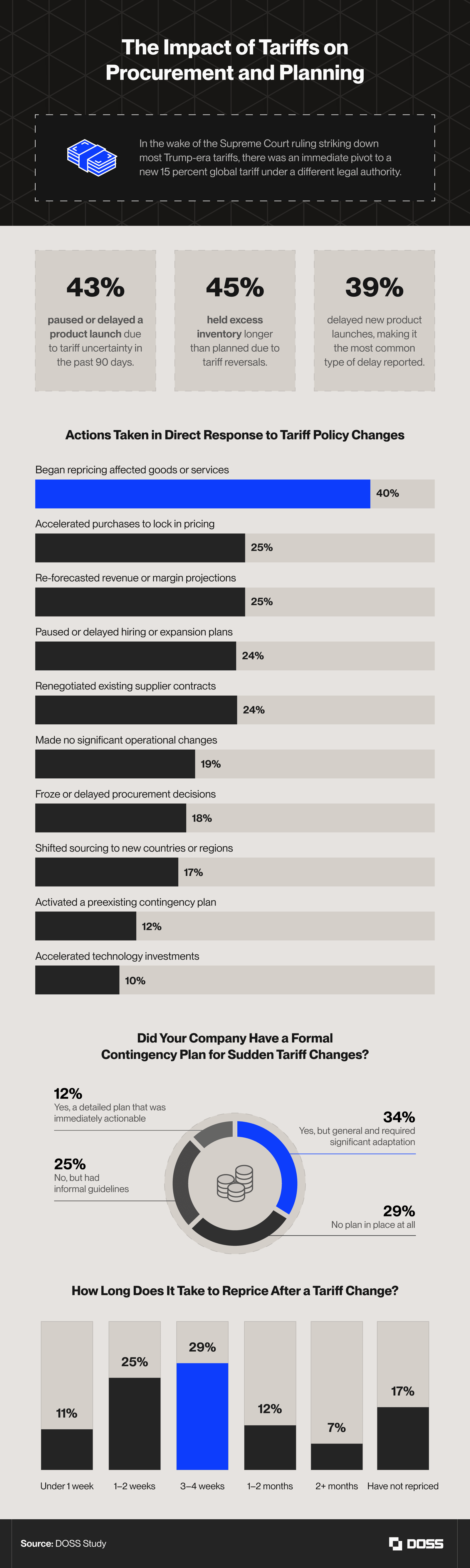
- 43% of decision-makers say their companies paused or delayed a major product launch within the past 90 days due to tariff-related uncertainty.
- 45% report holding excess inventory longer than planned, and 58% say their companies absorbed costs they initially intended to pass on to customers.
- 40% say their companies began repricing affected goods or services in response to tariff changes. Meanwhile, 25% accelerated purchases to lock in pricing, and 25% re-forecasted revenue or margin projections.
- Nearly one-third (29%) admit their companies have no formal contingency plan for sudden tariff changes, while 34% say their existing plan required significant adaptation.
- Only 11% say their companies can reprice goods in under a week after a tariff change. In contrast, 48% report it takes three weeks or more, and 17% say their companies have not repriced at all.
Cost Modeling Gaps Leave Companies Exposed
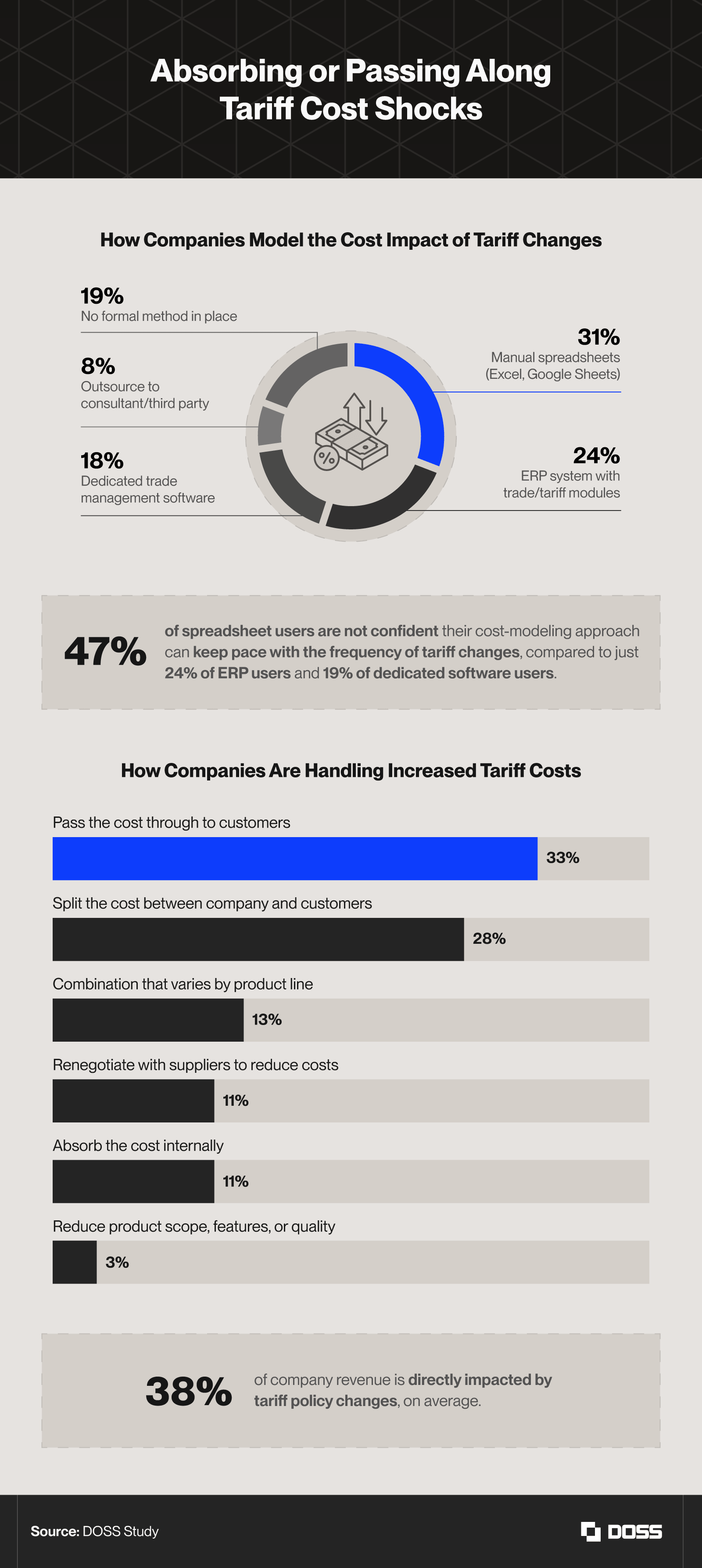
- 31% of decision-makers say their companies rely on manual spreadsheets to model tariff costs. By comparison, 24% use ERP systems with trade modules, 18% use dedicated trade management software, 8% outsource modeling to a third party, and 19% report having no formal method in place.
- Just 16% say they are very confident their company’s cost-modeling approach can keep pace with frequent tariff changes. Another 44% say they are somewhat confident, while 16% express a lack of confidence.
- Among decision-makers whose companies rely on spreadsheets, 47% say they lack confidence that their modeling approach can keep up with policy volatility. That lack of confidence is 2 times more than ERP users.
- When managing increased tariff costs, 33% say their companies pass costs directly to customers, while 28% split costs with customers and 13% vary their approach by product line. Additionally, 11% renegotiate with suppliers, 11% absorb costs internally, and 3% reduce product scope or quality.
- On average, decision-makers report that 38% of their company’s revenue is directly impacted by tariff policy changes.
Volatility Is Forcing Tech Decisions and Straining Teams
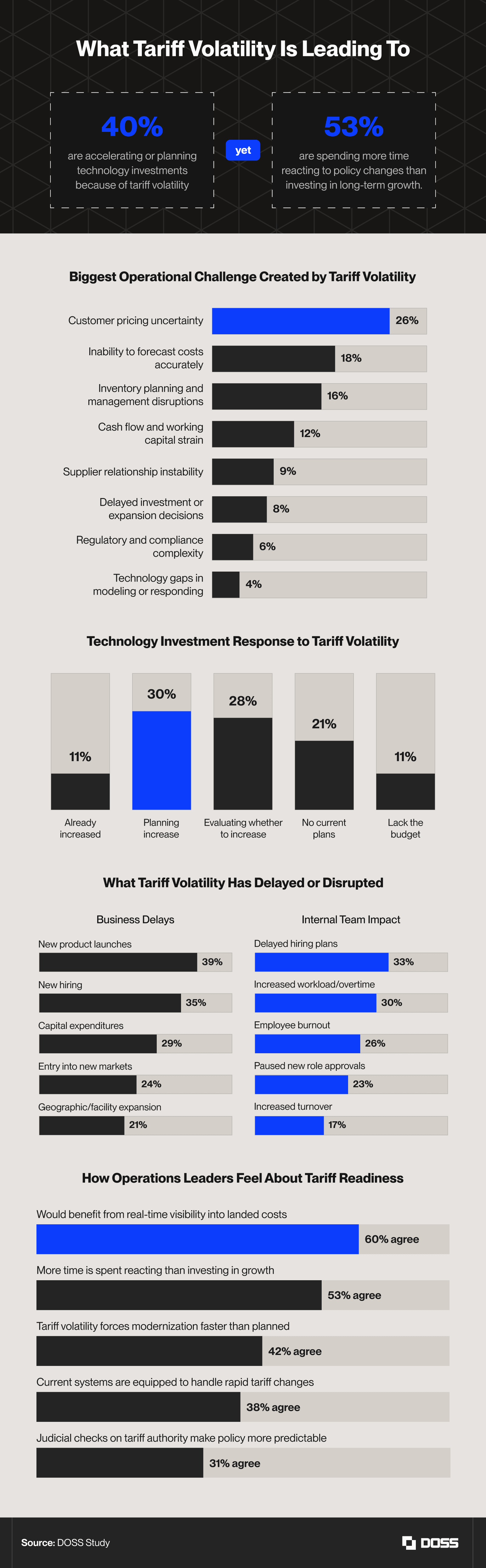
- 53% of decision-makers say their companies are spending more time reacting to trade policy changes than investing in long-term growth. At the same time, 40% report accelerating or planning technology investments in response to tariff volatility.
- Customer pricing uncertainty (26%) is the most commonly cited operational challenge. This is followed by difficulty forecasting costs (18%), inventory planning disruptions (16%), and cash flow or working capital strain (12%).
- 11% say their companies have already increased technology investment due to tariff volatility. Another 30% plan to increase investment, and 28% are currently evaluating whether to do so. Meanwhile, 21% report no plans to increase spending, and 11% cite budget limitations.
- 33% say their companies have delayed hiring plans, 30% report increased workload or overtime, 26% report employee burnout, 23% say new role approvals have been paused, and 17% report increased employee turnover.
- 60% agree their companies need real-time visibility into costs to manage tariff volatility effectively. However, only 38% believe their current systems are equipped to handle ongoing instability. Additionally, just 31% believe the Supreme Court’s judicial check on tariff authority has improved trade policy predictability.
Methodology
We surveyed 504 decision-makers (managers, directors, VPs, and C-suite) at physical product selling businesses about their experiences through tariff volatility, most recently the 15% universal tariff.
About DOSS
DOSS is the Operations Cloud built for the real world: a modern, AI-native platform that helps product-based businesses manage the flow of goods, dollars, and data across procurement, inventory, orders, fulfillment, and finance in real time. With composable modules and a unified master data model, DOSS helps operations teams adapt faster to volatility and make confident decisions when costs shift unexpectedly. Learn more at www.doss.com .
Fair Use Statement
The data and insights presented in this article may be used for noncommercial purposes only. If shared, please provide proper attribution to DOSS.
-p-1600_image62f.png)
_imagefdd.png)