




In 2026, tariffs, viral product swings, and seasonal volatility have made inventory planning even harder for retail and consumer product companies trying to stay lean without missing revenue targets. To understand how operations leaders are handling the pressure, DOSS surveyed 661 professionals involved in inventory management across the retail and consumer packaged goods space, including leaders across supply chain, procurement, forecasting, warehouse operations, and finance. Teams are operating with high stress, inconsistent inventory visibility, and forecasting systems they no longer fully trust.
Key Takeaways
- 3 in 4 retail professionals (75%) have either lost sleep over an inventory decision or come close to it, losing an average of 3 hours of sleep.
- Seasonal or trend-driven SKUs and perishable goods are tied as the most stressful inventory categories to manage among retail professionals, each cited by 33% of respondents.
- 1 in 2 retail industry organizations (50%) delayed or canceled purchase orders due to tariff uncertainty in 2026.
- More than half of retail professionals (51%) say they sometimes proceed with demand forecasts they know are unreliable, simply because no better alternative exists.
- 64% of retail industry organizations have not deployed AI or machine learning for inventory management, and among those with no plans to adopt, 59% say it's just not a current priority.
- Among the 1 in 4 retail industry organizations left holding excess inventory after a viral trend faded, TikTok was the responsible platform 60% of the time, followed by Instagram (13%) and YouTube (7%).
The Inventory Anxiety Index
Inventory pressure no longer stays confined to spreadsheets and warehouse reports. It follows operators into performance reviews, hiring decisions, and late nights spent recalculating inventory risk.
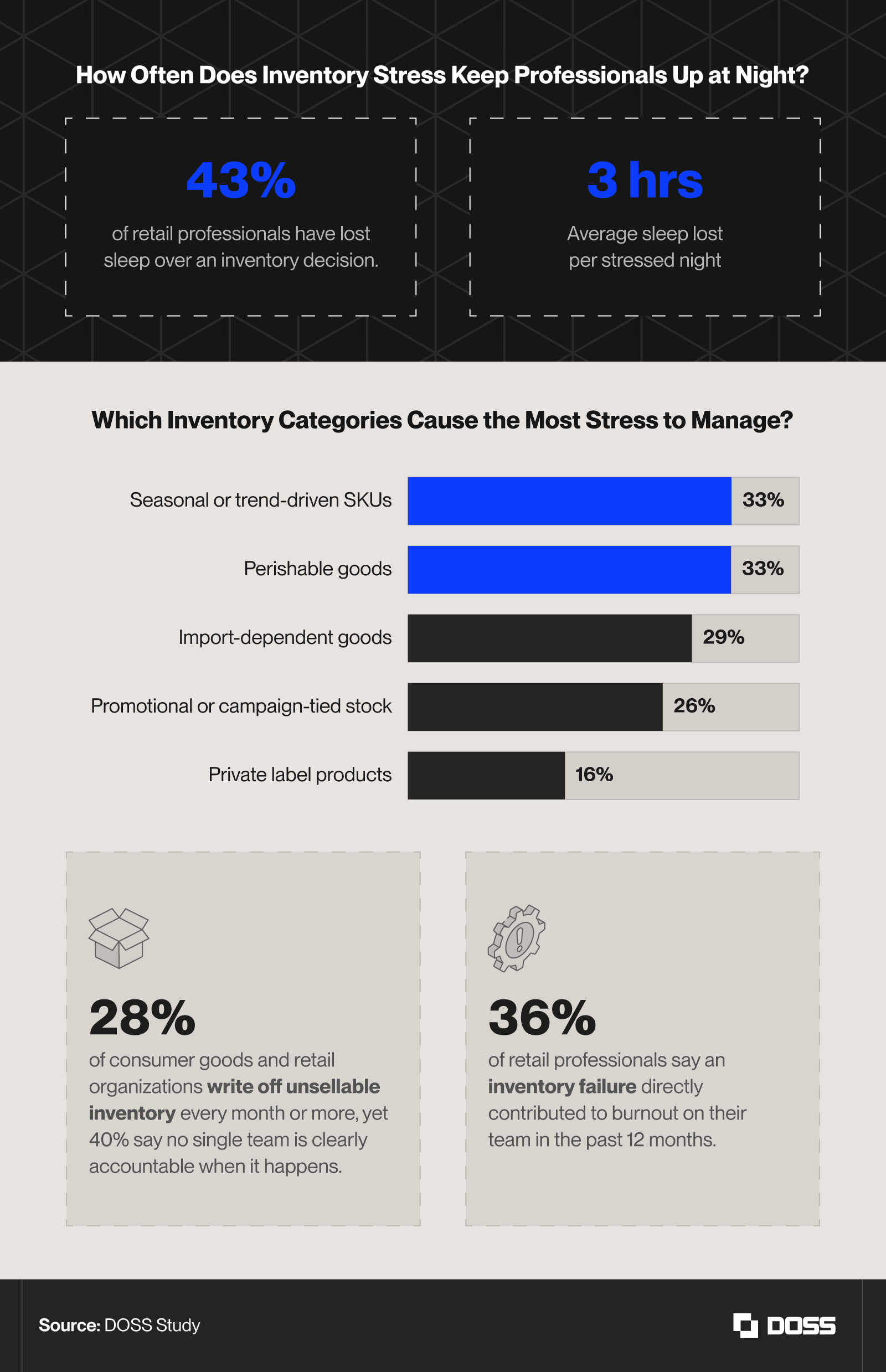
Inventory stress was widespread across retail and CPG operations teams. More than 2 in 5 professionals (43%) said they have lost sleep over inventory decisions, with 67% saying it happens weekly or more often.
The pressure increased alongside decision-making authority. Directors (57%) and managers (50%) were significantly more likely than individual contributors (24%) to report losing sleep over inventory decisions.
Inventory planning is no longer just an operational challenge. For many teams, it has become a chronic source of stress.
Seasonal and Perishable Inventory Carry the Most Pressure
Certain inventory categories consistently created more operational strain than others. The most stressful ones were:
- Perishable goods: 33%
- Seasonal or trend-driven SKUs: 33%
- Import-dependent goods: 29%
- Promotional or campaign-tied stock: 26%
- Private label products: 16%
More than half of retail professionals (51%) agreed that seasonal inventory had become harder to manage over the past three years. Another 29% specifically pointed to seasonal and trend-driven volatility as the reason inventory stress had intensified.
The problem is becoming harder to isolate because multiple forms of volatility are colliding at once. Seasonal demand shifts, tariff uncertainty, and shorter trend cycles are all compressing inventory planning timelines.
Fear of Stockouts Is Driving Overbuying
Half of supply chain leaders (50%) said they feel more pressure to avoid stockouts than excess inventory. Nearly the same share (49%) said their organizations tend to overbuy as a direct result.
At the same time, 40% of supply chain leaders believed more than 10% of their inventory was at risk of becoming unsellable at any given time. Nearly one-quarter of organizations (24%) were overbuying to avoid stockouts while already believing a meaningful share of their inventory could become dead stock.
That balancing act is becoming increasingly difficult for operations teams trying to protect service levels without inflating carrying costs.
Inventory Failures Are Affecting Careers
The operational consequences of inventory failures can extend beyond financial losses. More than half of retail professionals (53%) experienced at least one career or team consequence tied to inventory issues in the past year, including:
- Team burnout: 36%
- Negative performance review or bonus impact: 18%
- Team turnover: 17%
- Job security at risk: 8%
Inventory write-offs also remained common across the industry. More than half of organizations (54%) wrote off unsellable inventory at least once per quarter. Among companies generating $250M or more annually, 38% reported writing off inventory monthly or more, nearly double the rate of companies in the $50M to $250M range (20%).
When write-offs occurred, accountability often lacked clear ownership. The teams most commonly held accountable:
- Leadership or senior management: 17%
- Procurement: 14%
- Sales or commercial: 13%
- Demand planning: 9%
For another 40%, no single team was held responsible, or it varied too much to say.
The Demand Forecasting Fault Lines
Many organizations admitted they are making inventory decisions while knowing the numbers in front of them are unreliable.
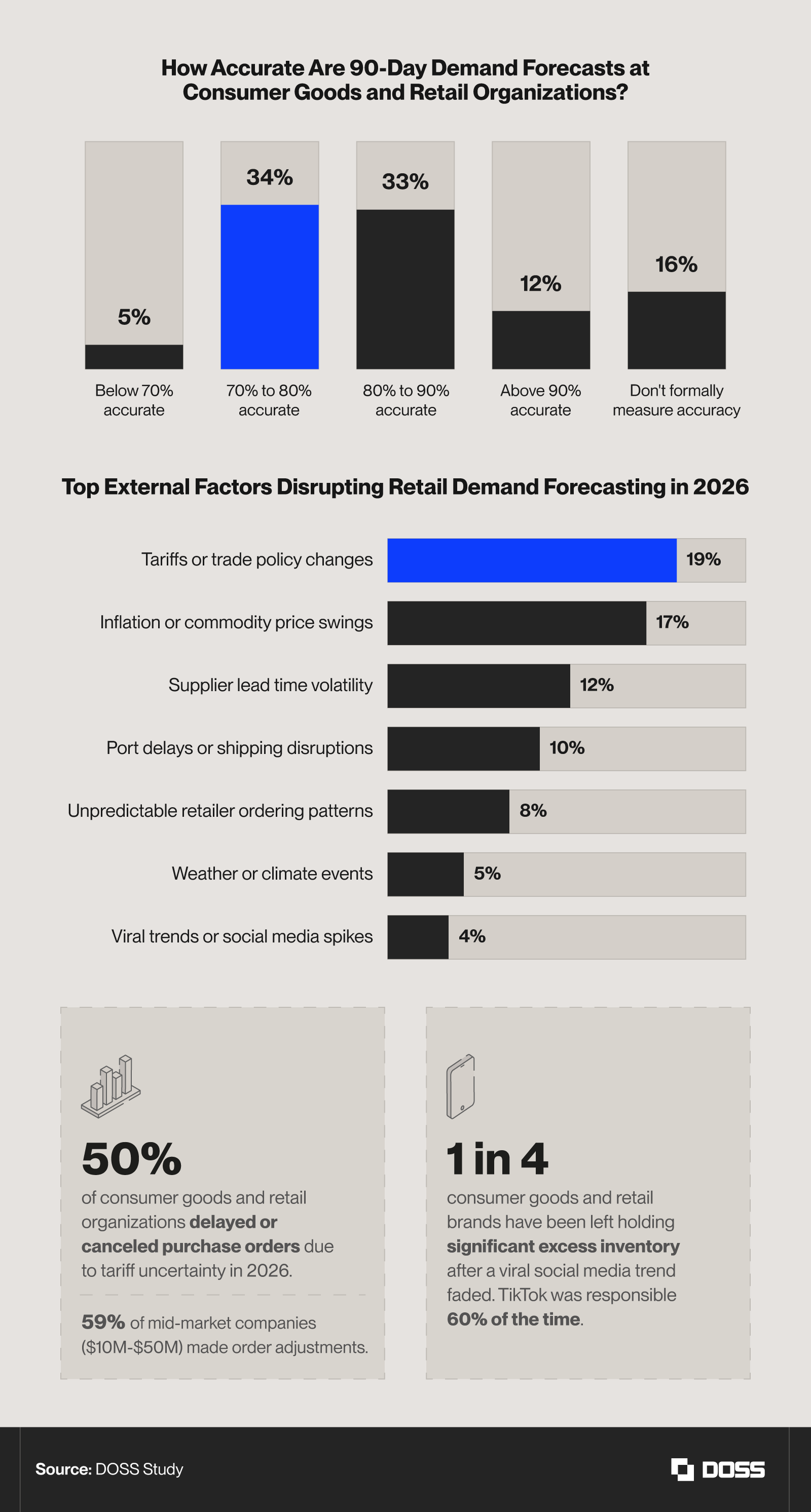
More than half of retail professionals (51%) said their organizations sometimes proceeded with demand forecasts they knew were unreliable because no better alternative existed. The issue was most severe among companies generating between $50M and $250M annually, where 60% acknowledged operating with forecasts they did not fully trust.
Another 16% of organizations said they did not formally measure forecast accuracy at all. That meant nearly 1 in 6 companies were making inventory decisions without a structured way to evaluate forecasting reliability.
Forecasting Misses Often Trigger Reactive Responses
When forecasts missed significantly, organizations most commonly responded by changing forecasting methods or discounting inventory aggressively to clear excess stock. The most common responses to forecasting misses were:
- Adjusting future forecasting methodology: 19%
- Discounting aggressively to move inventory: 17%
- Redirecting to secondary channels: 10%
- Accepting the write-off and moving on: 8%
- Conducting a formal post-mortem: 8%
- Escalating to executive leadership: 6%
Among organizations writing off inventory monthly or more, 23% said nothing formal happens after a major forecasting miss. That suggests many companies are still treating forecasting failures as isolated events instead of systemic operational issues.
Tariffs Became the Biggest Forecasting Disruptor
External volatility has affected inventory planning priorities in 2026. The top factors disrupting demand forecasting include:
- Tariffs or trade policy changes: 19%
- Inflation or commodity price swings: 17%
- Supplier lead time volatility: 12%
- Port delays or shipping disruptions: 10%
- Unpredictable retailer ordering patterns: 8%
- Shifts in consumer sentiment: 7%
- Weather or climate events: 5%
- Viral trends or social media-driven spikes: 4%
Half of organizations (50%) have delayed or canceled purchase orders because of tariff uncertainty, while another 25% considered adjusting orders but ultimately held off. Mid-market companies between $10M and $50M were the most exposed, with 59% delaying or canceling orders.
Directors (57%) and managers (50%) were significantly more likely than individual contributors (43%) to delay or cancel orders due to tariffs, reflecting where forecasting pressure and purchasing authority converged.
Viral Trends Created Long Inventory Recovery Cycles
Nearly 3 in 5 applicable organizations (58%) said they had either been left holding excess inventory after a viral trend faded or had come dangerously close. Among organizations hit by viral inventory gluts, 74% needed between one and six months to recover, while 6% never fully recovered and ultimately wrote off the inventory. TikTok drove the majority of those inventory swings (60%), followed by Instagram (13%) and YouTube (7%).
Retail and wholesale operators were also more exposed to tariff-driven order disruption than other sales channels. More than half (55%) delayed or canceled orders, compared to 45% of DTC operators and 44% of omnichannel organizations.
The Visibility Gap
Inventory visibility remains one of the biggest operational blind spots for growing consumer product companies. Many teams rely on fragmented systems, delayed reporting, and manual workarounds to understand what inventory they actually have and how quickly it is becoming a problem.
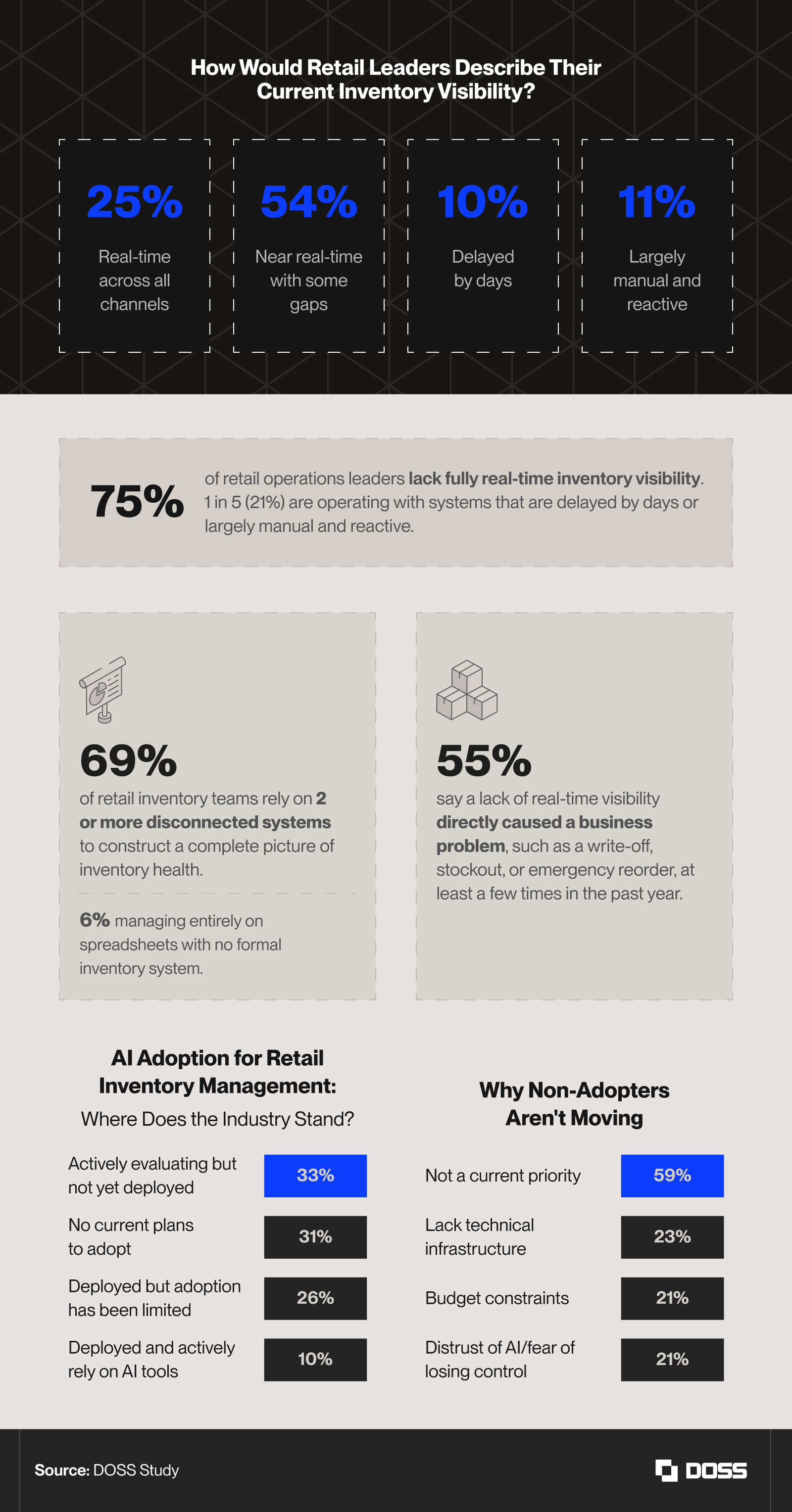
Nearly 1 in 5 inventory teams (18%) relied on four or more systems to assemble a complete picture of inventory health. Every additional platform introduces more opportunities for delays, manual work, and reporting inconsistencies.
More than half of retail professionals (55%) said a lack of real-time visibility directly caused a business problem at least a few times over the past year. Another 10% said these issues occurred monthly or more often. The consequences included:
- Stockouts
- Write-offs
- Missed sales
- Emergency reorders
At the same time, many organizations still felt relatively confident in their internal inventory alignment. Nearly two-thirds of respondents (63%) said their teams shared a consistent view of inventory data, while 51% expressed confidence in their ERP's ability to identify shelf-life risk in real time. That disconnect suggests many organizations may not fully recognize how fragmented systems and delayed reporting continue affecting operational outcomes.
AI Adoption Remains Limited Across Retail Operations
Overall, 64% of organizations had not deployed AI or machine learning tools for inventory management at the time of the survey. Adoption gaps were biggest among smaller organizations, where 79% of companies under $10M in revenue had not adopted AI tools compared to 56% of companies generating $250M or more.
Top Reasons Organizations Haven't Adopted AI
- Not a current priority: 59%
- Lack of technical infrastructure: 23%
- Budget or cost constraints: 21%
- Distrust of AI outputs/concern about losing human control: 21%
- Lack of internal alignment or organizational buy-in: 13%
Even among organizations that deployed AI tools, adoption often remained shallow. Among the 36% using AI for inventory management, only 10% said they actively relied on those tools, while 26% described adoption as limited.
Inventory Planning Has Become a Risk Management Function
Inventory teams are operating in a tougher environment than they were just a few years ago. Tariffs, fragmented systems, unreliable forecasts, and faster-moving demand shifts are forcing operators to make high-stakes decisions with less certainty than they want. But the organizations investing in better visibility, stronger forecasting discipline, and more connected operations platforms are putting themselves in a stronger position to respond faster when conditions change. In 2026, resilient inventory management is becoming a competitive advantage.
Methodology
This survey was conducted in May 2026 using CloudResearch Connect and Prolific. Respondents were screened to include only professionals with direct or indirect involvement in inventory management at consumer packaged goods organizations, including roles spanning inventory planning, demand forecasting, procurement, supply chain operations, warehouse and distribution management, and finance functions with inventory exposure.
A total of 661 qualified responses were collected and analyzed. Data was cleaned to ensure unique respondents prior to analysis. All results reflect self-reported perceptions and experiences. Demographic breakdowns are only reported for groups representing 5% or more of the total sample, and any subgroup findings based on smaller segments should be considered directional.
About DOSS
DOSS is the AI-native operating system for consumer goods, a single source of truth for procurement, inventory, and orders. The system adapts as the business changes and tightly integrates operations with financial accounting. DOSS provides inventory numbers the business can trust, contribution margin to the line-item level, and the ability to launch a new channel in days, driving growth and profit for growing consumer goods brands. Learn more at www.doss.com .
Fair Use Statement
The data and findings in this article may be used for noncommercial purposes only. When sharing or republishing, please include a link with proper attribution to DOSS.