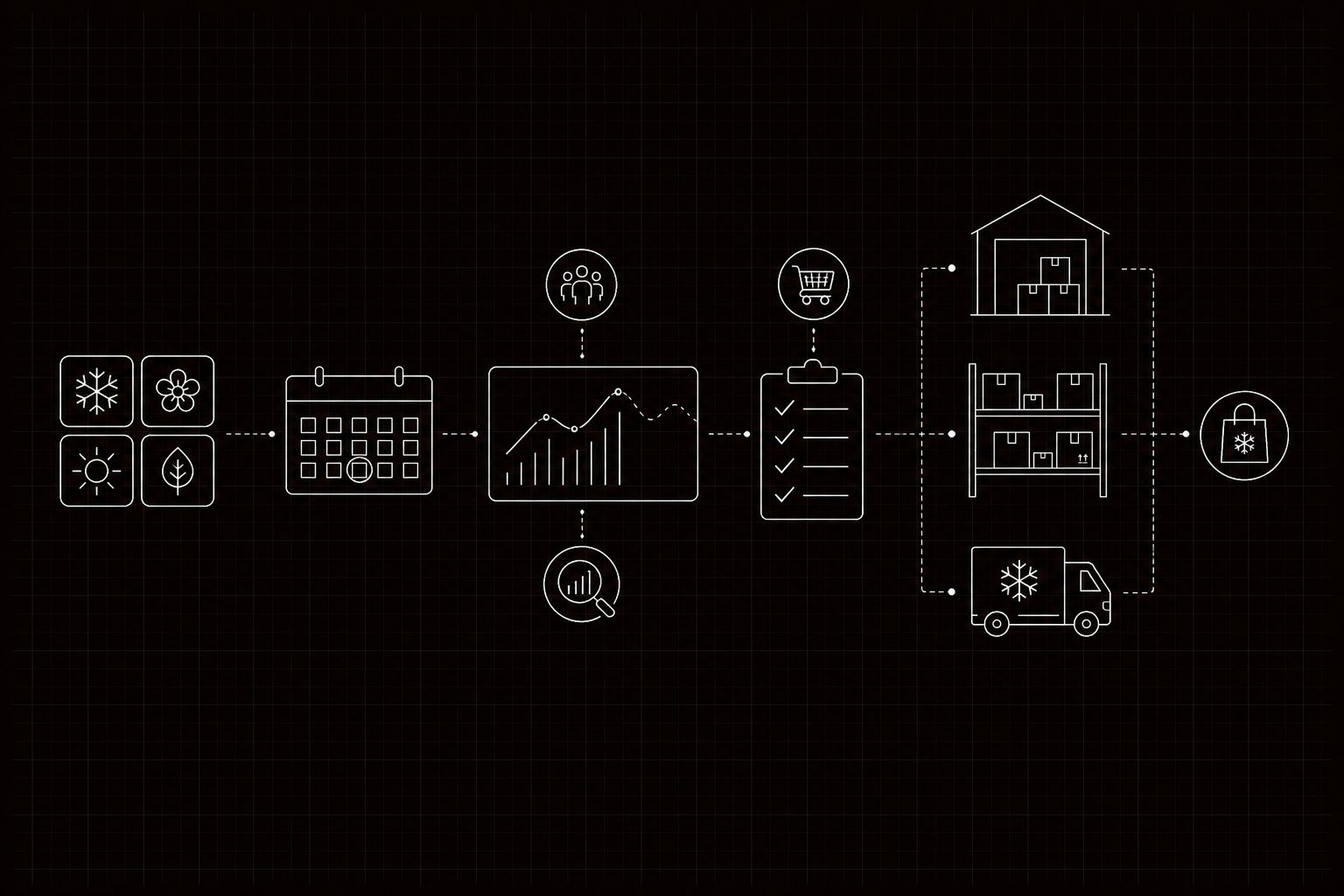

Six weeks before Black Friday, a mid-market beverage brand's operations team is facing a problem they've seen before: orders are coming in three times faster than normal, their order management software is two steps behind, and the manual workarounds that barely held things together last Q4 are already failing. They add headcount. They work nights. They ship late.
This is not a staffing problem. It's a systems problem.
Peak season (Q4 retail push, summer launch windows, a major promotional event) doesn't create operational gaps so much as expose them. The cracks that go unnoticed at normal volume become fractures when order flow spikes. An order management system that handles 200 orders a day without issue can fall apart at 800, not because the volume is unmanageable, but because the workflows, integrations, and visibility tools holding it together weren't built to flex.
Why Peak Season Breaks Most Order Management Systems
The typical order management failure during peak season is an accumulation of friction: a 3PL integration that doesn't update in real time, an approval workflow that still requires manual sign-off on every purchase order, a sales channel sync running on a four-hour delay. Individually, these are annoying. Together, during high-volume periods, they cause stockouts , delayed fulfillment, and returns that eat into the margins you were counting on from the season.
Order management systems built on static configurations are the underlying issue. When your order flow changes (a different channel mix, a higher average order value, a new retail account opening mid-season), a rigid system requires a configuration change that takes days or weeks to push through. By the time the fix is in, the window has passed.
Spreadsheets and point tools have the opposite problem: they flex until the volume hits, then become liabilities. A spreadsheet tracking open purchase orders works at 50 POs. At 500, with multiple team members editing simultaneously, errors compound. Stockouts get missed. Purchase orders go unreconciled.
The Prep Work That Moves the Needle
Operations leaders who handle peak season without crises don't get there by adding headcount or hoping the system holds. They close the gaps in their order management infrastructure before volume spikes. Here's what that looks like in practice.
Audit your channel-to-fulfillment path. For each sales channel (DTC, wholesale, EDI, marketplace), trace what happens between an order placed and an order shipped. Where does the flow touch a human? Where does it wait? Where does it hand off to a 3PL without a real-time confirmation? Every manual touchpoint is a potential bottleneck when volume triples.
Validate your inventory positions across all locations. Going into peak season with inaccurate inventory is the fastest way to oversell or undersell. If your order management system is pulling stock data that's hours stale, you're making fulfillment decisions on bad numbers. Real-time inventory visibility across your own warehouses and your 3PL partners is not a nice-to-have during high-volume periods.
Review your reorder point and safety stock settings. The parameters that make sense for baseline demand consistently underperform during peak. If your reorder logic is tuned for average weekly sales and peak volume runs 4x that, you'll be placing emergency purchase orders at premium prices when you should have replenished three weeks ago. Adjust before the season, not during it.
Test your approval workflows under load. A purchase order approval requiring two director sign-offs takes 48 hours under normal conditions. During peak, when purchase orders stack up daily and leadership is stretched, 48 hours becomes five days. If you can't approve and release POs at the speed your suppliers require, you lose lead time you can't recover.
Run a channel integration check. Every sales channel and every partner system those channels connect to should be verified before volume hits. A known delay in your EDI connection to a major retailer becomes a chargeback problem during peak. A 3PL integration that syncs inventory twice a day is a risk you can quantify now and address before you're managing damage control at 11pm.
What Good Order Management Looks Like at Peak Volume
Operations teams that consistently perform during peak season share one characteristic: their order management infrastructure gives them real-time visibility and the ability to act on what they see without waiting on a consultant or a dev ticket.
That means orders from all channels (DTC, wholesale, EDI, marketplace) flowing into a single system with accurate inventory attached. It means procurement and order management connected, so when a high-velocity SKU trends toward a stockout, a reorder triggers automatically rather than getting caught in a daily review meeting. It means fulfillment workflows the team can reconfigure in hours when a 3PL changes their cutoff time, not weeks after a change request clears a vendor queue.
It also means knowing, at any point during peak, which orders are on track, which are delayed, and why. Not from a manually assembled report, but from a live operational view that doesn't require anyone to stitch together data from three systems. The supply chain management practices that work at normal volume need to scale automatically, not require a new process layer each time volume increases.
How DOSS Operations Cloud Handles Peak Season
DOSS Operations Cloud connects inventory management , order management, and procurement in a single platform, so operators have real-time visibility across the full order-to-cash cycle without reconciling across disconnected tools.
Operators going into peak season on DOSS have inventory positions that reflect actual stock across all locations, including 3PL partners, in real time. Purchase orders connect to order velocity, so when sales spike, replenishment logic fires before the team has to catch it manually. Approval workflows can be modified in minutes when the business needs to move faster than its existing configuration allows. When a channel integration needs an adjustment, it happens same-day, not after a multi-week change request.
Mezcla, a rapidly growing CPG brand, credits DOSS with 2x purchase order processing speed and 12+ hours saved weekly — time recaptured from manual coordination and spreadsheet reconciliation. That efficiency compounds during high-volume periods, when the cost of manual processing is highest and the margin for error is smallest.
Build the Foundation Before the Season, Not During It
Peak season reveals the actual state of your order management system. The 6 to 12 weeks before volume spikes is the window where operators who consistently perform under pressure build the foundation that makes it possible.
Run the audits. Validate the integrations. Update the replenishment parameters. Confirm your team can act on what they see in real time, not after the data has been reconciled in a spreadsheet 48 hours later.
DOSS Operations Cloud is how physical product businesses connect inventory, orders, and procurement in one place, with real-time visibility across every channel and 3PL, and workflows the team can change in minutes. Most operators are live in 4 to 6 months. If your peak season prep is surfacing gaps your current system can't close, that's exactly where DOSS starts.