
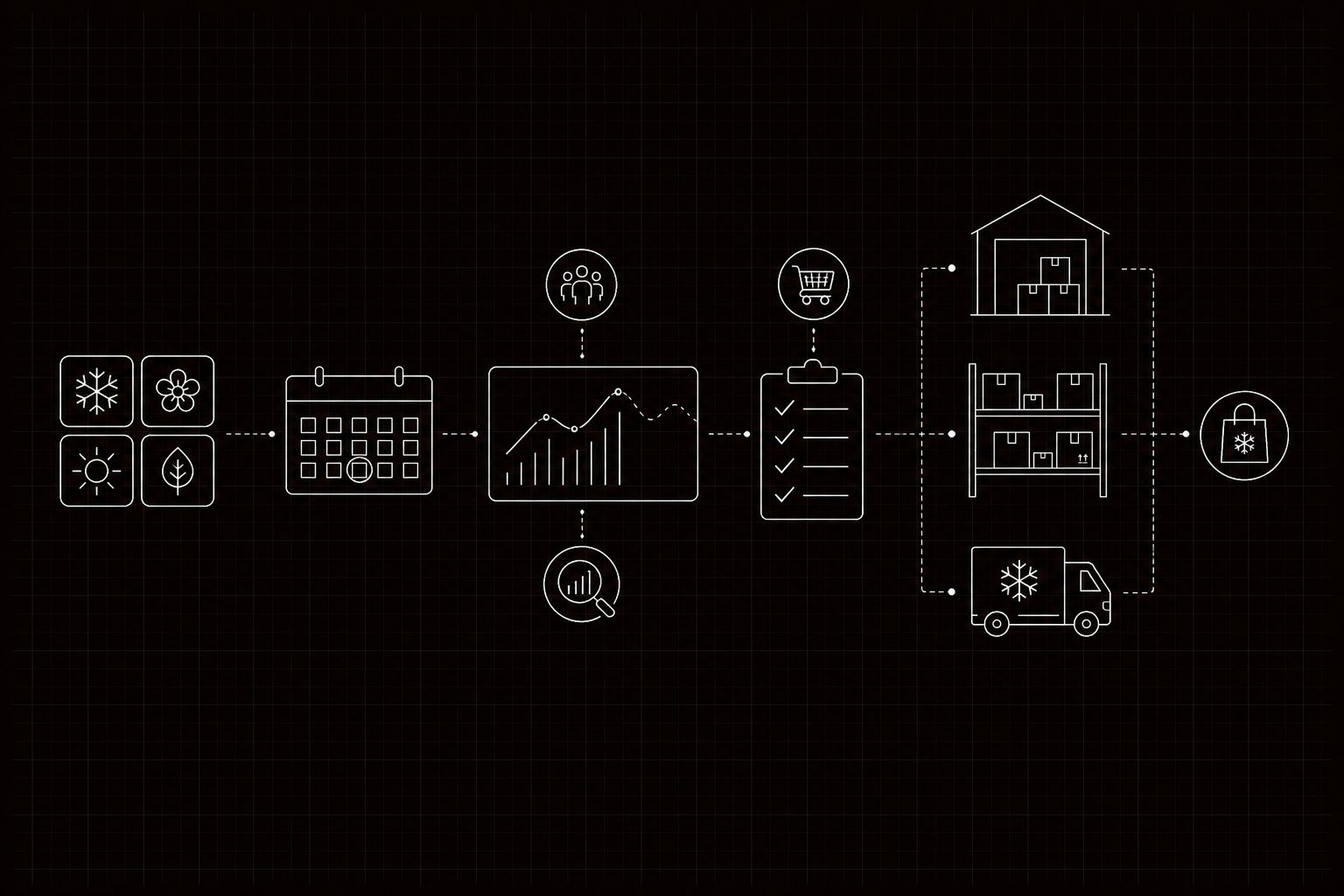
Every CPG brand has been through it. Your best-selling product peaks in Q4, your team places a bigger order than last year, and you still run short. Or you go the other direction, order conservatively, and watch margins erode on January markdowns. Seasonal demand shifts year to year, and most inventory management systems weren't built to handle the gap between historical averages and real-world variability.
The problem isn't that operations leaders skip planning, it's most frequently the tools they're using. Operations teams running seasonal plans on mid-market ERPs and spreadsheets are working in a guess-and-check cycle. By the time inventory data reconciles across systems, the buying window has closed.
Accurate seasonal inventory forecasting requires real-time visibility into what's selling, how suppliers are performing, and where inventory sits across locations. This guide covers how operations teams at physical product businesses can build a forecasting process that accounts for demand variability, informs procurement decisions, and holds up under pressure.
Why Seasonal Demand Breaks Most Inventory Management Systems
The mechanics of seasonal demand aren't complicated: sales spike, then normalize. What makes it hard is that the spike is never quite the same as last year. A new retailer channel, a one-time promotion, or a competitor's stockout that redirected demand your way can each shift the baseline. Most inventory management software is designed around historical averages, which makes it structurally optimistic during high-demand periods and structurally conservative when the tail end of a season drags out.
ERPs weren't designed to handle this kind of variability at the operating layer. They record what happened well, but they weren't designed to help your team respond to what's happening now. The result is that operations teams spend peak season firefighting instead of fulfilling: chasing data across disconnected tools, manually recalculating reorder points, and escalating to procurement only after a stockout is already underway.
Spreadsheets compound the problem. They work fine as a snapshot. The moment multiple team members are working from different versions, or you're reconciling warehouse counts against what an EDI feed reports, accuracy degrades. A spreadsheet can't alert you when a 3PL shows inventory discrepancies, and it can't update a reorder threshold when a supplier extends lead times.
The Four Building Blocks of Accurate Seasonal Forecasting
Accurate seasonal forecasting means building a process that goes beyond historical sell-through rates. Four things need to work together.
Clean historical data at the SKU level. Beyond just which units sold. Promotional lift, channel mix, and any external events that affected performance should be included as well. Without separating organic demand from promotional demand, your baseline is inflated and next year's order will be incorrect.
Real-time inventory visibility across all locations. If you manage inventory across a 3PL, a co-manufacturer, and a direct-to-consumer warehouse, your forecasting model is only as good as the inventory counts feeding it. Discrepancies between what the system shows and what's actually on the shelf compound over a season.
Supplier lead time data that reflects current performance, not contract targets. Lead times shift. A supplier who delivered in 30 days last season may be running at 45 days this season due to capacity constraints or logistics disruptions. If your purchasing decisions rely on the lead times a supplier quoted six months ago, you're running on assumptions that may no longer hold.
A way to act on that data without filing a request or waiting for a monthly report. The value of a good forecast is in the procurement decision it enables. If the data is clean but your team can't act on it in time, you've built a reporting layer, not an operating system.
How to Structure a Seasonal Inventory Forecasting Process
Operations teams that handle seasonal demand well share one habit: they treat forecasting as a rolling process, not a one-time pre-season exercise.
It all starts with demand segmentation. Not all SKUs have the same seasonal profile. Some spike in Q4 and go flat the rest of the year; others carry a moderate lift across two or three months. Treating them the same way produces the wrong stock levels for both. By segmenting your catalog by seasonal behavior (velocity profile, channel, and promotional history) and setting review cadences accordingly, you can have a more accurate forecast.
Build in a buffer for supplier variability. If a supplier's average lead time is 45 days but the standard deviation is 12 days, your safety stock calculation needs to reflect that range, not just the average. Operations leaders who treat lead time as a fixed number consistently understock during high-demand periods because they haven't accounted for supply-side disruption.
Set [reorder points](https://www.doss.com/glossary/reorder-point-rop) that update dynamically. Static reorder points are a liability during seasonal transitions. When demand accelerates going into a peak season, your reorder point should reflect higher daily sales velocity and the risk of a longer replenishment cycle. An inventory management system that lets you update thresholds without an engineering ticket is worth more than one that doesn't.
Run a post-season review on the gap between forecast and actual demand. The goal isn't to find who made the wrong call. It's to identify structural improvements to next year's baseline: which SKUs outperformed, what data you had, what data you didn't, and whether the variances were one-time anomalies or patterns worth building into the model. That analysis feeds the next planning cycle and makes each year's forecast more accurate than the last.
Inventory Management Software vs. Spreadsheets: Where the Real Gap Is
CPG brands at the $10M–100M revenue range often run on a mid-market ERP combined with a spreadsheet layer that handles the nuance the ERP can't. As the business adds SKUs, channels, and suppliers, the spreadsheet layer grows, handoffs get harder to manage, and monthly reconciliation becomes a bottleneck in itself. This all compounds into business complexity that can't be accommodated in that system.
When comparing inventory management software and spreadsheets, it isn't purely about features. The more important comparison is the cost of the coordination layer. Spreadsheets require someone to maintain them, someone to reconcile discrepancies, and someone to decide which version of the data to trust. Every hour your operations team spends reconciling data is an hour they're not spending on decisions that affect fulfillment and margin.
A dedicated inventory management system moves judgment upstream: to strategy and process design, rather than forcing it into a Friday afternoon emergency or a daily reconciliation flow.
What Seasonal Planning Looks Like with DOSS Operations Cloud
DOSS Operations Cloud connects inventory management , order management , and procurement in a single system, so the data driving your seasonal forecast is the same data your procurement team is acting on. No separate reconciliation step between systems.
The ARP module structure lets operations teams configure seasonal planning workflows without dev tickets or consultant engagements. When you need to set up a seasonal review cadence with automatic reorder point adjustments, that's a workflow configuration, not a development project. When your team finds a better way to handle a specific SKU category, they can update the logic themselves.
DataStudio provides real-time margin and inventory visibility across every channel, so your team isn't waiting for end-of-month reporting to know whether the season is tracking to plan. When a 3PL reports a discrepancy or a supplier signals a lead time extension, that information surfaces immediately and your team can respond before it becomes a fulfillment problem.
Brands like Mezcla have cut PO processing time in half and saved 12 or more hours per week in operational overhead. Kahawa reduced order processing time by 30x. For operations teams managing seasonal peaks, that kind of speed is the difference between getting product to shelf on time and explaining to a retailer why the SKU is out of stock during its highest-velocity window.
Keeping Ahead of Seasonal Demand
Seasonal inventory management gets more complex as a business grows. More channels, more suppliers, and more SKUs mean more failure points in the planning process. The operations leaders who handle it well aren't using smarter spreadsheets. They're building processes with real-time visibility, keeping inventory and procurement data in sync, and updating reorder logic as demand signals change.
DOSS Operations Cloud connects inventory, orders, and procurement in a single system. It integrates with existing tools, deploys in months, and lets operations teams make configuration changes in minutes. If your team is heading into a peak season on tools that weren't built for this kind of variability, that's worth addressing before demand arrives.
%20(1).png)