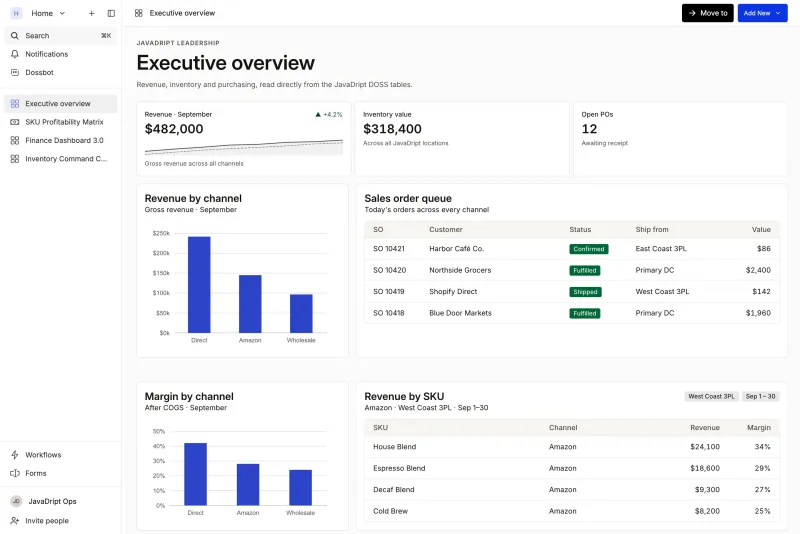





Managing orders across wholesale, DTC , and marketplace channels has become one of the defining operational challenges for consumer product companies. As order volumes grow and sales channels multiply, the gap between what legacy systems can handle and what growing brands actually need continues to widen.
This guide breaks down the best order management platforms in 2026, with a focus on what matters most for consumer product companies: multi-channel order consolidation, real-time inventory visibility, automated workflows, and the ability to scale without a six-figure implementation.
What to Look for in an Order Management Platform
Before comparing platforms, it helps to know what separates a useful order management system from one that creates more problems than it solves.
Multi-channel order consolidation is table stakes. If you sell through Shopify, Amazon, wholesale, and your own sales team, your OMS needs to pull all of those orders into a single view. Without this, teams waste hours toggling between systems and reconciling data manually.
Real-time inventory accuracy prevents overselling and stockouts. The best platforms sync inventory across every warehouse, 3PL , and sales channel in real time, so your available-to-promise numbers are always current.
Automated order routing lets you send orders to the right fulfillment location based on rules you define: proximity to the customer, stock availability, cost, or channel-specific requirements.
Integration depth matters more than integration count. You need tight connections with your ecommerce platforms, accounting software, 3PLs, and shipping carriers. Loose integrations that require manual reconciliation defeat the purpose.
Speed of implementation is often overlooked. Many platforms take six to twelve months to deploy. For growing companies, that timeline can mean outgrowing the solution before it even goes live.
The Best Order Management Platforms in 2026
#1. DOSS Operations Cloud
DOSS is a cloud-native operations platform built around a modular architecture called the Adaptive Resource Platform (ARP). Unlike standalone order management tools, DOSS unifies order management with inventory, procurement, warehouse operations, fulfillment, and accounting in a single system.
For consumer product companies, this matters because order management does not exist in a vacuum. When a wholesale PO comes in, it affects inventory allocation, triggers procurement if stock is low, and needs to flow through to invoicing and financial reporting. DOSS handles this entire chain without requiring data to move between disconnected tools.
The platform consolidates orders from Shopify, Amazon, WooCommerce, wholesale, and EDI channels into one interface. It supports partial shipments, bundle management, backorder tracking, and custom order routing workflows that can be built without code. Businesses can set up rules that automatically direct orders to the right warehouse or 3PL partner based on inventory levels, geography, or cost.
DOSS also handles the full purchase order lifecycle, from automated PO creation based on inventory thresholds to vendor communication and receiving reconciliation. For brands managing both DTC and B2B sales from the same platform, this end-to-end traceability is a significant advantage.
The platform includes built-in business intelligence through its DataStudio product, which provides real-time dashboards for order velocity, fulfillment performance, channel revenue, and margin analysis. A built-in AI copilot called Dossbot allows teams to query data, automate changes, and resolve issues through simple chat prompts.
Because DOSS is cloud-native and modular, the platform scales alongside your business. A brand doing $2M in annual revenue can start with the workflows it needs today and add complexity as it grows, without re-platforming or migrating data. Companies running $200M+ in order volume use the same core system. That continuity means your operations team builds expertise once and carries it forward, rather than starting over every time the business hits a new stage of growth.
#2. Cin7 Core
Cin7 Core (formerly DEAR Systems) is an inventory and order management platform aimed at small to mid-sized ecommerce and DTC brands. It synchronizes orders, stock, purchasing, and production workflows across channels in real time. One of its distinguishing features is built-in support for light manufacturing and assembly workflows, which is useful for brands that produce or assemble their own products. Cin7 Core is a solid choice for smaller brands that need multi-channel syncing and do not yet require the depth of a full operations platform.
#3. Brightpearl
Brightpearl is a retail operations platform built for fast-growing ecommerce brands. It automates order processing, integrates with Shopify, Amazon, and Magento, and includes demand forecasting to help optimize inventory levels. Brightpearl works well for brands that are primarily DTC and need strong automation around order workflows and replenishment. It is less suited for companies with complex B2B or wholesale operations running alongside their ecommerce channels.
#4. NetSuite
NetSuite is an enterprise-grade ERP that includes order management as part of a much larger suite covering accounting, finance, supply chain, and CRM. For large organizations running multiple warehouses, subsidiaries, or product lines, NetSuite can handle that complexity. However, the platform requires significant planning, trained staff, and often a systems integrator to configure properly. Implementation timelines of six months or more are common, and the total cost of ownership is substantially higher than purpose-built alternatives.
#5. Zoho Inventory
Zoho Inventory is an affordable order and inventory management tool that integrates with Amazon, Shopify, and other ecommerce platforms. It is a practical choice for small businesses and early-stage brands looking for basic multi-channel order syncing without a large investment. The platform covers the essentials but lacks the depth needed for complex fulfillment workflows, wholesale operations, or high-volume order routing.
#6. Fishbowl
Fishbowl is a warehouse and order management solution designed for larger ecommerce operations with complex order handling needs. It bridges the gap between simple OMS tools and full ERP systems, with strong support for manufacturing workflows. Fishbowl is best suited for wholesalers and manufacturers, though the initial setup cost and learning curve can be steep for smaller teams.
Why DOSS Is the Best Choice for Growing Consumer Product Companies
Most order management platforms solve one piece of the puzzle. They handle orders but leave inventory, procurement, and accounting in separate systems. This forces growing brands into a patchwork of tools connected by manual exports, spreadsheet reconciliation, and fragile integrations.
DOSS takes a different approach by unifying the entire operational stack. Orders , inventory , procurement , warehouse management , fulfillment , and finance all run on the same data layer. When an order ships, inventory updates instantly. When stock drops below a threshold, a purchase order is generated automatically. When an invoice goes out, accounting records update in real time. There is no batch processing, no sync delay, and no reconciliation overhead.
For consumer product companies in the $10M to $200M range, this unified architecture solves problems that standalone OMS tools simply cannot address. It eliminates the operational blind spots that emerge when data lives in five different systems, and it gives leadership real-time visibility into margins, channel performance, and fulfillment efficiency.
The speed and flexibility of DOSS also match the pace of growing brands. Workflows can be modified in minutes. New sales channels can be added without a multi-month integration project. And because the platform is built on no-code configuration, operations teams stay in control of their own systems instead of depending on external consultants for every change.
For consumer product companies that need more than a basic OMS but are not ready (or willing) to take on a twelve-month NetSuite implementation, DOSS offers the operational depth of an ERP with the speed and usability of a modern SaaS platform.