



For consumer product companies, knowing where your inventory is at any given moment is not a luxury. It is a baseline requirement for staying competitive, keeping customers happy, and protecting your margins.
Yet many brands still operate with significant blind spots across their supply chains. They rely on delayed reports, manual check-ins, and disconnected systems that only show where a product was, not where it is right now. In a market defined by fast-moving demand signals, expanding sales channels, and rising customer expectations, that gap between "was" and "is" can be costly.
What Supply Chain Visibility Means
Supply chain visibility is the ability to track products, inventory, and orders as they move through every stage of your operation. That includes procurement from suppliers, inbound freight, warehouse receiving, storage across multiple locations, and outbound fulfillment to retailers, distributors, or direct-to-consumer channels.
Real-time visibility takes this a step further. Instead of periodic snapshots or end-of-day reports, it provides continuous, live updates on inventory levels, order status, shipment locations, and potential disruptions. The difference between traditional tracking and real-time visibility is the difference between reading yesterday's weather report and looking out the window.
For consumer product brands, this distinction matters more than it might in other industries. Product lifecycles are short. Demand can spike overnight because of a viral social media post or a retail partner's promotion. And the penalties for stockouts or late deliveries are measured in lost shelf space, chargebacks, and eroded customer trust.
The Cost of Operating Without It
When a consumer goods company lacks real-time visibility into its supply chain, problems tend to compound. A delayed shipment from a co-manufacturer goes unnoticed until it is too late to adjust fulfillment plans. Inventory discrepancies between a 3PL 's warehouse management system and the brand's internal records lead to overselling or phantom stock. Purchase orders are placed based on outdated demand data, resulting in excess inventory that ties up cash or stockouts that cost sales.
These are not hypothetical scenarios. They are daily realities for growing CPG brands managing operations across multiple warehouses, retail partners, and sales channels. The financial impact shows up in rushed freight costs, markdowns on excess inventory, retailer penalties, and the opportunity cost of a team spending hours each week reconciling spreadsheets instead of making strategic decisions.
According to industry research, supply chain disruptions continue to represent a significant cost burden for organizations globally, with companies increasingly citing delayed operations and lost revenue as direct consequences of poor visibility.
Why Real-Time Data Changes the Equation
Real-time data does not just give you a clearer picture of your current state. It changes the types of decisions you can make and how quickly you can make them.
Inventory accuracy across locations. When you can see stock levels updating in real time across your own warehouses, 3PL facilities, and retail distribution centers, you can make allocation decisions with confidence. You know what is available, where it is, and whether it is committed to an existing order.
Faster response to demand shifts. Consumer product demand is volatile. A retailer increases an order by 30% ahead of a seasonal push. A DTC channel sees a sudden surge from a marketing campaign. With real-time data, your operations team can spot these shifts as they happen and adjust procurement, production, and fulfillment plans accordingly.
Proactive exception management. Instead of discovering problems after they have already impacted a customer or a retail partner, real-time visibility lets you identify and address exceptions early. A shipment running behind schedule, a receiving discrepancy at a warehouse, or an inventory count that does not match your records can all be flagged and resolved before they cascade into bigger issues.
Margin clarity. For many consumer product companies, understanding true landed cost and contribution margin by SKU is a constant challenge. When procurement, inventory, and order data flow through a unified system in real time, you can calculate margins accurately and make pricing, promotion, and assortment decisions based on actual numbers rather than estimates.
The Technology Shift Making This Possible
The supply chain visibility software market has been growing rapidly. Cloud-based platforms now account for the majority of deployments, reflecting a shift away from on-premise systems that required heavy IT resources and long implementation timelines.
For consumer product companies, cloud-based operations platforms offer several practical advantages. They integrate with the third-party systems that brands already depend on, including 3PL warehouse management systems, e-commerce platforms like Shopify and Amazon, accounting software, and freight carriers. They can be deployed in weeks rather than months. And they scale alongside the business without requiring a full system overhaul every time the company adds a new sales channel or warehouse location.
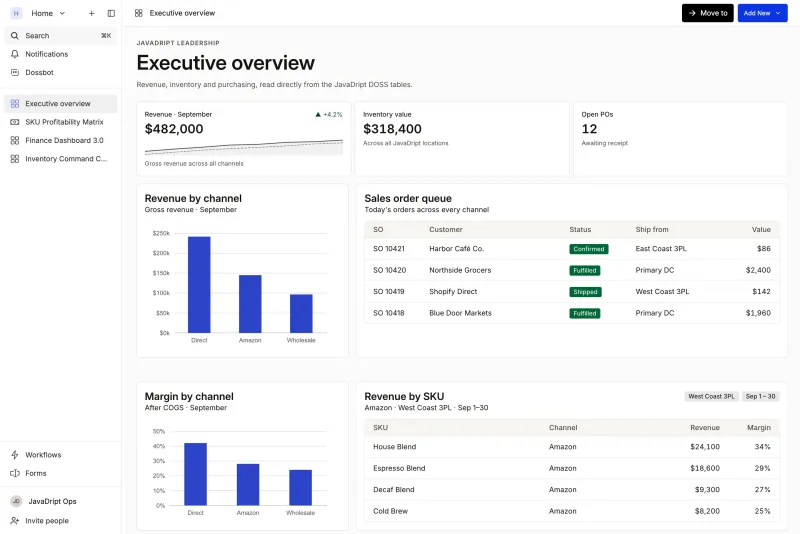
The most effective platforms go beyond simple tracking. They unify master data, automate workflows around procurement and order management, and provide embedded analytics that turn operational data into actionable insight. This is the difference between a system that tells you what happened and one that helps you decide what to do next.
What Consumer Product Brands Should Prioritize
If you are evaluating your supply chain visibility capabilities, here are the areas that tend to deliver the most immediate value for consumer goods operations:
Unified inventory view. A single, real-time view of inventory across all locations and partners. This includes not just quantities but also status (available, allocated, in transit, on hold) and the ability to reconcile with financial records automatically.
Order lifecycle management. End-to-end visibility from the moment an order is placed through fulfillment and delivery, across all channels. This should include automated routing logic based on factors like fulfillment cost, inventory availability, and delivery timelines.
Procurement automation. The ability to trigger purchase orders based on real-time demand signals and inventory thresholds, rather than relying on manual reorder processes. This reduces both stockout risk and excess inventory.
Integrated analytics. Dashboards and reporting that are embedded directly in your operations platform, not bolted on as a separate BI tool. When analytics live alongside your operational data, the path from insight to action is shorter.
How DOSS Operations Cloud Can Help
DOSS Operations Cloud is purpose-built for physical product companies that need to manage the flow of goods, dollars, and data across their business. It unifies procurement , inventory management , order management , and fulfillment into a single platform with real-time visibility at every step. DOSS integrates directly with 3PLs, sales channels, and financial systems, so inventory data stays accurate and synchronized without manual reconciliation. Its composable, no-code architecture means workflows can be configured and adjusted in minutes to match how your operations actually run, not how a rigid template says they should. And with embedded analytics through DOSS DataStudio , your team can track true landed costs, monitor margins by SKU, and spot trends as they emerge. For growing consumer product brands that need enterprise-grade operations without the enterprise timeline, DOSS delivers visibility and control on a fundamentally faster timeline. Learn more at doss.com .